Cleaning Business Lead Handling: Win More Jobs
Good lead handling for a cleaning business means replying to every enquiry within minutes, asking a few clear questions for the type of clean, and tracking each quote until it is booked or lost. Customers ask several firms at once, so the first useful reply usually wins the job.
TL;DR
- Customers message several cleaning firms at once. A fast, specific first reply puts you ahead before anyone has seen a price.
- Ask different questions for regular domestic, end of tenancy, office and after builders cleans, because each is quoted differently.
- Track every enquiry through five stages: new, quoted, chasing, booked, lost. Nothing should sit unlabelled.
- Quote in writing with the price, what is included and the next step. That keeps you clear with the customer on consumer rights too.
- Answer on every channel you advertise, including when your team is on a job. Booked one-off customers are your best source of regulars.
Table of Contents
- What should you do in the first five minutes of an enquiry?
- How do you capture enquiries from phone, email, web chat and WhatsApp?
- What should you ask before quoting each type of clean?
- How do you track an enquiry from new to booked?
- How do you turn one-off enquiries into regular customers?
- What do consumer rights mean for your cleaning quotes?
- What about data protection when you record enquiries?
- How do you choose an answering service for a cleaning business?
- Why do we think a shared front desk beats a single channel?
- What does DeskAgent cost for a cleaning firm?
- What does a good week of lead handling look like?
- FAQ
- Sources
What should you do in the first five minutes of an enquiry?
The first five minutes decide whether you are in the running. A customer who needs an end of tenancy clean before a checkout date will not wait politely. They will message the next firm on the list. In a 2022 Fix Radio survey of more than 220 tradespeople, 34% said they believed they had lost work because they could not answer the phone, and 60% said they struggled to answer while working. Cleaners are in the same position: hands in gloves, in a client’s bathroom, phone in the van.
Here is a playbook you can run by hand or have a front desk run for you.
- Minute 0-1: acknowledge. Reply with the job in the customer’s own words. “Thanks, an end of tenancy clean for a two-bed flat in Croydon. We can get you a price today.” A short holding message beats silence.
- Minute 1-2: set one expectation. Say when they will hear next, such as a price in the next hour or a callback this afternoon. Only promise what your team can actually do.
- Minute 2-3: ask the first qualifying question. Make it the one that changes the price most: property size for a home, floor area for an office.
- Minute 3-4: get the postcode and the date. Postcode tells you if the job is in your area. The date tells you whether it is urgent.
- Minute 4-5: flag it. Mark the enquiry as new in your tracker, with a note of what you asked and what you are waiting for.
The point is not to close the sale in five minutes. It is to be the firm that already looks organised. A cleaning firm that replies with a clear question and a time looks more reliable than one that sends a price with no questions at all.
We cover the wider case for speed in our guide to lead response time.
How do you capture enquiries from phone, email, web chat and WhatsApp?
Most cleaning firms get enquiries from four places: the phone, an email address, a chat or form on the website, and WhatsApp. Each one needs an owner and a rule, or messages sit unread for a day.
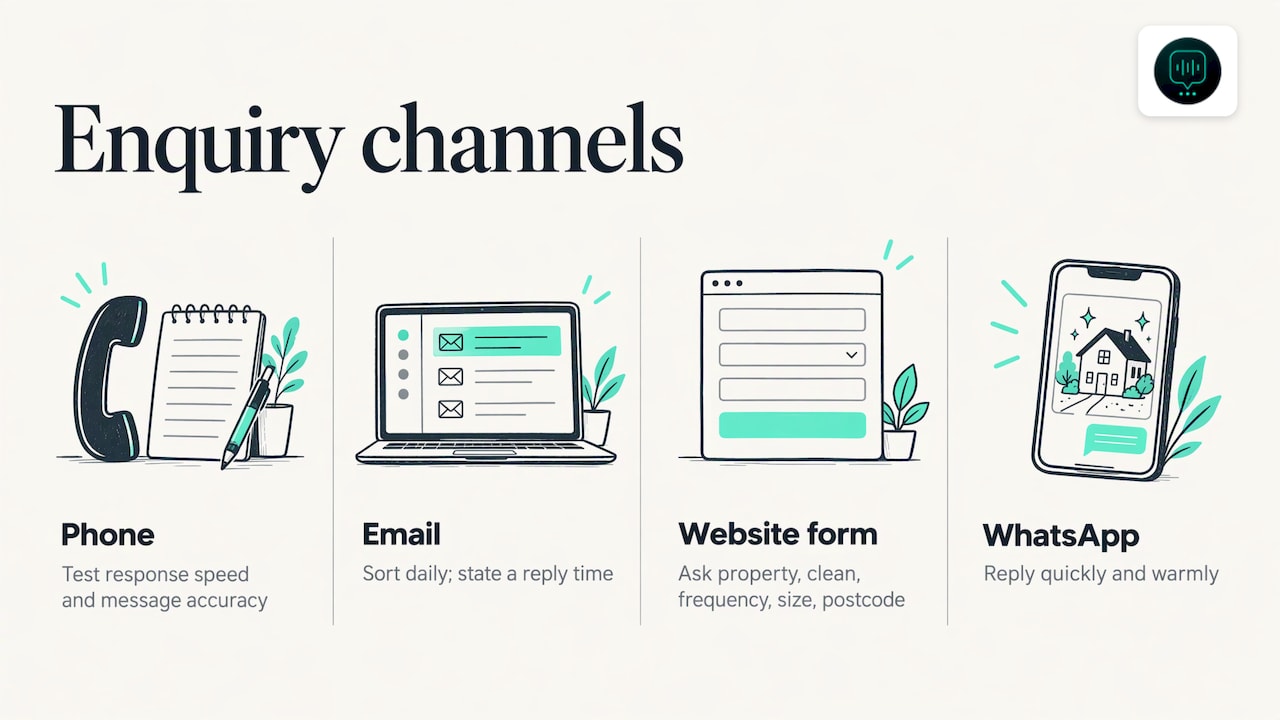
Phone. This is the hardest channel when you are on site. Options include a voicemail with a promise to call back, a missed-call text, call diversion to a colleague, a human answering service or an AI receptionist. They differ in what they cover out of hours, how well the details are handed over and what they cost. Whichever you choose, try it with realistic calls before you rely on it: an urgent one, a rambling one, a tricky address and a customer who changes their mind mid-call. Check how fast it answers, whether the message is accurate and how quickly you receive it.
Email. Enquiry inboxes fill with spam, supplier pitches and genuine requests. Sort them daily at the least, and send an acknowledgement with a stated reply time so the customer is not left wondering.
Website chat or form. Keep the form short. Property type, type of clean, frequency, size and postcode are enough to separate suitable local work from low-fit enquiries without putting people off.
WhatsApp. Many domestic customers would rather send a photo and a message than ring. A quick, friendly reply here goes a long way. Our guide to WhatsApp auto reply covers the setup.
If you are choosing between a few channels to cover first, start with the one where you lose the most. For most cleaning firms working on site all day, that is the phone. Our post on how to capture leads from missed calls lists six ways to do it.
What should you ask before quoting each type of clean?
A vague question gets a vague answer, and a vague answer gets a bad quote. Ask only what changes the price or the time, and ask in an order that feels like a conversation. Every job needs the postcode, the preferred date and a contact name. After that, the questions depend on the clean.
| Type of clean | Questions that change the price | Time-sensitivity |
|---|---|---|
| Regular domestic | Bedrooms and bathrooms, how often (weekly, fortnightly), preferred day, pets, who supplies products and equipment | Low. Often a week or two |
| End of tenancy | Bedrooms and bathrooms, furnished or empty, oven and carpet needs, when it was last properly cleaned, checkout date | High. Fixed deadline |
| Office | Site address, floor area, number of staff, toilets and kitchens, frequency, access times | Medium. Often a trial first |
| After builders | Size of the property, type and length of the building work, dust levels, windows and floors, how soon the property is needed | High when a handover date exists |
Regular domestic cleans
These are the jobs that build a stable diary. Ask about size, frequency and preferred day first. Then ask about pets, anything fragile and whether you or the customer will provide supplies. A one-off first clean often takes longer than later visits, so say so in the quote.
End of tenancy cleans
The deadline is the whole story. Ask for the checkout date in your first or second message. Then ask whether the property is furnished, how many bedrooms and bathrooms it has, whether the oven and carpets need doing and when it was last properly cleaned. Landlords and agents often work from a checklist, so ask whether one exists. A removals firm in Croydon or a letting agent may send these customers your way, which makes a fast and clear reply doubly important.
Office cleans
Commercial quotes start with the site address, type of premises, approximate floor area and how often the work is needed. For a larger site, a visit to look at layout, work type and access comes before a detailed written quotation. Alliance Cleaning’s FAQs describe that approach. Offer the visit promptly, and give an indicative range only if you are confident in it.
After builders cleans
Dust, plaster, paint splashes and leftover materials make these jobs unpredictable. Ask for photos, the length and type of the building work and the date the customer needs the space back. If you cannot price from a photo, say so and book a short visit rather than guess.
If you gather details before quoting, a free invoice template for cleaners can help you keep the same property and service fields from quote through to invoice.
How do you track an enquiry from new to booked?
A tracker does not need software. A shared sheet or a notes app works if everyone uses it the same way. What matters is that every enquiry sits in exactly one of five stages.
| Stage | What it means | What you do next |
|---|---|---|
| New | Enquiry received, no quote yet | Acknowledge, ask the first questions, flag urgency |
| Quoted | Written quote sent with price, inclusions and next step | Note the date sent and a follow-up date |
| Chasing | No reply yet to the quote | Follow up two or three days later, then about a week later if needed |
| Booked | Date agreed and in the calendar | Confirm details, send a reminder before the clean |
| Lost | Customer chose elsewhere or went quiet | Record the reason, and stop contacting them |
The follow-up timing above comes from CleaningProWebsites’ advice on turning leads into bookings. Their guidance is to keep a list of open quotes and send a short, polite nudge rather than let a good lead fade.
Two habits keep the tracker honest. First, never leave an enquiry in “new” for more than a day. Second, write the reason whenever something moves to “lost”. After a month you will see whether you are losing on price, on speed, on area or on dates you cannot cover.
Our guide to automated lead follow up explains how to keep the chasing stage moving when you are busy.
How do you turn one-off enquiries into regular customers?
A one-off clean is the best audition you will get. The customer has seen your reply, your price, your timekeeping and your standard of work. Use it.
- Offer the regular option in the quote. Show the one-off price and the regular price side by side, so the customer sees the saving without asking.
- Ask at the end of the first clean. “Would you like us back on the same day in a fortnight?” is easier to say yes to than a long pitch.
- Confirm before each visit. A short reminder the day or two before cuts missed access and no-shows.
- Ask for a review once the clean is done. Do it while the result is fresh.
For offices, a short trial period often leads to a longer agreement. Agree the scope in writing at the start, so the facilities manager knows exactly what they are paying for.
What do consumer rights mean for your cleaning quotes?
If you sell to households, consumer law applies to how you describe, price and deliver the service. Business Companion’s guide to supplying services sets out the basics for businesses. In plain terms:
- Carry out the work with reasonable care and skill.
- Stick to what you said before the customer agreed. What you say in a quote or message can form part of the contract.
- Agree the price up front where you can, and be clear about anything that could add to it.
- Finish the work within a reasonable time if no date was agreed.
This is why a written quote matters. State the price, what is included (oven, windows, inside cupboards), what is excluded and the next step. If the customer rebooks or the job changes, update the quote in writing. It protects you as much as them. For anything unusual, such as a dispute over a deposit or a cancellation, check the guide and speak to Trading Standards or a solicitor before you reply.
What about data protection when you record enquiries?
Names, phone numbers, addresses and the content of messages are personal data. The government’s data protection guidance for businesses says you should know what personal data you hold, collect only what you need, use it only for the purposes you have told people about, keep it only as long as necessary, store it securely and let people see, correct or delete it.
For a cleaning firm that means: ask only the questions you need to quote, tell customers how you will use their details, and delete old lost enquiries on a schedule you can explain. Keep customers’ door codes and key-holding details out of general chats. If you record calls, tell the caller at the start.
How do you choose an answering service for a cleaning business?
Searches for the best answering service for a cleaning business usually come down to the same practical trade-offs. Judge any option on these:
- Coverage: does it answer during jobs, evenings and weekends?
- Handover: do you receive a clear summary with the job type, postcode, urgency and contact details, or just “someone called”?
- Channels: does it cover calls only, or WhatsApp, chat and email too?
- Booking: can it put a visit or call into your calendar?
- Price and terms: is there a monthly fee, a setup fee or a contract?
- Caller experience: does it sound natural, and is it honest about what it is?
Test each with real calls before committing, and compare what customers actually experience. A cheap service that loses details costs more than a dearer one that passes them on cleanly. You can read more about what we do for firms like yours on our page for an answering service for cleaners.
Why do we think a shared front desk beats a single channel?
We built DeskAgent® for owners who spend the day on site and still want every enquiry handled properly. The problem is rarely that a cleaning firm is bad at quoting. It is that the enquiry arrives while the owner is doing a job, and the next firm replies first.
That is why we run four agents sharing one brain: Phone, WhatsApp, Web and Inbox. A customer might ring, then message, then fill in the website form. If each channel runs separately, the customer repeats themselves and your team pieces it together. With one shared brain, the agent knows what has already been asked.
Each agent is set up for your business, trained on your services, coverage area and FAQs. It asks about the job type, postcode and urgency, sends urgent work to you, books into your calendar and gives your team a summary with the full context. It then follows up with the customer on WhatsApp. The agents sound natural, and they always say they are AI if asked.
You stay in control. With DeskAgent HQ you run it from one WhatsApp chat: change prices, update FAQs, pause the agents, check today’s leads and ask for summaries when you want them.
Monty Gordon, founder of DeskAgent
What does DeskAgent cost for a cleaning firm?
You can start with the channel where you lose the most work, or cover them all. There are no contracts and you can cancel any time.
- Web Agent: £85 a month
- Inbox Agent: £85 a month
- Phone Agent: £125 a month
- WhatsApp Agent: £125 a month
- Full DeskAgent (all four agents plus DeskAgent HQ): £285 a month
Single agents have no setup fee, because the first month covers the build. The Full DeskAgent 3-month pilot is a one-off £500 that covers the build and three months live, then £285 a month. You can see the full details on our pricing page. If your website chat is where enquiries slip through, the Web Agent handles that channel. The easiest way to see how it fits is to book a free 30-minute demo. It is a 30-minute call where we show an agent built for your business.
What does a good week of lead handling look like?
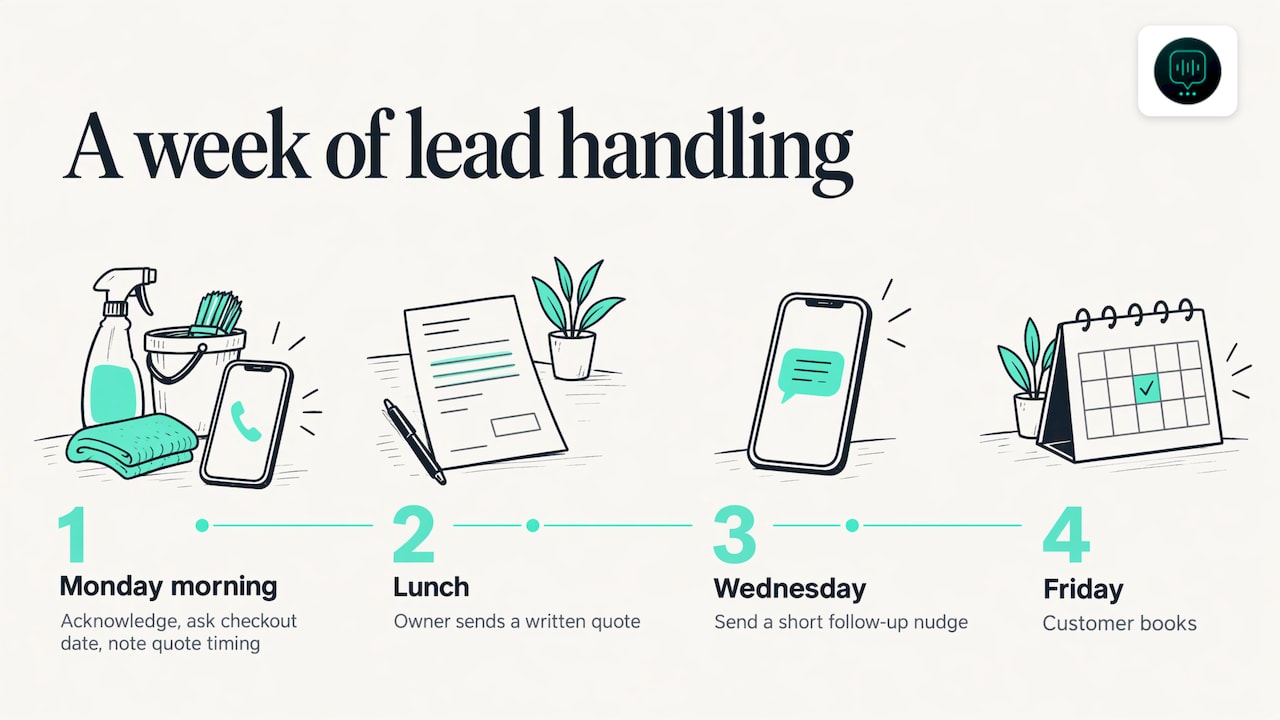
Imagine a cleaning firm in Ealing with four cleaners. On Monday morning, an enquiry for an end of tenancy clean arrives while everyone is on site. Within minutes the customer has an acknowledgement, a question about the checkout date and a note on when the quote is coming. The owner sees the summary at lunch and sends a written quote. On Wednesday the quote moves to chasing and gets a short nudge. On Friday it moves to booked.
Compare that with a firm where the phone rings out and the email waits until the evening. The same customer has already booked someone else. The work is identical. The difference is the first reply.
The same pattern applies across trades. A roofer in Ealing up a ladder, a drainage firm on a callout and a removals company in Croydon packing a van all face the same problem, and the fix is the same: someone, or something, answers while you work. If you want to talk it through, you can book a free 30-minute demo and see how the five-stage tracker would look for your own enquiries.
FAQ
How quickly should a cleaning company reply to an enquiry?
As fast as you realistically can, and certainly the same day. Even a short acknowledgement that names the job and says when you will be in touch puts you ahead of firms that stay silent. Promise only what your team can deliver.
What should I put in a cleaning quote?
State the price, what is included, what is not, and the next step for the customer. For a home clean, mention the size you priced for. For an office, mention the floor area and frequency. A written quote keeps both sides clear on what was agreed.
How many times should I chase a quote?
A common approach is one follow-up two or three days after sending, then another about a week later if you have heard nothing. Stop when the customer replies, books or asks you to stop. Record the outcome as booked or lost so the quote does not hang around.
Can I use WhatsApp for cleaning enquiries?
Yes, many customers prefer it. Keep a record of what is said, only ask for the details you need and tell people how you will use them. Treat names, addresses and messages as personal data and delete them when you no longer need them.
Do I need a contract to use DeskAgent?
No. There are no contracts and you can cancel any time. Single agents have no setup fee, as the first month covers the build.
Sources
- Missed calls causing lost business opportunities, PHAM News, 2022
- Commercial Cleaning FAQs, Alliance Cleaning
- Cleaning Leads: 9 Simple Ways to Win More Bookings, CleaningProWebsites
- Business Companion’s guide to supplying services
- Data protection in your business, Business.gov.uk
- Free Invoice Template for Cleaners, InvoiceLabs