Answering Service for Tradesmen: UK Guide

An answering service for tradesmen picks up calls you cannot take while you are on a job, captures the caller’s details and gets them to you. Your options are voicemail, a human call-answering service or an AI receptionist. They differ on cost model, night cover and how much detail is captured.
TL;DR
- Voicemail is free but passes the work to the caller, and many callers with a leaking pipe or a damaged roof simply ring the next firm.
- Human answering services take a message in your company name and usually charge per call, per minute or by monthly bundle, so check the rate card for what counts as a chargeable call.
- An AI receptionist answers every call at any hour, asks the job questions in your order and sends the summary on, for a flat monthly price.
- Whichever you choose, the call only becomes work if the details reach one monitored place and one named person owns the callback.
- Match the service to your mix of quote requests and emergency callouts, not to the cheapest headline price.
Table of Contents
- Why do tradesmen miss so many calls?
- What are the options for answering calls when you are on a job?
- How do voicemail, human answering and AI receptionists compare?
- What does an answering service cost a tradesman?
- Do you need cover out of hours?
- What details should an answering service capture?
- How does the job get from the call to you?
- What if the caller does not want to talk to a machine?
- Which answering service suits which trade?
- What does DeskAgent offer tradesmen?
- What do we think about answering services for trades?
- How do you turn answered calls into booked jobs?
- What should you check before signing up?
- FAQ
- Sources
Why do tradesmen miss so many calls?
The nature of the work causes it. A plumber under a sink, a roofer on a ladder in Ealing or a drainage crew with a jetting hose running cannot answer a phone. A removals firm in Croydon has three lads and a van on the M25 while the office line rings.
The caller does not wait. Someone with a blocked drain wants to speak to a person now, and someone gathering three removals quotes will usually go with the firm that replies first. Our guide on capturing leads from missed calls goes through the practical ways to stop that leakage. This article sits one step before it: which kind of answering service should sit between the caller and you.
The phone network itself is also changing under many firms. According to a House of Commons Library briefing from April 2026, UK landline services are due to move onto a fully digital network by January 2027, with calls carried over broadband. If your business number is still on an old landline, ask your provider how diverting calls will work after the move, because every answering option below depends on a working diversion.
What are the options for answering calls when you are on a job?
There are three realistic routes for a firm with 1 to 30 staff.
- Voicemail or a missed-call text. Costs little or nothing. The caller has to leave a message and wait.
- A human answering service. A receptionist at a call centre answers in your company name, follows a script you agree and sends you the details by email, text or app. Some will put urgent calls through or book appointments.
- An AI receptionist. Software answers the call, asks your questions, and passes a structured summary to you. It can book into a calendar and message the customer afterwards.
The rest of this guide compares them on the four things that decide whether a trades firm wins or loses the job: how you pay, what happens out of hours, what details are captured and how the job reaches you.
How do voicemail, human answering and AI receptionists compare?
| Voicemail | Human answering service | AI receptionist | |
|---|---|---|---|
| Cost model | Usually included with your phone line | Per call, per minute or monthly bundle, often with a minimum | Flat monthly price per agent or bundle |
| Out-of-hours cover | Always on, but only records a message | Depends on the plan; night and weekend cover is often a separate tier | Same answer at 3am as at 3pm |
| Details captured | Whatever the caller chooses to say | What the script asks, within the operator’s training | What you configure: job type, postcode, urgency |
| How it reaches you | You listen back and type it up | Email, text or app message | Summary sent to you with full context |
| Urgent jobs | Not flagged | Put-through if the script allows it | Routed to the owner according to your rules |
| Booking | None | Only on some plans | Into your calendar |
No single column wins for every firm. A sole trader with five calls a week has different needs from a drainage company with a crew on call overnight.
What does an answering service cost a tradesman?
The price you see first is rarely the price you pay, so compare the model rather than the headline.
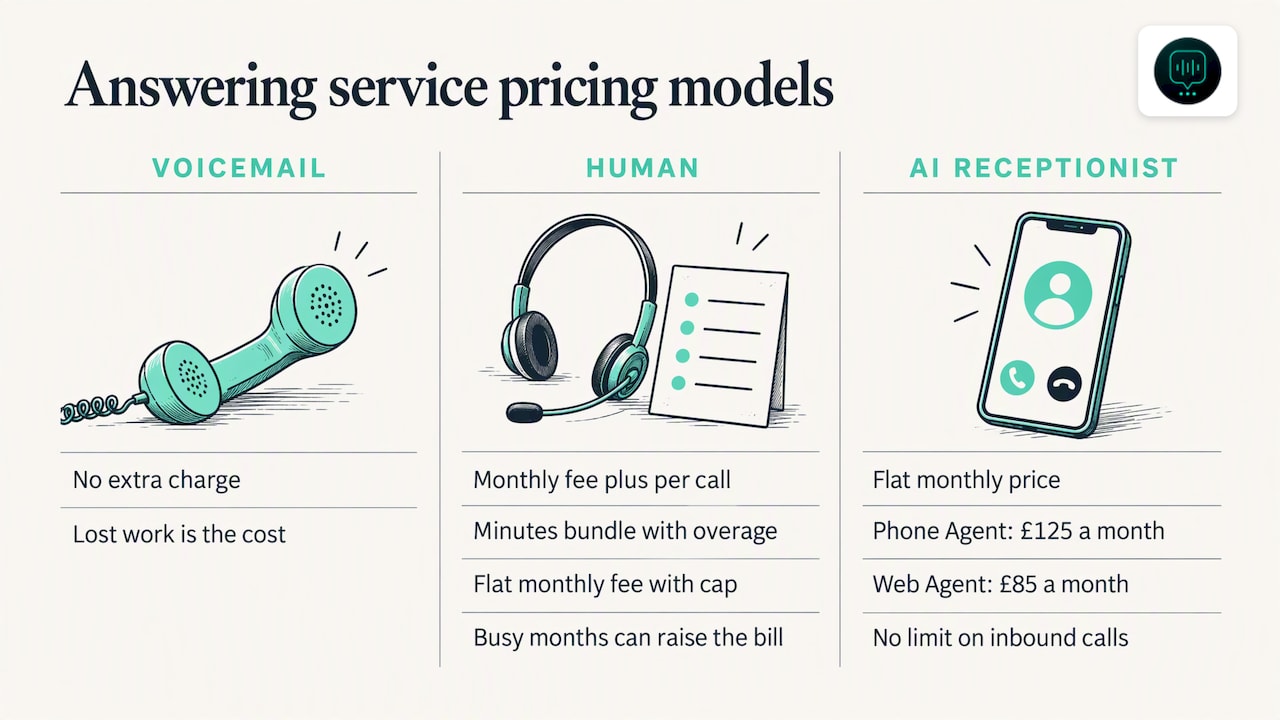
Voicemail costs nothing extra, but the cost sits in lost work. If one in five missed callers would have booked a boiler service, that is a real figure you can work out from your own call log.
Human services typically charge in one of three ways: a small monthly fee plus a charge per call, a bundle of minutes with overage, or a flat monthly fee with a cap. The things to check on a rate card are what counts as a call (does a wrong number count, does a sales call count), whether a call transferred to you is billed twice, what the minimum monthly spend is, and whether night and weekend calls cost more. These services answer well, but busy months can push the bill up, because you pay for every call including the ones that never become work.
AI receptionists usually charge a flat monthly price. With ours, the Phone Agent is £125 a month and the Web Agent is £85 a month, and there is no limit on inbound calls. A flat price means a burst of calls after a storm or a heatwave pest rush costs the same as a quiet week. You can see every plan on the DeskAgent pricing page.
To compare fairly, take last month’s call log. Count the calls, the misses and the jobs that would have been worth having. Then price each option against that number rather than against a brochure.
Do you need cover out of hours?
It depends on what you sell. Quote-led trades, such as removals, loft conversions and kitchen fitting, get most enquiries in the evening and at weekends when people are at home planning. Nobody needs a human at midnight, but they do want a reply by morning. Emergency trades are different: burst pipes, blocked drains, no-heating calls and storm-damaged roofs arrive at all hours and the caller wants to know someone is coming.
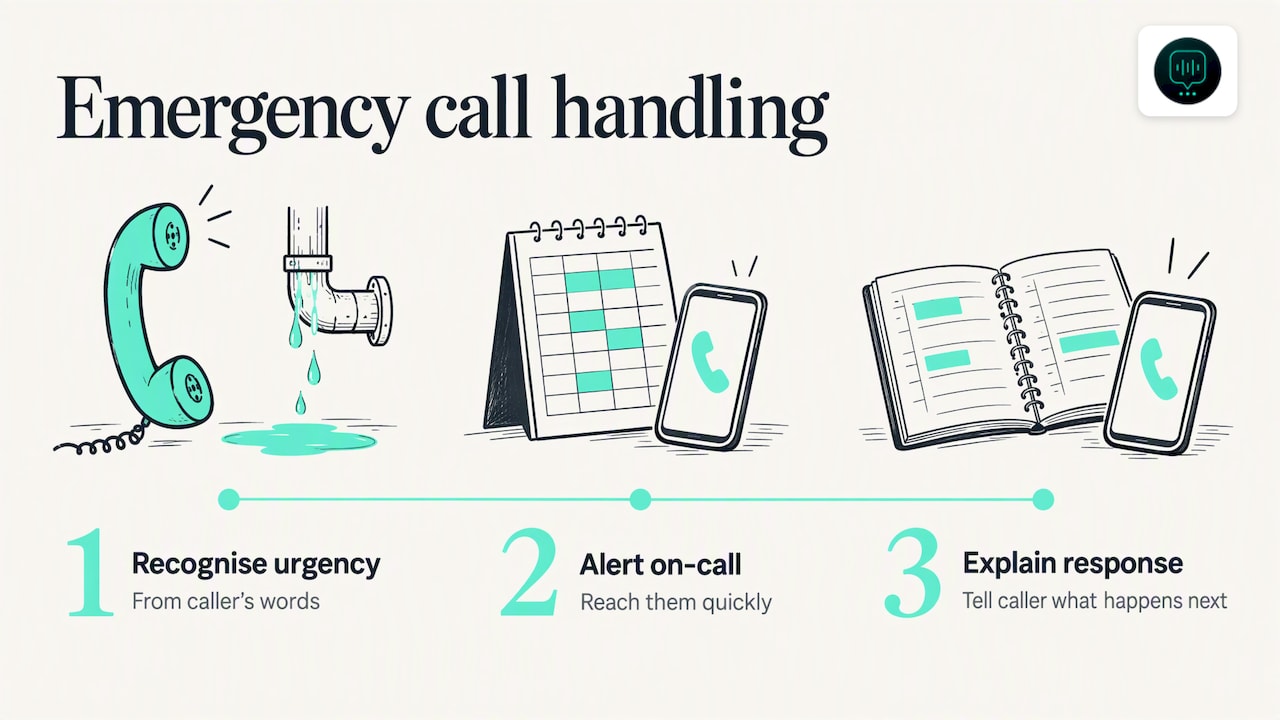
For emergency work, the question to ask any service is what happens at 2am when the caller says water is coming through the ceiling. A good setup does three things: it recognises the urgency from the caller’s words, it reaches the on-call person quickly, and it tells the caller what will happen next. Our post on emergency maintenance calls covers how to set those rules, and after hours calls covers setting limits so you are not woken for every enquiry.
For quote work, out-of-hours cover is mostly about speed of first reply. A removals enquiry left at 9pm that gets a structured reply and a follow-up on WhatsApp that night is in a better position than one that sits in voicemail until the office opens at 8am.
What details should an answering service capture?
This is where most services fail trades firms. A message that says “Mrs Patel called, please ring back” costs you a phone call to find out what she wants, and you may not get through the second time.
What you need depends on the trade.
Roofing. Is it a leak now or a quote for a new roof? What type of roof and how many storeys? Postcode, so you know whether it is in your area. Whether water is coming in.
Drainage. Blocked toilet, blocked external drain or a smell? Is anything overflowing? Is it a house or a block? Postcode and access.
Removals. Collection and delivery postcodes, number of bedrooms, date wanted, stairs or lifts, whether packing is needed. A Croydon to Leeds move and a flat-to-flat in Croydon are different quotes.
Plumbing and heating. Boiler make, no heating or no hot water, whether it is a landlord or a homeowner calling, and urgency.
Whatever the trade, you want the same core: name, number, address or postcode, the problem, how urgent it is and when they are free. A script that gets all of that on the first call saves you a second call. The point is also made in guidance written for trades firms: answering a call does not complete the sale unless the details land in one monitored place and a named person owns the callback by a set time.
Human services capture this well if the script is good and the operator is trained on your trade. They tend to struggle when the call falls outside the script. An AI receptionist asks the same questions every time, in the order you set, and sends the answers in the same format each time, so you are not reading a different style of message each day.
How does the job get from the call to you?
Capture is only half the story. The handoff decides whether the details help.
With voicemail, you retrieve the message, listen, note the number and ring back. With a human service, you get a text or an email, usually a short note. You may need to ring the call centre if you need more information.
With our Phone Agent, you forward calls from your business number, and the agent answers, qualifies the enquiry by job type, postcode and urgency, and sends your team a summary with the full context. Urgent jobs are routed to the owner. If the work fits, it books into your calendar, and the agent follows up with the customer on WhatsApp. You can read more on the Phone Agent page.
Then there are the other channels. Callers who cannot get through often try WhatsApp, the website chat or an email instead, so an answering service that only covers the phone covers a fraction of how customers reach you. Our Web Agent, WhatsApp Agent and Inbox Agent cover those, and all four share one brain so a customer who rings and then messages is not asked the same questions twice.
What if the caller does not want to talk to a machine?
Fair question, and one trades owners raise often. Our agents are natural-sounding, and they always say they are AI if asked. We do not try to pass them off as people. In practice, most callers with a job in mind care more about getting a clear answer and a next step than about who asked the questions.
Some callers will still prefer a person, and for a high-value job you may want to speak to them yourself. That is why urgent routing exists: the agent handles the first contact and the details, and you decide which calls to pick up.
If you record calls, tell the caller. Recording is covered by UK GDPR, so check the ICO’s guidance on recording calls before you switch it on, and ask any provider what they do with recordings and how long they keep them.
Which answering service suits which trade?
Here is a plain way to decide.
- Sole trader, low call volume, mostly repeat customers. Voicemail with a good greeting and a fast callback habit may be enough.
- Emergency-heavy trade with an on-call rota. You need cover at every hour with urgency detection and a route to the on-call person. Human or AI both work, provided the escalation rules are written down.
- Quote-led trade with high enquiry volume, such as removals or cleaning. Speed of reply and consistent details matter most. An AI receptionist with follow-up suits this, because it covers every channel and does not queue.
- Multi-van firm with an office that is often busy. Overflow is the issue. Forward unanswered calls rather than all calls, so your office still handles the ones it can.
- Property maintenance firm taking calls from agents, landlords and tenants. Qualification by property, postcode and urgency is key, and you want one place that shows the day’s jobs.
Our wider guide to 24/7 answering services for UK small businesses walks through escalation rules in more detail, and virtual receptionist vs AI receptionist compares the two models directly.
What does DeskAgent offer tradesmen?
DeskAgent® is a done-for-you AI front desk for UK service businesses with 1 to 30 staff, built in London first. We set each agent up for your business and train it on your services, coverage area and FAQs. There are four agents (Phone, WhatsApp, Web and Inbox) plus DeskAgent HQ, which lets you run everything from one WhatsApp chat: update prices and FAQs, pause the agents, check today’s leads and ask for summaries.
| Plan | Price |
|---|---|
| Web Agent | £85 a month |
| Inbox Agent | £85 a month |
| Phone Agent | £125 a month |
| WhatsApp Agent | £125 a month |
| Full DeskAgent (all four agents plus DeskAgent HQ) | £285 a month |
Single agents have no setup fee, as the first month covers the build. The Full DeskAgent 3-month pilot is a one-off £500 that covers the build and three months live, then £285 a month. There are no contracts and you can cancel any time.
If you take removals enquiries, our removals page shows how the agents handle quote requests. To see an agent built for your trade, you can book a free 30-minute demo: a call where we show an agent built for your business.
What do we think about answering services for trades?
We started DeskAgent because we kept seeing the same pattern in London trades and maintenance firms: good businesses, busy crews, and a phone that rings out while everyone is working.
Our view is that an answering service should do more than take a message. It should ask the questions you would ask, know your postcodes and your urgency rules, tell you straight away when a job is urgent, and follow up with the customer so the enquiry does not go cold. That is why we built four agents that share one brain, rather than a single chatbot or a script read by a stranger.
We also think you should stay in control. HQ means you can change a price, pause the agents or ask for today’s leads from the same WhatsApp chat you already use, without logging into anything.
The agents are natural-sounding, and they always say they are AI if asked. We would rather you trust them for the right reasons.
Monty Gordon, founder of DeskAgent
Monty Gordon, founder of DeskAgent
How do you turn answered calls into booked jobs?
Answering is the first step. The second is the reply you send once the details arrive. Have a short, consistent reply ready for each job type, with your availability and what you need from the customer. If you write these by hand, a set of email reply templates saves time and keeps the tone consistent across your team.
Then set a rule for who calls back, and by when. Write it down. The failure we see most is not the answering, it is the message that sits in a shared inbox because everyone assumed someone else had it. Our post on automated lead follow up shows how to keep a reply going out in minutes rather than hours, and lead response time explains why that matters for winning the job.
What should you check before signing up?
Use this list for any answering service, human or AI.
- Call log first. When do calls arrive, how many are missed, how many are emergencies?
- Contract terms. Is there a minimum term or a notice period? Ours has no contracts and you can cancel any time.
- Billing. What counts as a chargeable call, and what happens in a busy month?
- Coverage hours. Is night and weekend cover included, and how are emergencies treated?
- Required details. Can you set the questions per job type?
- Delivery. Where do summaries land, and how fast?
- Ownership. Who calls back, and by when?
- Recording and data. What is recorded, who can access it and how long is it kept?
- Test it. Ring your own number from your mobile, at the awkward times, before you rely on it.
FAQ
Do I need an answering service if I am a one-man band?
Not always. If most of your work is repeat custom and you can return calls within the hour, a clear voicemail greeting may do. If you regularly lose first-time callers while you are up a ladder or under a floor, an answering service pays for itself quickly, so check it against your own call log.
Will customers know it is an AI answering?
Our agents are natural-sounding and always say they are AI if asked. We do not present them as people. Most callers want the job logged and a next step, and you still pick up the calls you want to take yourself.
Can it tell an emergency from a quote request?
Yes, that is part of qualification. The Phone Agent asks about job type, postcode and urgency, and urgent jobs are routed to the owner. You set the rules, so a burst pipe and a request for a quote for a new bathroom are handled differently.
How much does it cost, and am I tied in?
The Phone Agent is £125 a month and the WhatsApp Agent is £125 a month. The Web Agent and Inbox Agent are £85 a month each, and Full DeskAgent is £285 a month. There are no contracts and you can cancel any time. Single agents have no setup fee because the first month covers the build.
Do I have to change my business number?
No. The Phone Agent answers calls on your business number via call forwarding, so customers keep ringing the number they already have. If you want to see how it would work for your firm, book a free 30-minute demo.
Sources
Recommended
- Phone System for Trades: What to Choose Before 2027
- Best 24/7 Answering Service for UK Small Businesses
- Emergency Maintenance Calls: How to Handle Them 24/7
- AI Receptionist for Small Business: A Practical UK Guide