Last updated
Emergency Maintenance Calls: How to Triage and Respond 24/7

A burst pipe at 2am goes to whoever answers. If your phone rings out, the customer calls the next firm, the damage spreads and you can lose the job, and sometimes the contract with the landlord behind it.
An emergency maintenance call is one where somebody could be harmed, or the property badly damaged, if nobody acts quickly. Handling those calls well comes down to three things: ask the same few triage questions every time, make sure a real person or a tested system picks up at any hour, and log the time you were told.
This guide is written for owners and office managers of UK trades, drainage, roofing, removals, cleaning and property maintenance firms. It covers what counts as an emergency, the social housing timescales in the government guidance, out-of-hours cover, dispatch and record keeping.
DeskAgent® is an AI front desk for UK service businesses, so we see these calls from the front-desk side. Where we mention it, we stick to what it does.
TL;DR
- An emergency is a risk that cannot wait: gas or carbon monoxide leaks, broken boilers, total loss of water, significant leaks and exposed wiring are the government’s own examples.
- For social landlords, the guidance sets 24 hours to investigate and make safe an emergency hazard, counted from the moment the landlord becomes aware. If your team takes the call, your intake time matters.
- Use a fixed set of triage questions so a call-out is decided by facts, not by who happened to answer.
- Write down when the call came in, what was said and who was sent. A call you cannot evidence is a call you cannot defend.
- Your out-of-hours cover is only as good as your phone line, your escalation list and the habit of testing both.
Table of Contents
- What counts as an emergency
- The social housing timescales
- Triage questions that decide the call-out
- Out-of-hours cover that actually works
- Dispatching the right engineer
- Records that protect you
- Our view: the first answer sets the clock
- How DeskAgent fits emergency enquiries
- Getting started this week
- FAQ
- Sources
What counts as an emergency
Most callers think their problem is an emergency. Your job is to separate the ones that are from the ones that are urgent, and from the ones that can wait for Monday.
The clearest definition comes from the government. In the government’s Awaab’s Law guidance for social landlords, an emergency hazard is one that poses an imminent and significant risk of harm to the health or safety of the occupier. The regulations describe that as a risk a reasonable landlord with the relevant knowledge would take steps to make safe within 24 hours.
The guidance gives examples that will be familiar to any trades firm:
- gas or carbon monoxide leaks
- broken boilers
- total loss of water supply
- significant leaks
- exposed electrical wiring
The guidance is clear that the answer depends on the circumstances. A reasonable landlord has to use professional judgement, and factors such as the vulnerability of the person living there and the time of year matter. A dead boiler in July is usually a standard repair. The same fault in a cold January, in a home with an elderly or very young occupant, can be an emergency.
That is why a flat list on the wall is not enough. Your triage needs to capture the context as well as the fault.
Emergency, urgent or routine
A three-level scheme keeps the decision simple. These are working categories for your own team, not legal terms.
| Level | What it looks like | What you do |
|---|---|---|
| Emergency | Gas smell, carbon monoxide alarm, burst pipe flooding a room, sparking or exposed wiring, no water at all, roof open to the weather after storm damage | Make safe first, dispatch an engineer straight away, log the time |
| Urgent | No heating but the household is otherwise safe, a slow leak that can be contained, a blocked drain with a working second toilet | Book the earliest visit, give the caller interim advice |
| Routine | Dripping tap, cosmetic damage, planned work | Book into the normal diary |
The edges move. A blocked drain is routine until sewage starts coming up into a kitchen. A roof leak is urgent until water reaches the electrics. Your triage questions should catch those shifts.
Private rented homes
If you work for letting agents or private landlords, the same instinct applies, though the rules differ. A landlord’s right to enter to inspect or repair normally needs at least 24 hours’ notice, but immediate access may be possible in emergencies. In practice this tells you something useful: the law itself treats genuine emergencies differently from everything else, so your process should too.
The social housing timescales
If you carry out repairs for housing associations or councils, the timescales in the Awaab’s Law guidance affect how you are briefed and how quickly you are expected to move. Here is how the guidance sets them out:
| Situation | Timescale in the guidance |
|---|---|
| Potential emergency hazard | Investigate, and make safe if confirmed, within 24 hours of becoming aware |
| Potential significant hazard | Investigate within 10 working days of becoming aware |
| Supplementary preventative work to stop a hazard recurring | Begin, or take steps to begin, within 5 working days of the investigation concluding |
| If work cannot begin within 5 working days | Do it as soon as possible, with work physically started within 12 weeks |
The duties sit with the landlord, not with you. But the clock starts when the landlord becomes aware of the hazard. If your firm is the first to hear about it, whether through a tenant ringing your out-of-hours line or a message sent to your inbox, your intake process is where that awareness is recorded. Treat the time of the call as evidence and pass it to the landlord promptly.
The phasing of the new rules has moved on over time, so check the current Phase 2 guidance and your contract with each landlord for exactly which hazards and dates apply. If you are unsure whether a contract falls within them, ask the landlord’s compliance team rather than guessing.
Triage questions that decide the call-out
Triage works when every call, whoever takes it, gets the same questions in the same order. Keep them short enough to ask a stressed person on a bad phone line.
- Is anyone in danger right now? If someone smells gas, hears a carbon monoxide alarm or sees sparking, the first instruction is to get everyone out and contact the emergency services or the gas emergency service on 0800 111 999 (HSE’s domestic gas FAQs set out what to do). That is not a job to diagnose over the phone.
- What is happening, in their own words? Let them describe it before you tick boxes.
- Can it be contained? Can they turn off the water at the stopcock, isolate the electrics at the consumer unit, or move belongings away from the leak?
- Who is in the property? Children, an older person, someone relying on a medical device or someone with limited mobility all raise the priority.
- What is the weather and season doing? No heating in winter or an open roof in a storm changes the answer.
- Who are they, and who owns the property? Tenant, landlord, agent or housing association decides who authorises the work and who must be told.
- Where exactly is it, and how do we get in? Address, access, keys, a contact on site.
A few trade-specific examples show why the questions matter.
Drainage. A caller says their drain is blocked. Question three and four reveal it is the only toilet in a house with young children and foul water is backing up into the bathroom. That moves from routine to urgent, and perhaps emergency if it is spreading.
Roofing. After a storm, a caller reports a few missing slates. Asking where the water is going shows it is dripping onto a light fitting. Now you have an electrical risk, and the advice is to keep out of the room and isolate the circuit if safe, while you arrange a temporary cover.
Removals. A removals firm gets a call at 9pm: the van has broken down with a completion the next morning. It is urgent for the customer, but not a safety emergency. The triage tells the office to call the customer first thing with a fallback, rather than waking the whole team.
The last example is worth noting. Not every out-of-hours call is a hazard, and a good process protects your team’s sleep as much as the customer’s property.
Out-of-hours cover that actually works
There are broadly three ways small firms cover nights and weekends. Each has a cost.
- The owner’s own phone. Cheap, and it works until you are on holiday, ill, or exhausted. It also means every call, including the routine ones, lands on you.
- A rota between engineers. Fairer, but you need a rule for who is on, a handover and a back-up when the person on call does not answer.
- A front desk that answers every time and escalates by rule. It captures the details, applies your triage and passes real emergencies to whoever is on call.
Whichever you choose, write the escalation rule down. A simple version: emergency, call the on-call engineer. No answer within a few minutes, call the second name. Still nothing, call the owner. We go deeper on this in our piece on escalation for out-of-hours calls, and on setting limits in after-hours calls for service owners.
Check the line before you need it
Emergency cover fails quietly. The number is diverted to a phone that is off, the broadband is down and your internet phone line goes with it, or a router restarts overnight. Ofcom has been pressing providers over the reliability of emergency calls, and the same principle applies to your own business: a regulator letter to providers stresses the importance of meeting obligations on emergency calls. If your lines rely on the internet, think about business phone resilience and backup connections so a power cut or outage does not take your emergency line down with it. Then test it: ring your own out-of-hours number from a mobile every month and see who answers.
Also allow for callers with specific communication needs. Ofcom explains that people can reach the emergency services through services such as the 999 BSL app, Emergency SMS and Relay UK. Your own line should have a text or messaging route for customers who cannot speak on the phone.
Dispatching the right engineer
Once a call is classed as an emergency, speed depends on a clean handover. The engineer should not have to ring the customer back to find out what is wrong.
A good dispatch message contains:
- the address and how to get in
- the fault in plain words, with the caller’s own description
- the triage answers: who is in the property, what has been contained, any vulnerability
- the time the call came in
- the customer’s preferred way to be contacted
- who is paying or authorising: tenant, landlord, agent or housing association
Match the person to the job. A gas smell goes to a Gas Safe registered engineer, wiring to a qualified electrician, a flooded kitchen to a plumber with the right tools, a collapsed section of roof to a roofer who can make it weathertight. Sending the wrong trade wastes the first hour.
After dispatch, keep the customer informed. A short message saying who is coming and roughly when, with no promise you cannot keep, takes pressure off the next call. A WhatsApp message or a text both work for this, and our WhatsApp vs SMS guide covers which to use when.
Records that protect you
When something goes wrong, the question is rarely whether you did the work. It is when you heard, what you were told and what you did next. Keep a record for every emergency call:
- time and channel the enquiry arrived
- caller’s name, address and relationship to the property
- triage answers and the category you gave it
- who you contacted, and when
- time the engineer arrived and what was done to make it safe
- follow-up work and who it was passed to
This is also how you show a landlord that you passed on awareness quickly. For preventative checks that reduce emergencies in the first place, such as fire alarm tests or equipment inspections, a digital logbook for safety checks keeps dates, certificates and follow-up actions in one place. The government’s landlord and agent guide to the Housing Health and Safety Rating System also makes the point that rented homes need to be well managed, with repairs promptly addressed.
Our view: the first answer sets the clock
Many service firms do not lose work because their engineers are slow. They lose it because nobody answered the first call, or the details were scribbled on a notepad and lost between the office and the van.
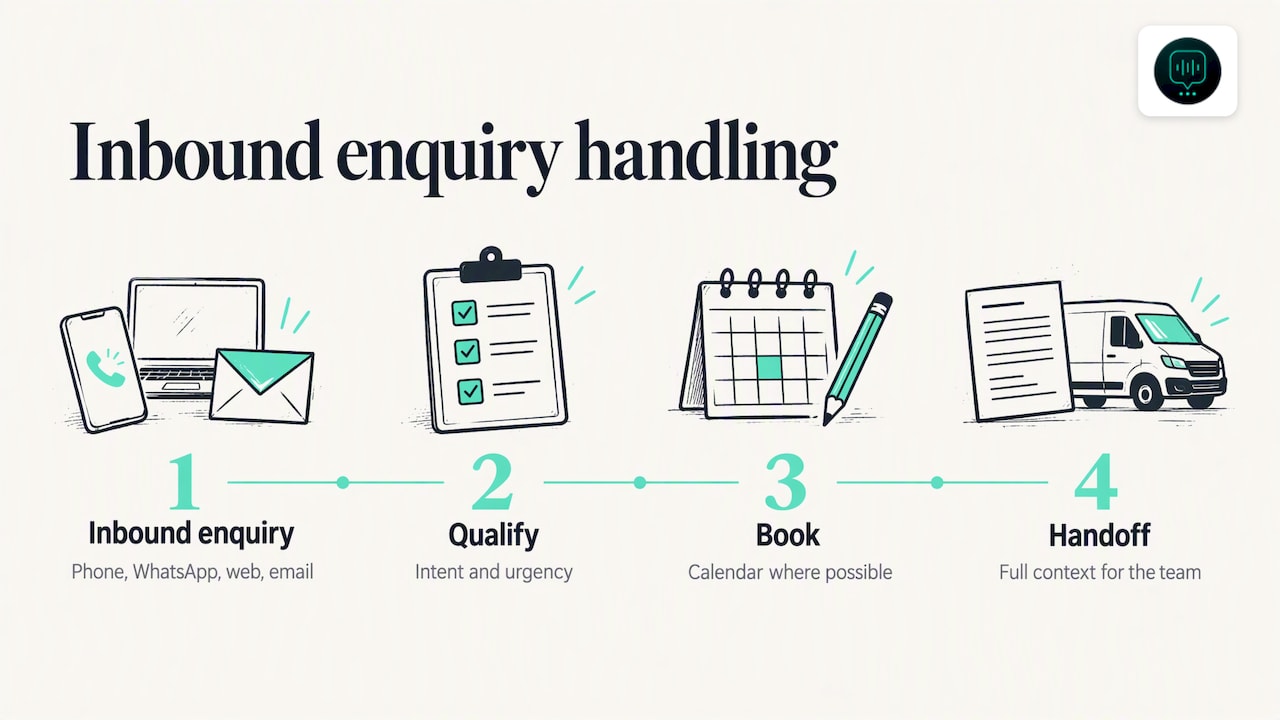
We built DeskAgent around that gap. The Phone Agent answers inbound calls, the WhatsApp Agent handles messages, the Web Agent runs website chat and the Inbox Agent reads email enquiries, filters spam and replies. Each one qualifies the lead by intent and urgency, books into the calendar where it can, and hands your team a summary with the full context. It is trained on your services, coverage and FAQs, so the questions it asks are yours.
We would not claim any front desk replaces your judgement on a gas leak or a collapsing ceiling. What it can do is make sure the call is picked up, the right questions are asked, the time is recorded and your team gets the full picture without having to phone back. Our advice is to decide your emergency list before the first call comes in, put it in writing and test it. Good triage is mostly preparation. For more on why speed matters, see our piece on lead response time.
Monty Gordon, founder of DeskAgent
How DeskAgent fits emergency enquiries
If phone calls are where you miss most work, the Phone Agent is the place to start, at £125 a month. The WhatsApp Agent is also £125 a month, and the Web Agent and Inbox Agent are £85 a month each. Single agents have no setup fee, because the first month covers the build.
The Full DeskAgent, with all four agents plus DeskAgent HQ, is £285 a month. HQ lets you run it from WhatsApp: update prices and FAQs, pause it and check today’s leads. There is also a Full DeskAgent 3-month pilot for a one-off £500, which covers the build and three months live, then £285 a month. There are no contracts and you can cancel any time. See the full pricing, or book a free 30-minute demo, a call where we show you an agent built for your business.
Getting started this week
You do not need new software to improve your emergency handling today. Do these in order:
- Write your emergency list, using the government’s examples as a starting point and adding the ones specific to your trade.
- Turn it into the seven triage questions and put them where whoever answers can see them.
- Write the escalation order: first call, second call, owner.
- Test your out-of-hours line from an outside phone and fix whatever fails.
- Start logging the time of every emergency call, even on a spreadsheet.
- If you work for social landlords, ask each one how they want awareness and call times passed on.
If you want to see how an agent would handle this for your trade, you can book a free 30-minute demo and we will build the call flow around your own emergency list. For wider context on how enquiries arrive across channels, see our guide to multichannel customer service.
FAQ
What counts as an emergency repair for a property maintenance firm?
Anything with an imminent and significant risk of harm to the people in the property. The government’s examples include gas or carbon monoxide leaks, broken boilers, total loss of water, significant leaks and exposed electrical wiring. Circumstances matter, so a boiler failure in winter with a vulnerable occupant ranks higher than the same fault in summer.
How quickly must a social landlord deal with an emergency hazard?
The Awaab’s Law guidance says a potential emergency hazard must be investigated, and made safe if confirmed, within 24 hours of the landlord becoming aware. The duty is the landlord’s, but the clock starts when they know, so pass on any call you take straight away. Check the current guidance and your contract for what applies to you.
Do I need to give notice before entering a rented home in an emergency?
For private rentals, landlords normally need to give at least 24 hours’ notice to enter for repairs, but GOV.UK says immediate access may be possible in emergencies. Your customer, the landlord or agent, should authorise access. Keep a record of who agreed and when.
Should I give tenants my personal mobile number for emergencies?
It works while you are small, but every routine call then lands on you at any hour. A better habit is one out-of-hours route for everyone, with a triage script and an on-call order, so only genuine emergencies reach a person.
What should I do if the caller smells gas?
Tell them to leave the property straight away and contact the gas emergency service on 0800 111 999 or the emergency services from outside. Do not spend time on questions inside the building. Once it is safe, a Gas Safe registered engineer should deal with the fault.
Sources
- Awaab’s Law: guidance for social landlords, GOV.UK
- Awaab’s Law Phase 2: guidance for social landlords, GOV.UK
- Renting out your property: making repairs, GOV.UK
- Landlord and agent guide to the HHSRS, GOV.UK
- Further letter to communication providers, June 2026, Ofcom
- Accessibility of communications services, Ofcom