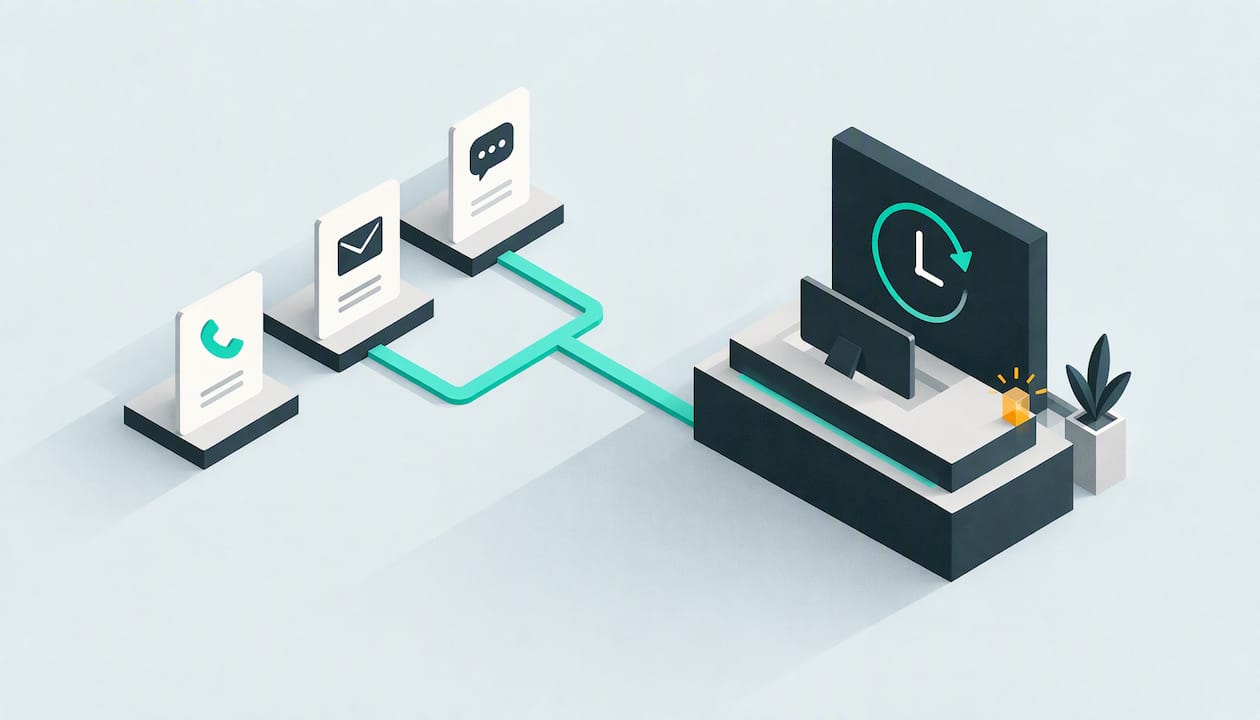
Lead Response Time: Why Replying in Minutes Wins the Job
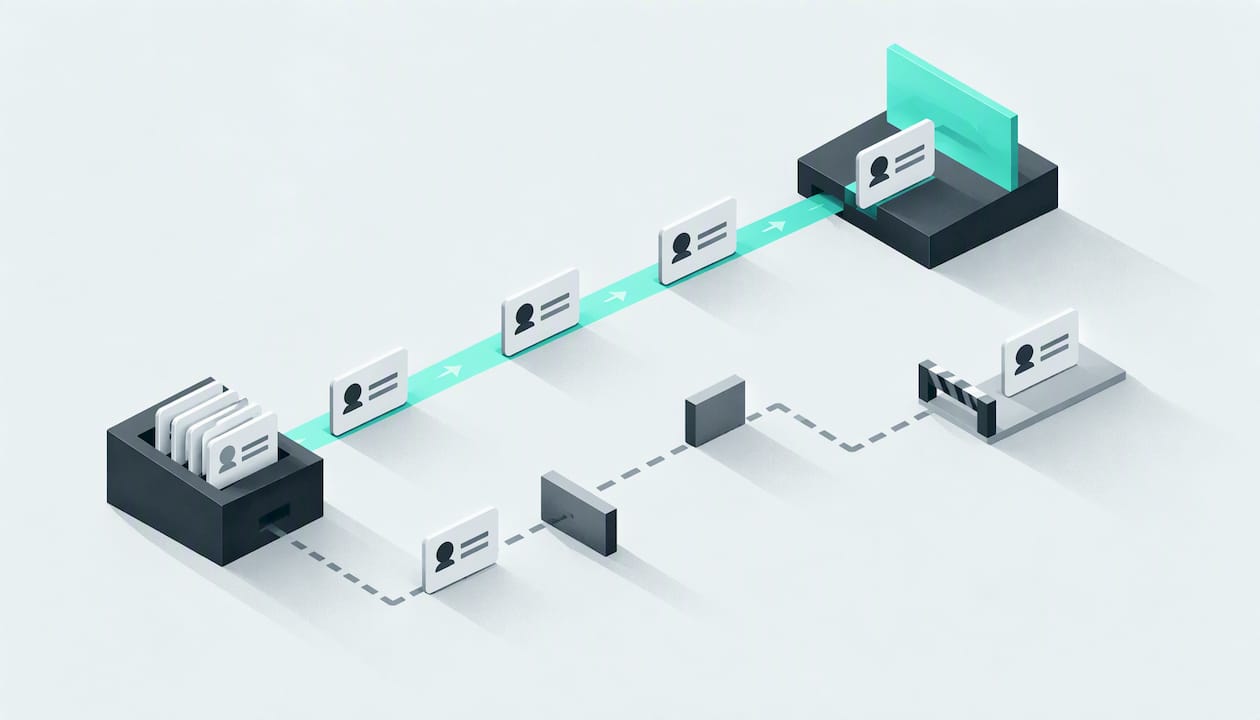
Lead response time is the gap between a customer getting in touch and your first useful reply. For a plumber, cleaner or property maintenance firm, that gap often decides who gets the job. The customer has a problem now and is usually contacting two or three firms. The one that answers first, and answers well, tends to be the one that gets booked. This guide covers why speed matters, what to aim for on each channel, how to measure where you stand and how to reply faster when nobody is at a desk.
TL;DR
- Speed decides jobs because customers contact several firms at once and the first credible reply sets the pace. Harvard Business Review research on online sales leads found that firms replying within an hour were nearly seven times more likely to qualify the lead than firms that took longer.
- UK firms are slow. A 2024 white paper reports an average of 47 hours and only 7% of firms replying within five minutes, so a fast reply sets you apart.
- Sensible targets differ by channel: answer the phone live or call back fast, reply to WhatsApp within minutes, and acknowledge web forms within minutes even if the full quote takes longer.
- Measure first. Log when each enquiry arrives and when you first replied, then look at the median, not the best day.
- Out of hours, an instant acknowledgement that sets expectations beats silence until 8am.
Table of Contents
- Why response time matters so much for service businesses
- What a good response time looks like by channel
- How to measure your current lead response time
- Practical ways to reply faster
- Replying faster out of hours
- Our perspective: speed is a front desk problem, not a sales problem
- Where DeskAgent fits
- FAQ
- Sources
Why response time matters so much for service businesses
Most service enquiries are urgent or semi-urgent. A leaking stopcock, a failed boiler, an end-of-tenancy clean that needs booking before the keys go back: the customer wants it sorted, and wants to know someone is on it.
That changes how people behave. They do not wait politely for your reply. They ring the next firm on the list, or send the same message to three companies. By the time you call back after lunch, the job may be booked.
The best-known evidence is the Harvard Business Review research on online sales leads. It looked at how quickly companies responded to web enquiries and what happened next. Firms that tried to contact the potential customer within an hour of the query were nearly seven times as likely to qualify the lead as those that waited longer. Against firms that waited 24 hours or more, the figure was 60 times. The study is from 2011 and covers online leads in several industries, not trades specifically, so treat it as a direction rather than a promise. But the logic holds for any business where the customer is comparing options in real time.
The Direct Marketing Association makes a related point: prospects live in an era of instant gratification, and timing is the first thing a lead response strategy has to get right.
What the UK numbers look like
The picture for British small firms is not flattering. A 2024 white paper on UK SMEs reports an average lead response time of 47 hours, with just 7% of firms replying inside five minutes and 55% taking five days or more to give a first reply.
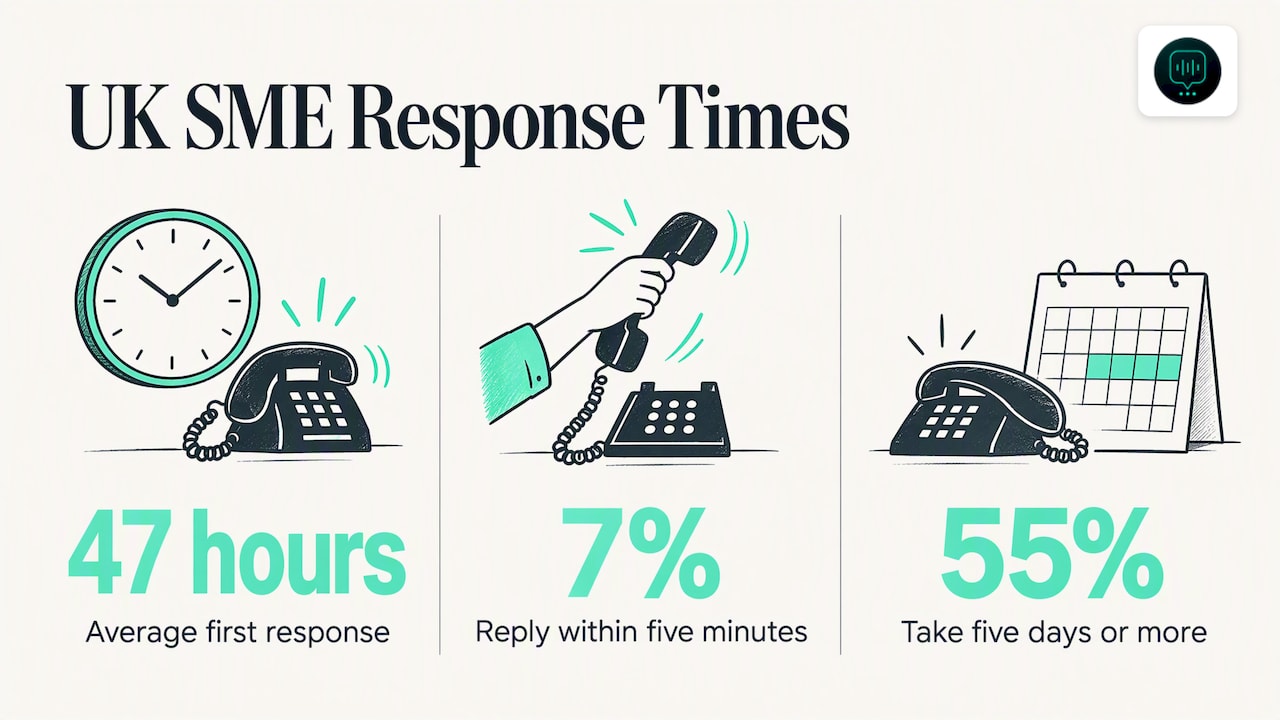
That is good news if you are willing to move. If most of your competitors take days, a reply inside an hour already puts you in a small minority. A reply inside minutes puts you almost alone.
Speed is not the whole story
A fast but useless reply does not win work. “Thanks for your message, we’ll be in touch” is better than nothing, but it is not a response in the sense that matters. The reply needs to show you understood the job: what is wrong, where, how urgent, and what happens next. Speed gets you into the conversation. Relevance keeps you there.
What a good response time looks like by channel
There is no single number that suits every business. A one-person electrician on a roof cannot answer a call within 30 seconds. But you can set a standard for each channel and hold to it. The targets below are our practical suggestions for UK service firms, not published benchmarks.
| Channel | Realistic target (working hours) | What counts as a response |
|---|---|---|
| Phone | Answered live, or call back within 15 minutes | A person or system that takes the details and says what happens next |
| First reply within 5 minutes | A relevant answer or question about the job, not just “received” | |
| Web form or chat | Acknowledgement within minutes, qualified reply within the hour | Confirms the job type, area and urgency, and gives a next step |
| Within the hour for new enquiries | A reply that moves things forward |
Phone
Phone callers are the hottest leads you have, and the least patient. Many will not leave a voicemail. If you cannot answer, a quick call back matters, but the first few minutes are when the customer is most likely still to be waiting. If you are on the tools all day, the question is who or what picks up when you cannot.
WhatsApp feels like a conversation, so customers expect conversational speed. A reply that arrives six hours later feels like a stranger answering a text from yesterday. Aim for minutes, and make the first reply do some work: ask for the postcode, a photo of the problem or the preferred day.
Web forms and chat
Forms are where many firms lose the most. The enquiry lands in an inbox nobody checks until evening. Set up an immediate acknowledgement that says what you will do and when. Then aim to send a proper reply, with the questions you need answered, within the hour.
Be honest about your standard
If you cannot reach those targets yet, say what you can do. The Federation of Small Businesses advises setting a realistic response standard, such as 24 to 48 hours, and stating it clearly on your website or contact page, because customers accept a wait far better than being left in the dark. That is a floor, not a goal. For urgent trades, it is slower than customers will tolerate. But a stated promise you keep beats an unstated one you break.
How to measure your current lead response time
Most owners think they reply faster than they do. The memory of the quick answers on a good day hides the enquiries that sat overnight. Measuring takes a week and costs nothing.
- List your entry points. Phone, WhatsApp, web form, contact email, social messages, review site messages. Include every place a customer can reach you.
- Record two timestamps for every enquiry. When it arrived, and when a person or system first gave a useful reply. A missed call that you returned at 4pm counts as a four-hour wait, however good the call was.
- Include the misses. Count calls that went to voicemail and forms that were never answered. They belong in the data, as the worst results.
- Work out the median per channel. The median, the middle result, tells you what a typical customer experiences. Averages get dragged around by one-off extremes.
- Split by time of day. Compare weekday mornings with evenings and weekends. You will probably find that the problem is not your working hours but the gaps around them.
- Note the outcome. Was the job booked, lost or still open? After a month, you can see whether faster replies line up with more bookings in your own numbers, which is more persuasive than any study.
A simple spreadsheet is enough. If your phone system and inboxes keep logs, use them to check your memory.
What to look for in the results
Three patterns come up again and again. First, one channel is much slower than the rest, usually the web form or a shared inbox. Second, the slow replies cluster at the same times: first thing, lunchtime or after 5pm. Third, enquiries that arrive when you are on a job get no first reply until you are done. Each pattern points at a specific fix, which is better than a vague resolution to “reply quicker”.
Practical ways to reply faster
Speed rarely comes from working harder. It comes from taking the first reply out of the queue of things that need your attention.
Decide who owns the first reply
If everyone is responsible for the shared inbox, nobody is. Name one person for each channel, with a named cover for holidays and sick days.
Prepare the answers you give every day
Most enquiries ask the same things: do you cover my area, how much roughly, when can you come, are you insured. Write short, accurate answers once and keep them somewhere your team can reach. Quality stays consistent and the first reply takes seconds.
Ask the questions that qualify the job
A good first reply asks what you need to know to price or schedule: type of job, postcode, access, urgency, photos. It also stops wasted trips to jobs outside your area or scope. We cover this in more detail in our guide to AI lead qualification for service businesses.
Keep every channel in one place
A customer who started on a web form and then rings should not have to repeat everything. Fragmented channels slow replies and make firms look disorganised. Our piece on multichannel customer service for UK service firms looks at fixing handoffs between channels.
Follow up, because the first reply is not the last
People get busy, forget and compare quotes. A short follow-up a day or two after you quote often rescues jobs that would otherwise go quiet. See automated lead follow-up for service businesses for how to do it without chasing too hard.
The same principle applies if you sell larger, higher-value work to private clients, where the first contact shapes the relationship. This piece on pitching to luxury clients is a useful read from the other end of the market.
Replying faster out of hours
A lot of enquiries arrive when you are not working: early morning, evenings and weekends, when people are at home and notice the problem. If your first reply waits for Monday, you are slowest exactly when many customers have time to ask.
You do not need to be awake at 10pm. You need a system that deals with the first step. A sensible out-of-hours approach has four parts:
- An immediate acknowledgement on every channel, so the customer knows the message arrived.
- A clear statement of what happens next, such as when someone will call and what counts as an emergency.
- The key details collected up front, so the morning call is productive rather than starting from scratch.
- Limits you control. Decide which jobs you will take out of hours and which wait. Do not promise emergency cover you cannot deliver.
We go further on this in after-hours calls for service owners, including how to set limits so that capturing leads does not cost you your evenings.
The point from the FSB advice applies here too: if the customer knows when to expect a reply, a wait is easier to accept. Silence is what drives them to the next firm.
Our perspective: speed is a front desk problem, not a sales problem
We built DeskAgent for service businesses, and the pattern we see is consistent. Owners are good at the work. The weak point is the front desk: the phone rings while you are under a sink, a WhatsApp message arrives at 9pm, and a form lands in an inbox that nobody opens until the next day.
That is why we do not think of lead response as a sales tactic. It is the job a receptionist used to do, and most small firms cannot afford a person on shift around the clock. The aim is to cover every channel, reply immediately, understand what the customer needs and how urgent it is, and hand your team a clear summary so they can act.
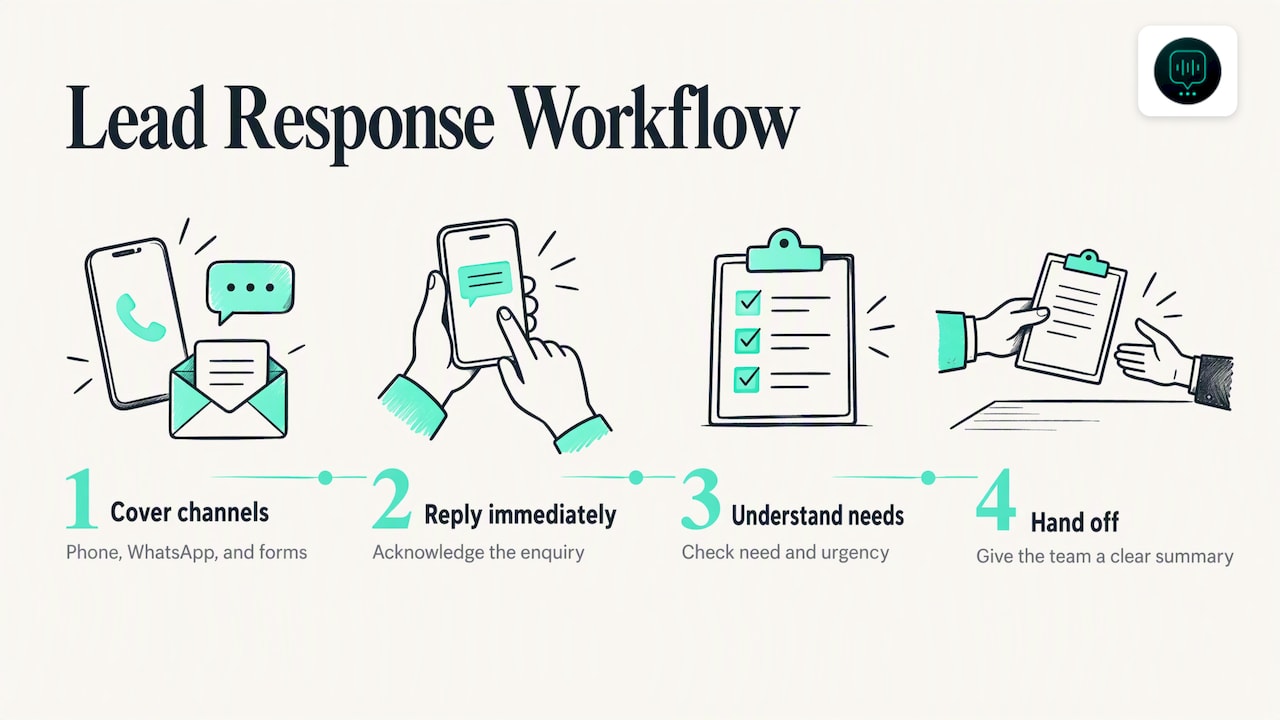
Two things matter more than any speed figure. The first reply has to be relevant, which is why we train the system on each business’s own services, coverage and FAQs. And the handoff has to keep context, so the customer never repeats themselves when a person takes over.
We would also be wary of anyone who promises that faster replies will deliver a set number of extra jobs. Results depend on your pricing, your reputation, your capacity and the quality of your follow-up. What we can say is that a business that replies in seconds is in a different position from one that replies in days, and in the UK, most are the second kind.
— Monty Gordon
Where DeskAgent fits
If your slowest channel is the obvious one, you can start there. Our DeskAgent plans are priced by channel:
| Plan | Price |
|---|---|
| Web Agent | £85 per month |
| Inbox Agent | £85 per month |
| Phone Agent | £125 per month |
| WhatsApp Agent | £125 per month |
| The full DeskAgent® system | £285 per month |
Full DeskAgent® setup is a one-off fee of £500. The system answers inbound calls, WhatsApp messages and web enquiries around the clock, qualifies leads by intent and urgency, sends your team detailed summaries, books into your calendar, filters spam from email enquiries and handles automated follow-ups. It is designed to give a first response in under a second. For a wider look at costs, see what service firms actually pay for an AI receptionist, and for background on the numbers, our practical UK guide to AI receptionists.
FAQ
How quickly should you respond to a lead?
As fast as you realistically can, and inside the hour during working hours as a minimum. The Harvard Business Review research found a sharp advantage for firms that made contact within an hour. For urgent trades, aim for minutes on phone and WhatsApp, and send an immediate acknowledgement on everything else.
What is a good lead response time for a UK service business?
There is no official standard. As a practical target, answer or return calls within about 15 minutes, reply to WhatsApp within five and acknowledge web forms within minutes. For context, a 2024 white paper puts the UK average at 47 hours, so these targets would already put you well ahead.
What does response time mean for a lead?
It is the time between a potential customer making contact and your first meaningful reply. An automatic “message received” shows the enquiry arrived, but the clock that matters to the customer stops when they get something useful: an answer, a question about the job or a next step.
Is it worth replying to enquiries out of hours?
Yes, if you control what you promise. An instant acknowledgement and a clear next step stop the customer drifting to another firm overnight. You can still keep your evenings: decide which jobs you will take out of hours and which wait until morning.
Sources
- The Short Life of Online Sales Leads, Harvard Business Review
- The Lead Response Crisis: How Poor Response Times Cost UK SMEs, white paper
- Four ways to manage customer expectations, FSB