AI Receptionist for Small Business: A Practical UK Guide
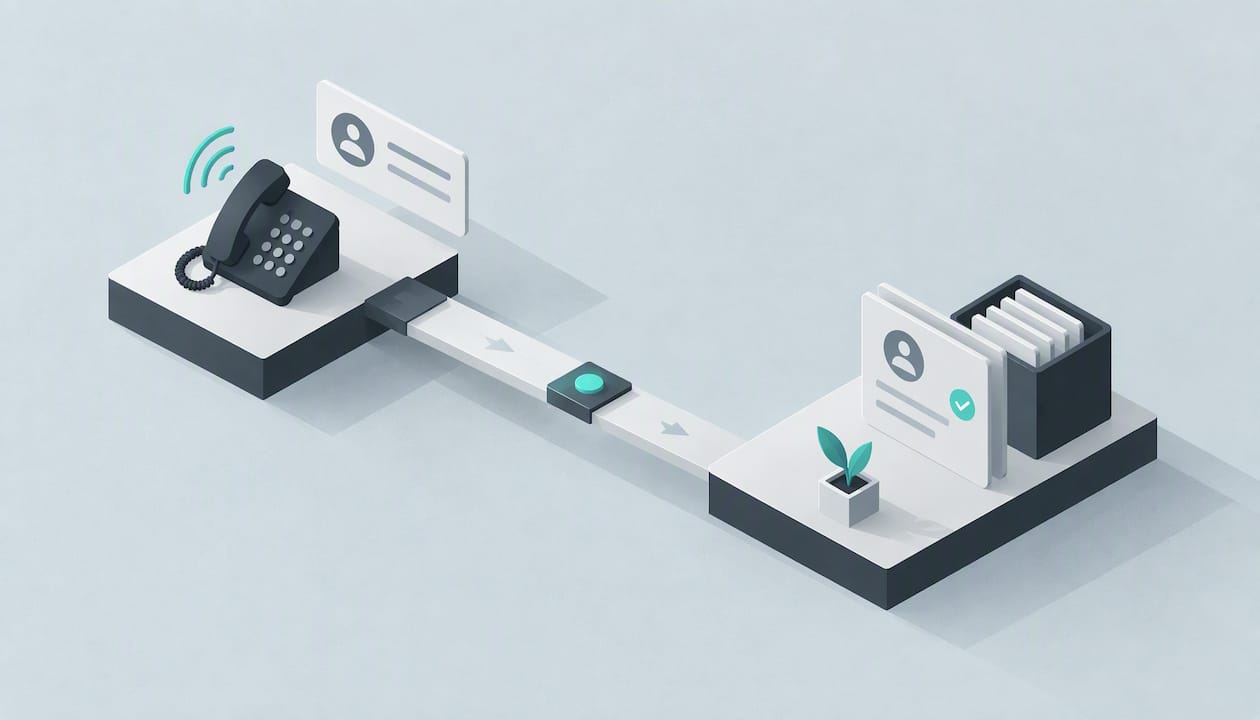
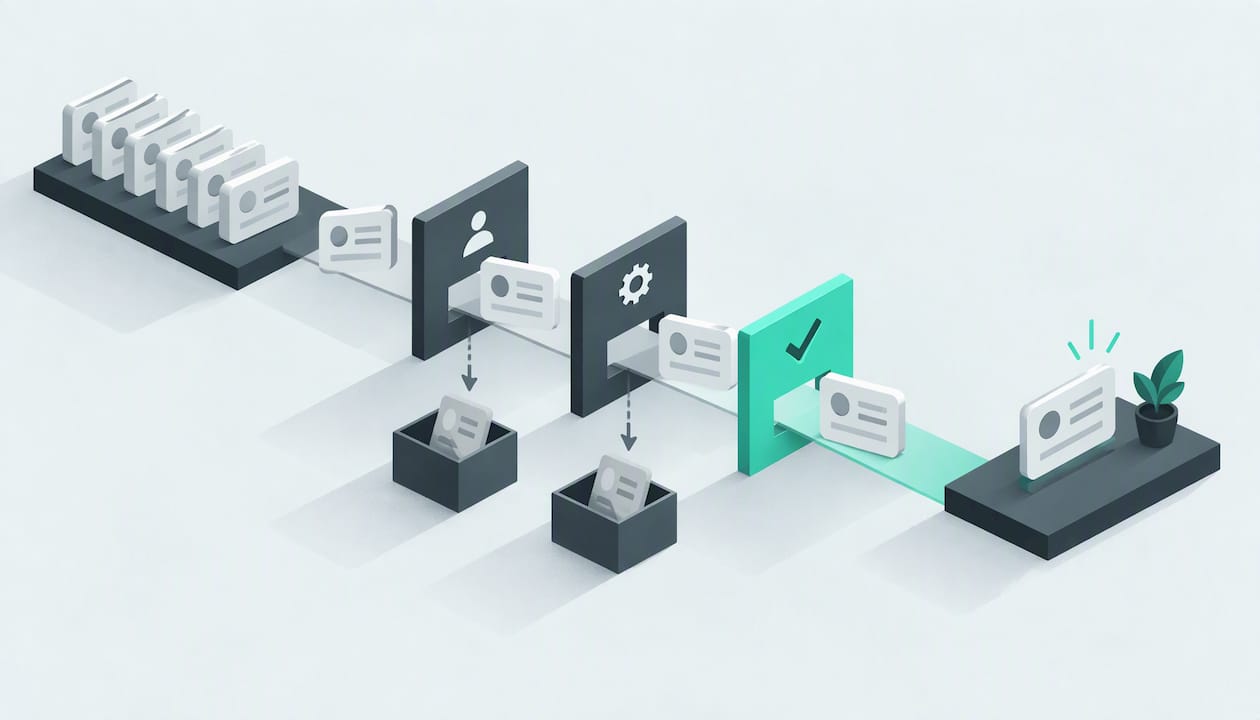
An AI receptionist answers your enquiries the moment they arrive, by phone, WhatsApp, web form or email. It asks the right questions, works out how urgent the job is, books it or passes it to a person, and leaves your team a short summary. For a plumber up a ladder, a cleaning firm with a full diary or a property maintenance office that closes at five, the gain is simple: fewer enquiries go cold while nobody is free to reply.
This guide covers what an AI receptionist does well, where it falls short, how to set one up over a week, and how to tell whether it is paying for itself. It also pulls together the speed to lead statistics that matter for UK service firms, with the source for each one.
TL;DR
- Speed decides who wins the job. Research on UK property enquiries found that replying within five minutes made a lead 21 times more likely to qualify than replying after 30.
- Most small firms are slower than they think. One UK white paper reports that only about 7% of businesses reply within five minutes.
- An AI receptionist suits the routine: answering common questions, taking details, booking, chasing and out-of-hours cover. It should hand over anything unusual, sensitive or angry.
- Set it up on your real services, areas and FAQs, test it with awkward calls, and measure response time, missed enquiries and booked jobs before and after.
Table of Contents
- Why response speed matters for service businesses
- Speed to lead statistics worth knowing
- What an AI receptionist can handle
- Where it falls short, and when a person takes over
- How to set one up in a week
- Measuring whether it works
- How UK firms are adopting AI
- Which DeskAgent plan fits
- Our view: speed is a service, not a trick
- FAQ
- Sources
Why response speed matters for service businesses
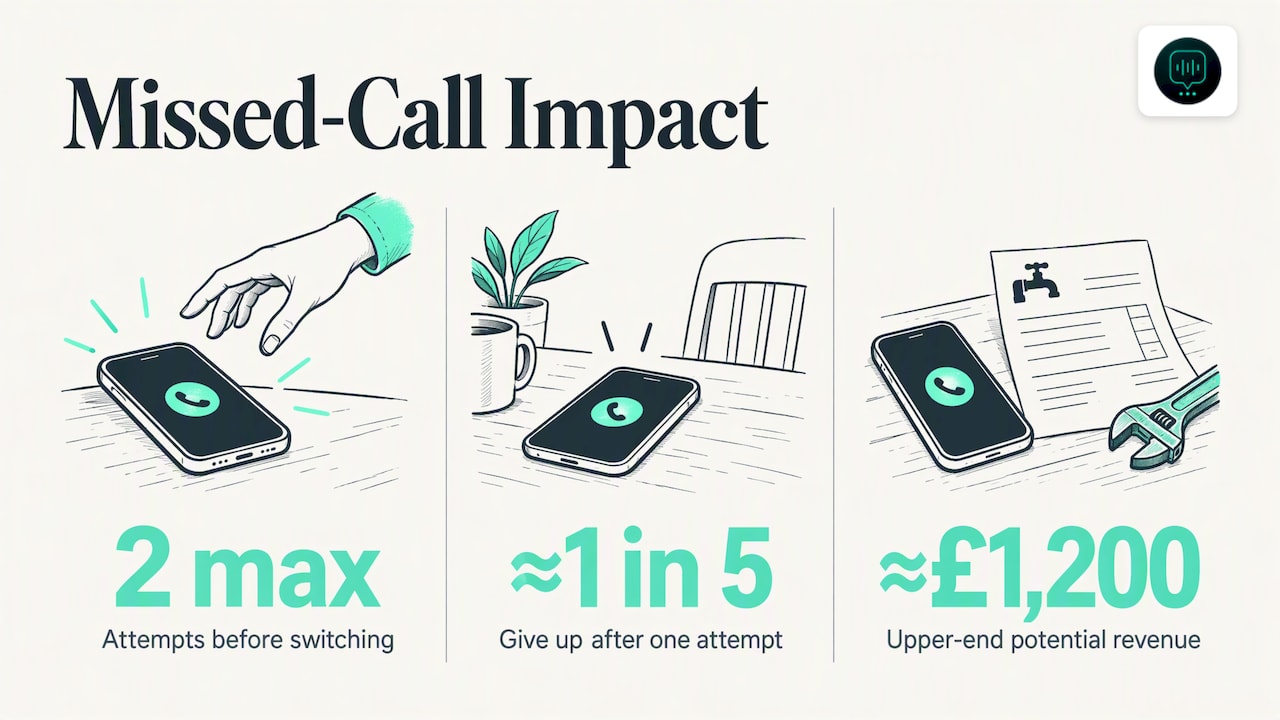
People rarely ring one tradesperson and wait. They ring, get voicemail, and ring the next name on the list. A BT Business study, published in 2014, found that customers will try a business at most twice before going elsewhere, and about a fifth would give up after one unanswered attempt. The research is dated, but the behaviour it describes will be familiar to anyone who has searched for an emergency electrician at 9pm.
The same release is the source of the widely repeated estimate that a single missed business call can cost around £1,200 in potential revenue. Treat that as an upper-end illustration, not a promise: a missed call about a £60 callout is worth far less than one about a full bathroom refit. Work out the value of a typical missed enquiry for your own firm, using your average job value and your quote-to-job rate.
Speed to lead statistics worth knowing
Most speed to lead figures come from sales studies, many of them American and aimed at software firms. Few were run on UK trades. The ones below are the most useful for a service business, with their limits stated.
| Finding | What it means for you | Source |
|---|---|---|
| Replying within 5 minutes made a lead 100 times more likely to be reached and 21 times more likely to qualify than replying after 30 minutes | The first few minutes are the window. Conversion potential falls by up to 80% after the first five. | Lightwork, UK property |
| Only about 7% of businesses manage a reply inside five minutes | The five-minute rule is a direction of travel, not something most small teams hit by hand. | Made Smarter white paper |
| 93.8% of calls to UK property businesses between 6pm and 9pm on weekday evenings went unanswered | Evenings are when many householders have time to ring. Unattended phones lose them. | UK Property Responsiveness Report |
| Six to nine contact attempts are needed to maximise connection with cold leads | A single reply is rarely enough. Follow-up matters as much as the first response. | InsideSales |
| Contact form enquiries convert at roughly 2% to 5% on typical UK service sites, against 25% to 40% for phone enquiries handled on the call | A live conversation, even with an AI, tends to convert better than a form that waits for a callback. | Virtually Local |
Two cautions. First, the 21x and 100x figures come from lead response studies in sales settings, and the property data is the closest UK match. Your result will differ with the type of job. Second, a quick reply only helps if it is a useful one. An auto-reply that says “we’ll be in touch” is not the same as an answer.
What an AI receptionist can handle
Think of it as the first person a customer reaches, not the last. Here is what a good set-up covers.
Answering calls and messages
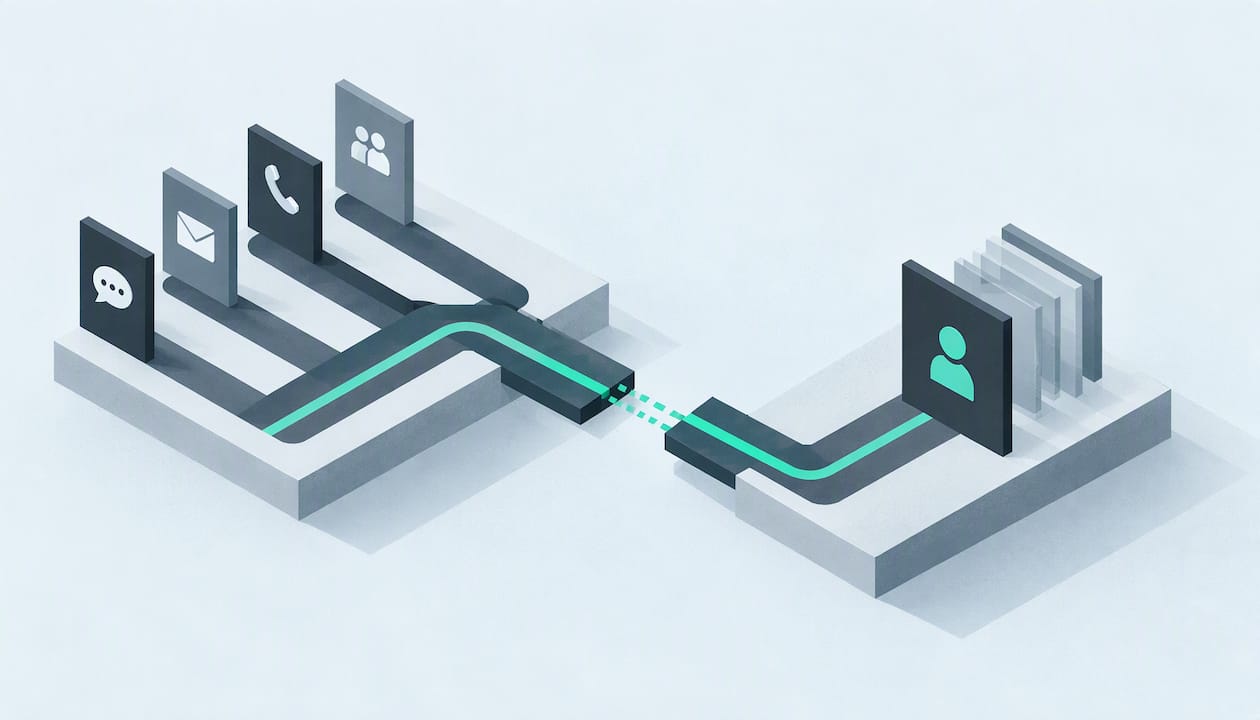
It picks up inbound calls, WhatsApp messages and web enquiries straight away, at any hour. With DeskAgent, the aim is a first response in under a second, so the customer is never left on a ringing line or an unread message. The customer gets the same experience whichever channel they choose, and the conversation stays in one place.
Answering common questions
Most enquiries to a service firm repeat. Do you cover my postcode? Do you do emergency callouts? Do you work weekends? Can you do a one-off deep clean? Do you handle commercial properties? An AI receptionist trained on your services, coverage area and FAQs can answer these consistently. It can only be as accurate as what you give it, so the content you supply matters more than the technology.
Qualifying the enquiry
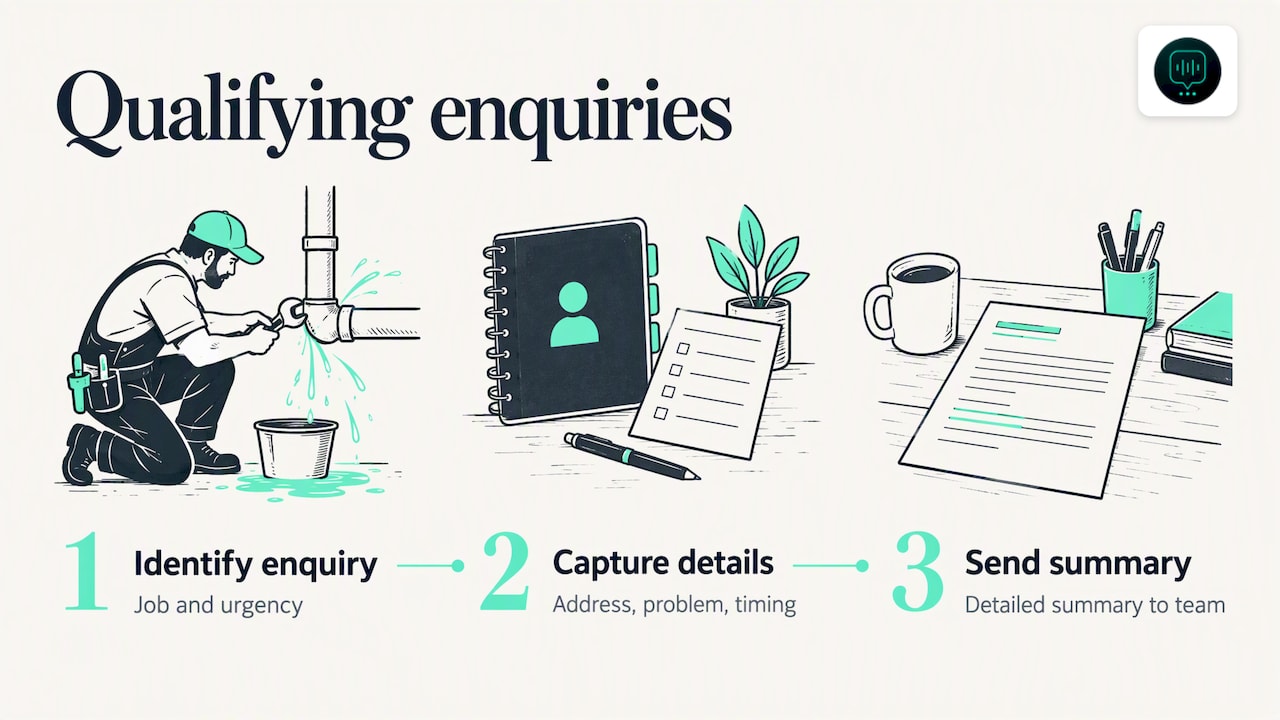
Qualifying means working out what the job is and how urgent it is. A burst pipe and a request for a quote on next spring’s gutter clearance are different enquiries, and they should reach your team differently. DeskAgent qualifies leads by customer intent and urgency, then sends your team a detailed summary, so whoever picks it up already knows the address, the problem and the timing.
Booking jobs
Where the customer is ready, the system can book into your calendar. That removes the back-and-forth that so often loses a job: the customer asks for Thursday, you reply on Friday, and they have already booked someone else.
Taking messages and following up
Not everything can be booked on the spot. Sometimes you need to see the job or price it. The system can capture the details properly and run automated follow-ups, which matters because, as the sales research above suggests, one attempt is rarely enough. It also filters spam from email enquiries, so your inbox does not fill with sales pitches that hide the real ones.
Covering evenings, weekends and busy periods
This is where the gap is widest. The Instep report quoted above looked at property businesses, not trades, but the pattern will be recognisable: phones go unanswered when staff have gone home. A cleaning firm with a surge of Monday-morning enquiries or a maintenance company hit by a cold snap has the same problem in a different shape, which is volume arriving faster than people can answer.
Where it falls short, and when a person takes over
An honest guide has to say this clearly: an AI receptionist is not a replacement for your judgement. Plan for these limits.
- Complex or unusual jobs. If a customer describes something outside your listed services, the system should not guess. It should take the details and pass them on.
- Safety and emergencies. A gas smell or flooding near electrics needs a person and, where relevant, the emergency services. Decide in advance what your system says in those cases, and who is on call. Do not rely on automation alone for anything where harm is possible.
- Pricing and quotes. Unless you have fixed prices you are happy to share, leave quotes to your team. The AI can gather the information a quote needs.
- Upset customers. A complaint about a job gone wrong deserves a human voice. Set a rule that complaints, repeat callers and anything the system cannot resolve go straight to a named person.
- Gaps in your own information. If your coverage map is out of date, the answers will be too.
The handover is the part to get right. A good one preserves context, so the customer does not have to repeat themselves. DeskAgent hands over with the conversation history and a summary, so your colleague starts from what has already been said, not from scratch.
How to set one up in a week
This is a sensible plan for preparing and launching, whichever system you choose. How long the technical set-up takes depends on the provider and your existing tools.
- Day 1: audit your current position. Look at the last month of missed calls, unanswered messages and web forms. Note how long replies actually took. Most owners assume they are faster than the logs show.
- Day 2: list your services and boundaries. Write down what you do, what you do not, the postcodes you cover, your opening hours, and your emergency policy.
- Day 3: gather your FAQs. Take the twenty questions customers ask most. Write the answers as you would say them on the phone, in plain words.
- Day 4: define urgency and handover rules. Decide what counts as urgent, who gets alerted and how, and which situations always go to a person.
- Day 5: connect your channels and calendar. Link the phone line, WhatsApp, web form and inbox you want covered, and the calendar jobs should be booked into.
- Day 6: test with awkward calls. Ring it as a difficult customer would. Ask for something you do not offer. Give a postcode you do not cover. Interrupt. Mumble an address. Fix what breaks.
- Day 7: go live and watch closely. Read every conversation in the first week. Adjust answers and rules daily at first.
If you take card details, record calls or store customer records, check your obligations under UK data protection law, and tell callers when they are talking to an automated system. The Information Commissioner’s Office is the place to start for current guidance.
Measuring whether it works
Do not judge by feel. Record a baseline before you switch on, then compare after a month.
- Response time. Median time from enquiry to first useful reply, by channel.
- Missed enquiries. Calls and messages that got no response at all, especially out of hours.
- Qualified leads. How many enquiries had enough information to quote or book.
- Booked jobs. Enquiries that became jobs, split by channel, so you can compare phone with web forms.
- Time saved. Hours your team spends on repetitive replies and chasing.
- Customer feedback. Read a sample of conversations and ask a few customers how it felt.
Be realistic about attribution. A busy season, a price change or a good review will all move your numbers. DeskAgent’s own published claim is that businesses can see increases in booked jobs of up to 38%, but that is a ceiling from its own information, not a guarantee, and your results will depend on your starting point, your market and how well the system is set up.
How UK firms are adopting AI
Adoption is still modest. According to the government’s AI adoption research, around one in six UK businesses (16%) were using at least one AI technology at the time of the survey, and a further 5% planned to adopt it, while most were neither using it nor planning to. Other surveys report higher figures, so check the date and the definition before you quote any number.
For a small service firm, the modest uptake cuts both ways. It means you are not behind if you have not started. It also means a firm that answers every enquiry within seconds, at 8pm on a Sunday, has an edge over local rivals still relying on voicemail.
Which DeskAgent plan fits
We built DeskAgent for UK service businesses such as maintenance, property management, cleaning and trades. You can start with one channel or cover them all:
| Plan | Price |
|---|---|
| Web Agent | £85 per month |
| Inbox Agent | £85 per month |
| Phone Agent | £125 per month |
| WhatsApp Agent | £125 per month |
| The full DeskAgent® system | £285 per month |
| Full DeskAgent® setup | £500 one-off |
If missed calls are your main leak, the Phone Agent is the obvious start. If most enquiries come through your website and inbox, the Web Agent and Inbox Agent cover those. The full system brings all channels together so a customer who rings, then follows up on WhatsApp, is treated as one person. You can see the details on the DeskAgent site.
Our view: speed is a service, not a trick
We talk to owners who are good at their trade and poor at being in two places at once. That is not a failing. A electrician on a roof cannot also answer the phone, and a cleaning manager in a handover meeting cannot reply to WhatsApp.
The temptation is to treat speed to lead as a sales gimmick. We see it differently: a quick, accurate answer is simply good service. The customer wants to know whether you can help and when. Giving them that in seconds, at any hour, respects their time.
What we would warn against is automation that pretends to be more than it is. An AI front desk should be trained on your own services, coverage and FAQs, should qualify by intent and urgency, and should know when to step aside. The best outcome is when the customer does not mind who answered, because they got a clear answer and a person who already knew the story.
Start with the enquiries you lose today, not the ones you win. That is where the evidence, and your money, is.
— Monty Gordon
FAQ
What is the 5 minute rule for leads?
It is the finding that the first five minutes after an enquiry are the most valuable. UK property research reports that replying within five minutes makes a lead 21 times more likely to qualify than replying after 30. Treat it as a direction to aim for, not a precise law.
How quickly should I respond to a new enquiry?
As fast as you can give a useful answer, ideally within minutes. Only about 7% of businesses manage that, according to the Made Smarter white paper, so automated first replies are one way to close the gap. Follow up too, since research suggests several attempts are often needed.
Can an AI receptionist replace a human receptionist?
Not entirely. It handles routine questions, bookings, messages and out-of-hours cover well, but complaints, emergencies and unusual jobs need a person. Most small firms use it to catch what would otherwise be missed, not to remove staff.
Will customers mind speaking to an AI?
Many care more about getting a prompt, accurate answer than about who gives it. Be open that it is an automated system, make handover to a person easy, and read early conversations to see how customers respond.
Sources
- Lightwork: lead response time in property
- Made Smarter: The Lead Response Crisis
- Instep: UK Property Responsiveness Report
- InsideSales: The Fast and the Frequent
- Virtually Local
- BT Business research on the cost of missed business calls
- GOV.UK: AI adoption research