AI Lead Qualification for Service Businesses: A UK Guide

AI lead qualification means an automated agent answers every enquiry the moment it arrives, asks the questions you would ask, sorts the lead by urgency and fit, and hands the promising ones to a person with the details already written up. For a plumber on a roof, a cleaning firm with a full inbox or a property maintenance team out on call-outs, it replaces the missed call and the reply that goes out two days late. This guide covers what the agent asks, how leads get scored, when a human should step in and what UK data protection rules mean for you.
TL;DR
- An AI agent qualifies a lead by asking a short set of questions (job type, postcode, urgency, budget, timing) and turning the answers into a summary and a priority.
- Speed matters: only 7% of UK SMEs reply within five minutes, and a quick reply is often what wins the job.
- Keep a human in the loop: let the agent triage and book, and let people take the hot leads, the awkward ones and any decision that affects the customer.
- Under UK GDPR and PECR you need a lawful basis, clear transparency and, for some uses, a DPIA. Marketing messages need consent rules checked first.
Table of Contents
- What AI lead qualification actually is
- Why speed is the first qualifier
- What an AI agent asks: the five core questions
- How leads get scored
- Keeping a human in the loop
- Why a missed lead costs more than one job
- Perspective: what we see when firms start qualifying properly
- Data protection basics for AI qualification
- Where DeskAgent fits
- Getting started: a four-week approach
- Frequently asked questions
- Sources
What AI lead qualification actually is
Qualifying a lead is deciding whether an enquiry is worth your time, and how quickly. In a sales team that might mean checking budget and authority. In a service business it is more practical: can we do this job, do we cover that postcode, how urgent is it and when can someone go?
Done by hand, this happens when the owner or office manager finds a gap. Done by AI, it happens in the moment the customer reaches out, by phone, WhatsApp, web form or email. The agent holds a conversation, collects the answers and records them in a consistent format, so every lead is treated the same way at 3pm on a Tuesday and 11pm on a Sunday.
A few terms are worth separating:
- Lead qualification: the questions and the judgement about whether the enquiry fits your business.
- Lead scoring: a way of ranking qualified leads, for example hot, warm and cold, so your team knows who to call first.
- Handoff: the point where a person takes over, ideally with the whole conversation visible.
Most of what ranks for this topic is written for software sales teams chasing demos. A drain blockage, a deep clean for a block of flats or a landlord’s repair request is a different kind of lead, with different questions. That is the angle here.
Why speed is the first qualifier
Before getting to the questions, it helps to see why the first reply carries so much weight.
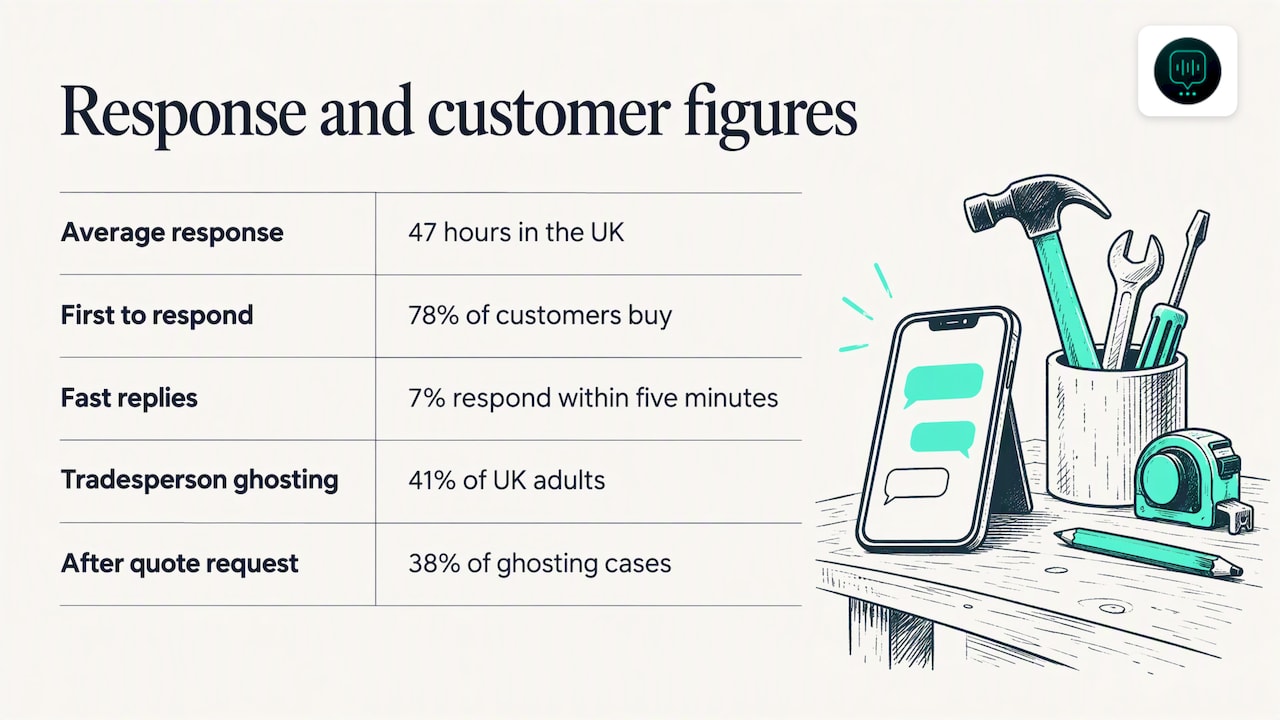
A 2026 report on UK response times found that the average UK service business takes 47 hours to respond to an enquiry, and 78% of customers buy from the first business to respond. Only 7% of firms manage five minutes or less. If those figures hold for your area, a fast, sensible reply puts you ahead of most of the competition before you have said anything clever.
The tradesperson side of the story is similar. HomeServe research found that 41% of UK adults have been “ghosted” by a tradesperson, with 38% of those cases happening after the customer asked for a quote. Trade press coverage of the same research notes that demand for tradespeople was up 22% year on year, so customers were struggling to find anyone to commit.
Most of this is not laziness. It is a firm of three people who are all on site. The enquiry arrives, nobody can answer, and the customer moves on to the next name in the search results. Qualification by AI is mostly a fix for that gap.
What an AI agent asks: the five core questions
A good qualification flow is short. Each question should either change who handles the lead, how fast, or whether you take the job at all. If an answer changes nothing, drop the question.
1. Job type
“What do you need help with?” is the opening question, and the answer decides everything else. The agent should map free-text answers to the services you actually offer. “My boiler’s making a banging noise” and “radiator cold” both land in heating repair. “Need someone to clear out after a tenant left” lands in end-of-tenancy cleaning or void property works.
This works best when the agent has been trained on your services and your FAQs, not on a generic template. A cleaning firm that does not do carpet shampooing should have an agent that says so politely rather than taking a booking it cannot fill.
2. Postcode or location
Coverage is the quickest disqualifier. If you work within 20 miles of Leeds, a lead in Truro is not worth a conversation. Asking for the postcode early saves the customer’s time as well as yours. It also lets you route leads: north-side jobs to one engineer, south-side to another.
3. Urgency
This is the question that makes qualification worth having. “Is this an emergency, something this week or just getting quotes?” separates a flooding kitchen from a garden-fence enquiry. The agent can also pick up urgency from wording, such as “leaking through the ceiling” or “no heating and we have a baby”, even if the customer does not say the word urgent.
For anything involving immediate danger, such as a suspected gas leak, the agent should be set up to tell people to contact the appropriate emergency service and not simply log a lead. Decide that script in advance with your own safety procedures in mind.
4. Budget
Budget is the most sensitive question and the one many firms skip. Customers often do not know what a job costs, and an abrupt “what is your budget?” can feel pushy. Softer versions work better: “Do you have a rough range in mind, or would you like us to quote?” or, for recurring work, “Is this a one-off or something you’d want regularly?”
Treat budget as a signal and not a gate. A customer without a figure is not a bad lead; they are a normal one. Your scoring should not mark them down simply because they declined to answer.
5. Timing
“When would you like this done?” completes the picture and feeds directly into the diary. A customer who wants a visit tomorrow and a customer planning a refurbishment in three months need very different handling. Where the system has calendar booking, timing turns into an actual slot instead of a note for someone to chase.
Optional extras that earn their place
- Whether the customer is the owner, tenant or managing agent, which matters for approval and invoicing in property maintenance.
- Whether access is straightforward (keys, concierge, parking).
- For commercial or facilities work, the number of sites or units.
- A photo or short description of the fault, where the channel allows it.
Keep the whole exchange to a handful of questions. Every extra one is a chance for the customer to give up.
How leads get scored
Once the answers are in, the agent or system assigns a priority. You do not need anything exotic. A simple three-tier approach covers most service firms.
| Tier | Typical signals | What should happen |
|---|---|---|
| Hot | In your area, matches a service you offer, urgent or wants a date in the next few days, asks for a visit or a price | Person notified straight away, or a slot booked |
| Warm | In area, right service, timing in a few weeks, gathering quotes | Booked for a callback or quote visit, automated follow-up if no response |
| Cold | Outside your area, a service you do not offer, vague or no intent, or spam | Polite reply, signposting if sensible, no staff time used |
Industry analysis suggests that separating hot from warm leads lets firms put human time where bookings are likely, while automated workflows look after people still gathering information. The same analysis claims conversion gains of up to 80% in some cases. That is a vendor-side figure, so treat it as an upper bound and not a forecast. What you can rely on is the logic: your best people should not spend the morning on leads that were never going to book.
Build the scoring from your own jobs
The most useful scoring rules come from your history. Look at the last 50 or 100 enquiries and ask which ones became profitable jobs. You will probably find patterns: certain postcodes, certain job types, a minimum job size below which the visit does not pay. Put those into the qualification rules, and review them every quarter as your work changes.
If you also buy leads from outside sources, scoring helps there too. AIViral, for example, describes a B2B service that delivers pre-qualified leads with a human review of each response, which shows the same principle at work: qualify before anyone spends time on a conversation.
Watch for the bias problem
Scoring can go wrong. If your rules downgrade leads from certain areas, or an agent misreads accents or phrasing and underrates them, you are quietly turning away customers. Read a sample of the cold leads every month. If you see jobs you would have wanted, adjust the rules.
Keeping a human in the loop
An AI agent is good at asking the same questions politely, every time, at any hour. It is not good at judgement calls, empathy or the one-off situation nobody planned for. The CIPD frames this well, arguing that people should see AI as an enabler that takes on repetitive tasks such as initial screening, leaving staff free for the work that needs empathy and nuance.
In practice, set clear rules for when a person takes over:
- Hot leads. Notify someone immediately, with the summary attached.
- Distress or vulnerability. If a customer sounds upset, elderly and alone, or mentions a safety issue, the agent should hand off, not carry on with the script.
- Complex or high-value jobs. Commercial contracts, multi-site work and anything requiring a site survey should go to a person for pricing.
- Requests for a human. If a customer asks to speak to a person, they should reach one, or be told clearly when someone will call.
- Complaints. An existing customer with a grievance is not a lead to qualify.
What a good handoff looks like
The worst handoff is the one that makes the customer repeat everything. A good one gives your team the job type, the address, the urgency, the customer’s own words and the full conversation, whichever channel it came through. If someone starts on WhatsApp and then rings, the person answering should already know the story. That context-preserving handoff is what makes the arrangement feel like one team and not a robot followed by a stranger.
Why a missed lead costs more than one job
It is tempting to think of each missed call as the loss of one job. In recurring work it is worse. One trade-press feature on missed calls puts a single emergency call at roughly £400 to £600, while a lost recurring cleaning or facilities contract can run to £3,000 to £10,000 over time. Treat those as illustrations from a provider’s own marketing, not audited figures, and run the sums with your own average job values.
There is also the point that the phone has changed role. Moneypenny’s comment in FMJ is that customers research online and the call is often the last step before buying. A caller who rings you is probably nearly ready, which is exactly the moment you cannot afford to leave on ringing.
HomeServe’s research adds that 22% of inbound calls go unanswered in working hours and 62% of callers do not ring back. Even if your own numbers are better, check them. Your phone provider’s call logs will show how many calls went unanswered last month.
Perspective: what we see when firms start qualifying properly
We built DeskAgent for UK service businesses because the same pattern kept showing up: good firms, busy people, enquiries going cold. Nobody is ignoring customers on purpose. They are up a ladder, in a meeting with a landlord, or at home with their family at 8pm.
Our view is that qualification should be boring and consistent. The agent asks the same few questions, in plain English, on whichever channel the customer chose, and gives your team a summary they can act on in ten seconds. It should be trained on your services, coverage area and common questions, so it sounds like your firm and not a generic script.
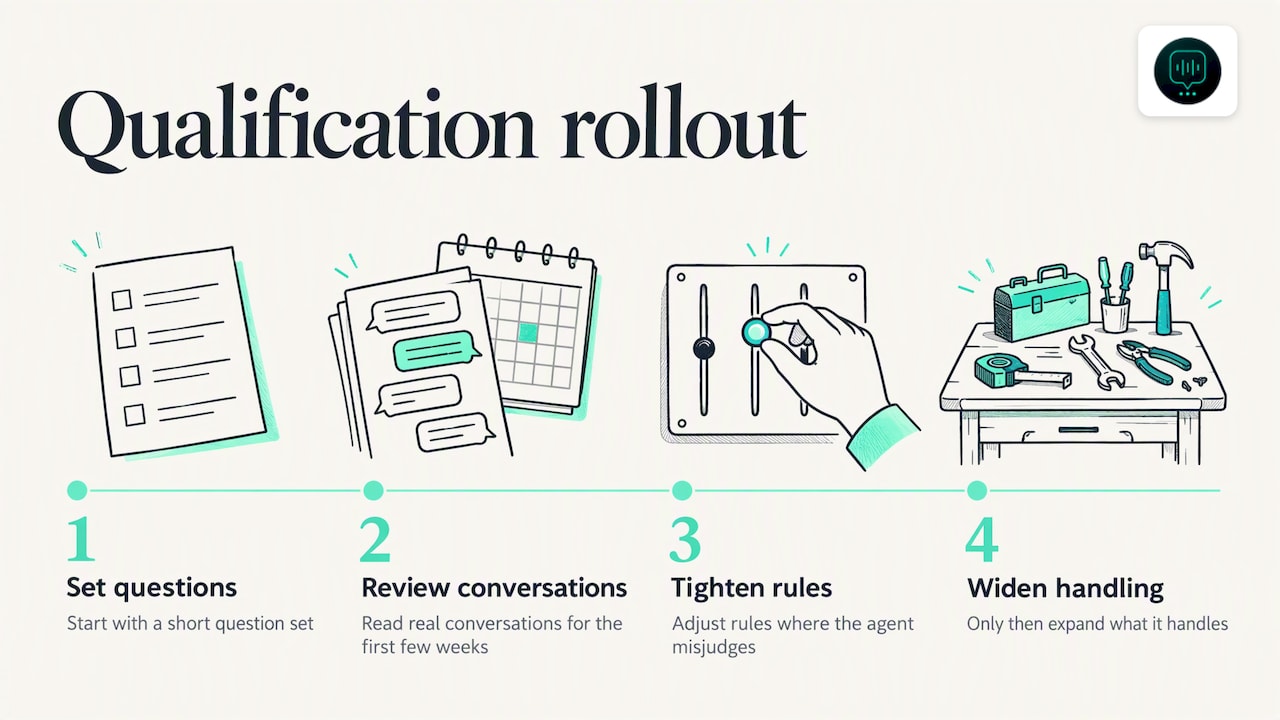
We also think the human part matters as much as the automation. The point is not to keep customers away from your people. It is to make sure that when your people pick up, they are talking to someone who is ready, with the facts in front of them. Start with a short question set, read real conversations for the first few weeks, tighten the rules where it misjudges, and only then widen what it handles.
— Monty Gordon
Data protection basics for AI qualification
This section is general information for small firms, not legal advice. If you handle sensitive data or are unsure about your position, ask a data protection adviser or check with the ICO.
When an agent collects names, addresses, phone numbers and descriptions of problems, you are processing personal data. UK GDPR applies as it would to any other system. The Information Commissioner’s Office has published the ICO’s guidance on AI and data protection, which is the best starting point for how lawfulness, fairness and transparency apply when AI is involved.
A practical checklist
- Know what you collect. The government’s guidance for businesses says to identify all the personal data you hold about customers and leads. Write down what the agent captures and why.
- Tell people. Customers should know they are talking to an AI, and your privacy notice should explain what you collect and how long you keep it. A short line at the start of the conversation does the job.
- Collect only what you need. Do you need a date of birth to quote for a gutter clean? No. Keep the question set tight.
- Set retention. Decide how long unconverted leads are kept, and delete them on schedule.
- Check your supplier. Understand where data is stored and who can see it, and make sure there is a written agreement in place.
- Consider a DPIA. Where AI is used for profiling or automated decisions likely to be high risk for individuals, the ICO expects a data protection impact assessment. Scoring a plumbing enquiry for priority is usually low-stakes, but write down your reasoning anyway.
Automated decisions
The ICO explains that UK GDPR has specific provisions on solely automated decision-making and profiling. Extra rules apply where a purely automated decision has legal or similarly significant effects on someone. Deciding which lead to call first is rarely that. Refusing someone a service on the strength of an automated score alone is closer to the line, which is another reason to keep a person in the loop.
Follow-ups and marketing: PECR
This is where small firms trip up most often. The ICO says you must not send marketing emails or texts to individuals without specific consent, with a limited soft opt-in for your own previous customers. Sole traders and some partnerships count as individuals. Companies are treated differently, though it is good practice to keep a list of those who object.
The practical split looks like this:
- Replying to an enquiry the customer started, returning a missed call or confirming a booking is a service conversation, not marketing.
- A follow-up to a quote the customer asked for is generally in the same territory, but keep it relevant and stop when they say so.
- Promotional messages, such as a seasonal offer to everyone who ever enquired, are marketing and need the consent rules checked first.
Whatever the channel, make it easy to opt out and make sure the opt-out is honoured quickly and everywhere. WhatsApp is not exempt. A practical UK guide to WhatsApp Business and GDPR is a useful read before you automate messaging there, though it is a third-party guide and not law.
Where DeskAgent fits
DeskAgent is an AI front desk for UK service businesses. It answers inbound phone calls, WhatsApp messages and web enquiries around the clock, qualifies each lead by intent and urgency, and gives your team a detailed summary. It also offers calendar booking, context-preserving handoff between channels, spam filtering for email enquiries and automated follow-ups. It is trained on your own services, coverage and FAQs.
You can start with one channel or take the lot:
| Plan | Price |
|---|---|
| Web Agent | 85 GBP per month |
| Inbox Agent | 85 GBP per month |
| Phone Agent | 125 GBP per month |
| WhatsApp Agent | 125 GBP per month |
| The full DeskAgent® system | 285 GBP per month |
There is a one-off setup fee of 500 GBP for the full system. If you are not sure which channel is losing you the most work, check your missed call log and your inbox response times first. The DeskAgent plans page sets out what each agent covers. No tool guarantees results, so judge it by the conversations it produces in your first few weeks.
Getting started: a four-week approach
- Week one: measure. Count missed calls, unanswered WhatsApps and average reply time. Note your average job value and the share of enquiries that become work.
- Week two: write the question set. Agree the five core questions, your coverage area, your emergency rules and the triggers for handing off to a person.
- Week three: run it, read everything. Read each conversation. Fix wording that confuses customers, and tighten scoring where it misjudges.
- Week four: review the numbers. Compare response time, booked jobs and time spent on poor-fit enquiries against week one. Then decide whether to add channels.
Do the data protection homework in parallel: update your privacy notice, set retention, and record your reasoning on scoring and any DPIA.
Frequently asked questions
Is AI lead qualification only for big sales teams?
No. It is arguably more useful for small service firms, where the person who would qualify the lead is also the person doing the job. The questions are simpler, such as job, postcode, urgency and timing, and the benefit is not missing work while you are busy.
Do I need a DPIA to use an AI agent for enquiries?
The ICO expects one where AI is used for profiling or automated decisions likely to be high risk for individuals. Prioritising routine enquiries is usually lower risk, but it is sensible to record your assessment either way. If you are unsure, take advice from a data protection professional.
Can the AI send follow-up messages to every lead?
Only within the rules. Replying to someone who contacted you, or continuing that conversation, is different from sending promotions. Marketing to individuals, including sole traders, generally needs consent under PECR, so check your position and honour opt-outs.
Will customers mind talking to an AI?
Most customers want a quick, accurate answer more than they care who gives it, but be open about it. Say upfront that it is an automated assistant, make a human easy to reach, and hand over quickly when the situation needs it.
What should I measure to know it is working?
Track reply time, the number of enquiries that become booked jobs, the share of leads marked hot that actually convert, and the time your team spends on enquiries that go nowhere. Review a sample of conversations each month for errors and missed opportunities.
Sources
- The Lead Response Crisis: How Poor Response Times Cost UK SMEs Billions
- HomeServe: four in ten UK adults ghosted by a tradesperson
- Heating & Plumbing Monthly: ghosted by a tradesperson research
- Spotler: lead scoring
- CIPD: AI as an enabler
- Professional Electrician: missed calls and missed revenue
- FMJ: respond first or risk losing the customer
- ICO: guidance on AI and data protection
- ICO: rights related to automated decision making including profiling
- ICO: electronic mail marketing
- Business.gov.uk: data protection in your business
- Is WhatsApp Business GDPR compliant? UK guide