Best 24/7 Answering Service for UK Small Businesses
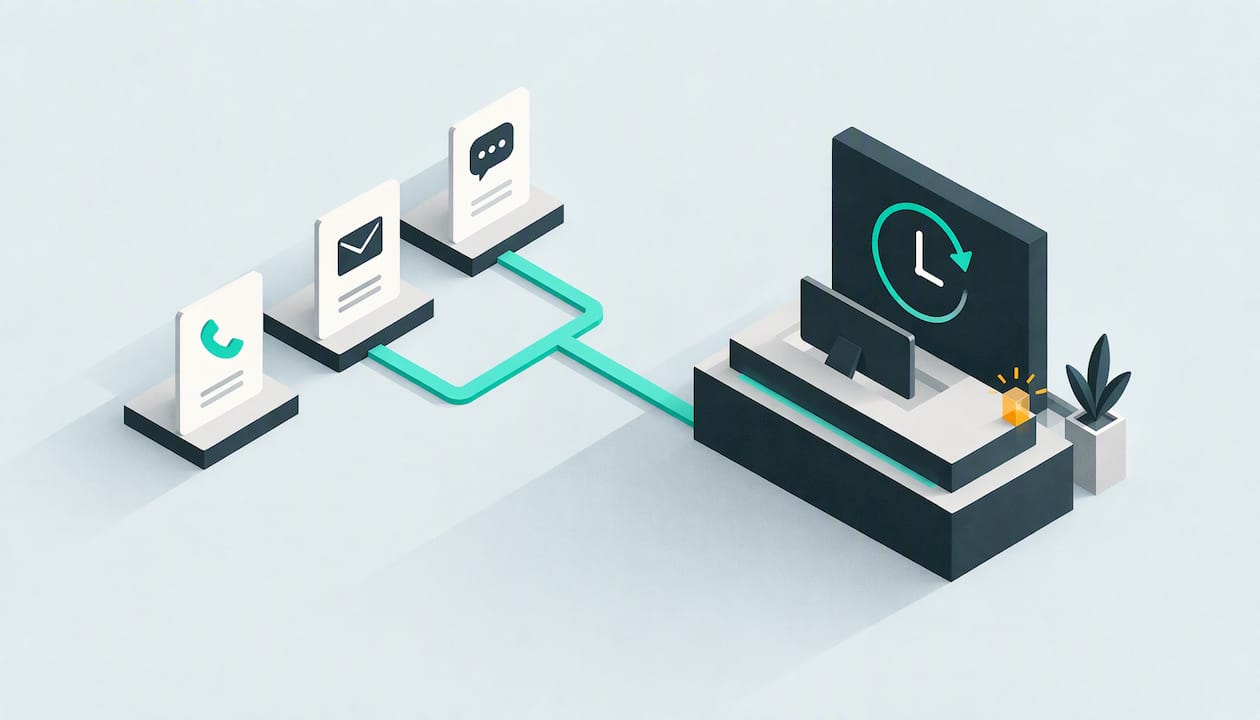
The best 24/7 answering service for a small UK service business is the one that picks up every enquiry, works out how urgent it is, and passes the right job to the right person without you being awake. There are four ways to get there: night staff of your own, an outsourced call centre, a virtual receptionist, or an AI agent. They differ most on cost, on how well they know your work, and on what happens when a call needs a human decision. That last point is where an escalation matrix earns its place, so we cover it in detail below.
TL;DR
- Night staff of your own is the most controlled option and the most expensive. One seat covering 11pm to 7am costs about £37,113.20 a year at the National Living Wage alone, before any other employment costs.
- Outsourced call centres and virtual receptionists are cheaper than hiring, but they answer for many firms at once, so they often take messages rather than qualify and book jobs.
- An AI agent trained on your services, coverage and FAQs answers instantly at any hour and can book into your calendar. You still decide what counts as an emergency.
- Whichever you choose, write a simple escalation matrix first: who is contacted, for what, and how fast.
Table of Contents
- The four ways to cover nights, weekends and busy hours
- What the night shift really costs you
- How the options compare
- What to compare before you choose
- The escalation matrix: the part most owners skip
- Questions to ask any provider
- Our view: cover that qualifies, not just answers
- Where DeskAgent fits
- FAQ
- Sources
The four ways to cover nights, weekends and busy hours
Most owners think of “24/7 cover” as someone answering a phone. For a trades, cleaning or property maintenance firm it means more than that. A burst pipe at 2am, a landlord emailing at 9pm, a tenant sending a WhatsApp photo of a leak on Sunday: each needs a reply, a decision on urgency and a next step.
Night staff of your own
You employ people, or rota existing staff, to answer out of hours. You get full control and people who know your business. You also take on the rota, sickness cover, training and the legal duties that come with night work.
Outsourced call centre
A team of agents answers for several businesses, usually following a script you supply. It suits firms that mainly want calls answered and a message sent on. The agent is rarely able to judge whether a leak is a drip under a sink or water coming through a ceiling unless you have scripted that precisely.
Virtual receptionist
A small team, or sometimes one person, answers as your front desk during agreed hours. The tone is often more personal than a large call centre. Hours of cover and holiday arrangements vary, so “24/7” needs checking in the contract rather than assuming it.
AI agent
Software answers calls, messages and web enquiries at any hour, asks the questions you have set, and sends your team a summary. It does not tire, and it does not need a rota. It does need setting up properly, because it can only be as good as the rules and information you give it.
What the night shift really costs you
The cost of staffing nights yourself is easy to underestimate, so work it out properly.
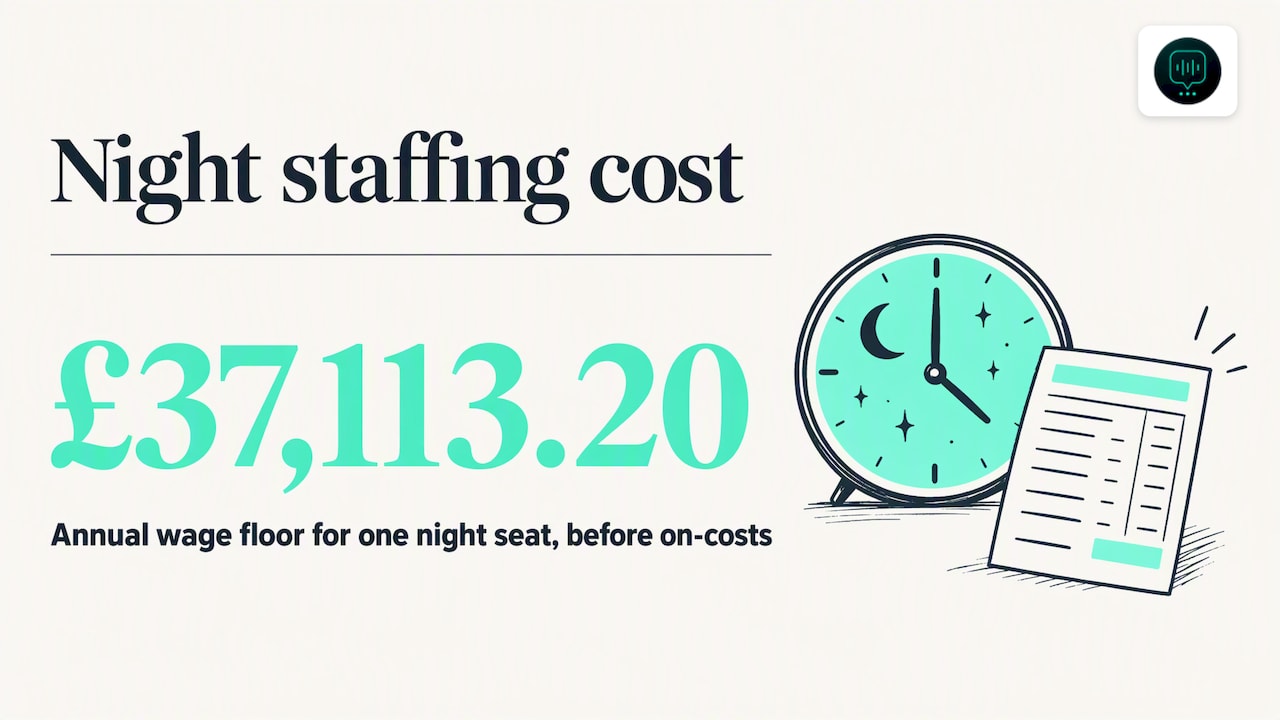
The National Living Wage is £12.71 an hour for workers aged 21 and over from April 2026. Covering one seat from 11pm to 7am, every night of the year, is 8 hours x 365 nights = 2,920 hours. At £12.71 that is £37,113.20 a year. This is our own arithmetic, and it is the floor: it leaves out employer National Insurance, pension contributions, holiday pay and any night premium you choose to offer.
It also assumes one person works every single night, which they cannot. In practice you need at least two or three people to cover a single seat across a week, which pushes the headcount and the cost up again.
The legal duties of night work
Night work brings obligations that daytime rotas do not. Under the GOV.UK rules on night working, anyone who regularly works at least 3 hours in the night period is a night worker, and the night period is 11pm to 6am unless you and the worker agree a different seven-hour period that includes midnight. Night workers’ hours are limited to an average of 8 in each 24, calculated over a 17-week reference period. You must also offer a free health assessment before someone becomes a night worker, and regular ones afterwards. Workers do not have to accept.
There is a safety side too. The Health and Safety Executive notes in its shift work guidance that the risk of fatigue-related problems is higher during the night and towards the end of a shift. For a small firm, that is a lot of administration and risk to carry just to answer the phone.
How the options compare
| Own night staff | Outsourced call centre | Virtual receptionist | AI agent | |
|---|---|---|---|---|
| Answers 24/7 | Only with a full rota | Usually | Check contract hours | Yes |
| Knows your services | Very well | Only what the script says | Moderately | As well as you train it |
| Qualifies urgency | Yes, with judgement | Limited to the script | Limited | Yes, to your rules |
| Books jobs | Yes | Often takes a message only | Sometimes | Calendar booking where set up |
| Covers WhatsApp and web enquiries | Only if staff handle them | Often phone only | Varies | Depends on the service chosen |
| Cost pattern | Highest, fixed | Mid, often per call or per minute | Mid, often a monthly bundle | Lower, usually a flat subscription |
| Main risk | Fatigue, rota gaps, legal duties | Generic handling | Cover gaps | Poor set-up or unclear escalation rules |
Pricing models in the last two columns vary by supplier, so ask for the full cost on a realistic month of calls, not a headline rate.
What to compare before you choose
- Hours and holidays. Does “24/7” include bank holidays and Christmas Day, which is exactly when boilers fail?
- Channels. Customers now phone, message on WhatsApp, use a web form and email. If the service only covers calls, the rest wait until morning.
- Knowledge of your work. Can it tell the difference between your emergency call-out area and a job you do not cover?
- Qualification, not just messages. A name and number is a message. A summary with the problem, address, urgency and photos is a qualified lead.
- Booking. Can it put the job in your calendar, or does someone have to call back?
- Handoff. When a human is needed, does the context travel with the enquiry, so the customer is not asked everything twice? We cover this in more detail in our guide to multichannel customer service and handoffs.
- Spam. Can it filter junk from your enquiry inbox so real work is not buried?
- Follow-up. What happens to the enquiry that did not book first time? See our piece on automated lead follow-up.
- Total cost. Add setup fees, per-minute charges, overage and contract length.
The escalation matrix: the part most owners skip
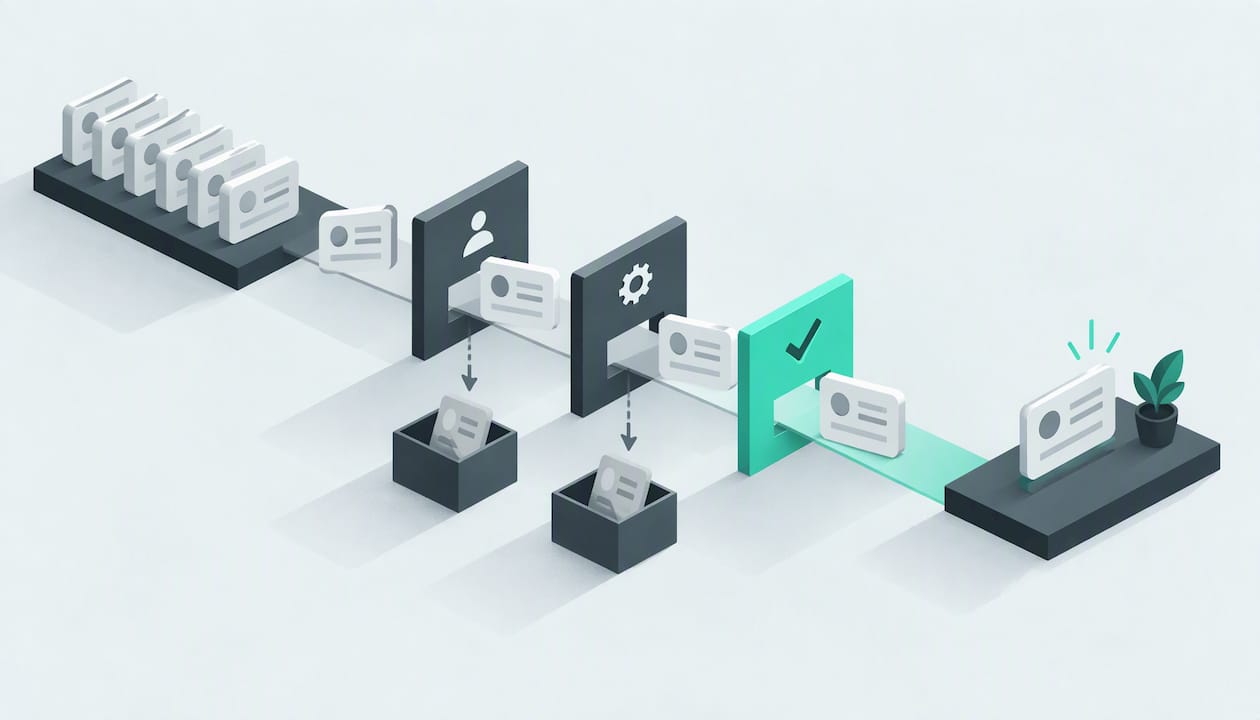
An escalation matrix is a simple table that says what kind of enquiry arrives, who deals with it, how quickly, and who is contacted if that person does not respond. Whoever answers, human or AI, needs one. Without it, “urgent” means whatever the person on the phone thinks it means.
Start with triage at first contact
The Housing Ombudsman’s repairs guidance says a reported repair should be assessed to decide whether a visit is needed and whether it is an emergency or urgent, with any immediate action identified. That is good practice for any maintenance business, not just landlords. Triage at the first contact gives the customer a realistic timeline from the start, which makes later complaints less likely.
A simple matrix you can copy
Adjust the categories and times to your own business. These are example targets, not legal requirements.
| Level | Typical enquiry | First contact | Who acts | If no response |
|---|---|---|---|---|
| 1: Emergency | Flooding, gas smell, no heating for a vulnerable occupant, security breach | Immediate answer, owner or on-call engineer alerted straight away | On-call engineer | Alert the owner, then the backup engineer |
| 2: Urgent | Leak contained, appliance failure, access problem | Same-day callback | Duty office manager | Escalate to the owner at an agreed time |
| 3: Routine | Quotes, regular cleans, planned maintenance | Reply and booking offered straight away, confirmed next working day | Office or booking system | Flag at the start of the next working day |
| 4: Complaint | Customer unhappy with work or response | Acknowledge promptly, record the details | Manager not involved in the original job | Owner reviews |
Note that a gas smell is a call for the gas emergency service, not your rota. Your script should say so, and the matrix should log it.
Response time benchmarks
There is no single legal standard for how fast a private-sector firm must respond. For repairs in a private tenancy, the law does not say how long a reasonable time is; it depends on how serious or urgent the problem is. That is why publishing your own targets matters.
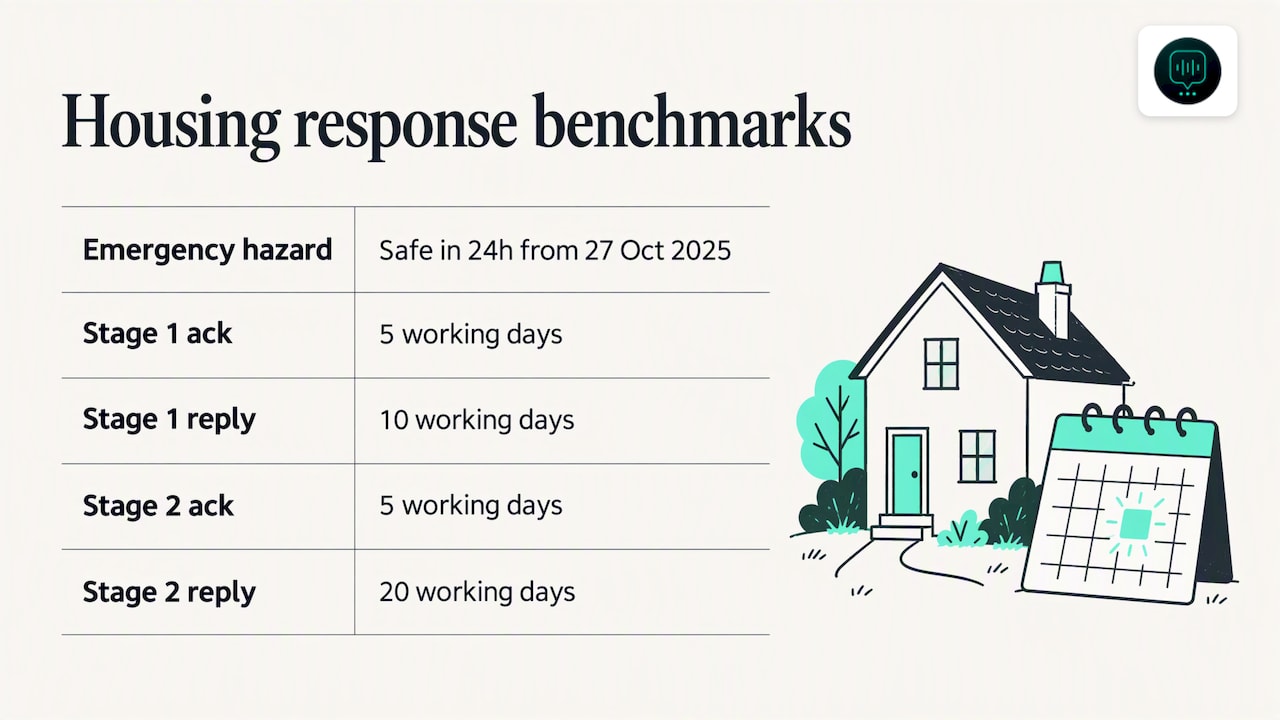
If you work for social landlords or housing associations, their obligations will shape yours. From 27 October 2025, under Awaab’s Law, emergency hazards in social housing must be made safe within 24 hours. Check what your contracts require, because your response times may need to fit theirs.
For complaints, the Housing Ombudsman’s Complaint Handling Code uses two stages: a first-stage response and a final internal review. It sets an acknowledgement time of 5 working days at each stage, 10 working days to respond at stage one and 20 working days at stage two. It applies to landlords, not to trades firms, but it is a sensible model to borrow. Two stages is also what the consumer body CCW recommends for water companies’ formal complaint procedures.
Two habits from that code are worth copying. The stage-two review should be done by someone who was not involved at stage one. And if you cannot meet a timescale, tell the customer the new date and why, rather than going silent.
Make the matrix work for a answering service
Whoever answers for you needs the matrix in a form they can use at 3am:
- A short list of words and situations that always mean Level 1.
- The order of people to contact, and how long to wait before trying the next.
- What to say to the customer while they wait.
- A record of every escalation, so you can review what happened the next morning.
Questions to ask any provider
- Who decides what counts as an emergency, and can I change the rules myself?
- What exactly do I receive after each enquiry: a message, or a summary with urgency and details?
- What happens if the first person on my escalation list does not answer?
- Which channels are covered, and are any of them extra?
- Is there a contract term, a setup fee, or a charge for going over a volume?
- How is my business information stored and who can see it? Ask for their data protection statement, as personal data is involved.
- Can I try it, or see a demo with my own services before committing?
Our view: cover that qualifies, not just answers
We built DeskAgent for the owners we hear from most: people running a van, a cleaning round or a maintenance team who lose work because the phone rings while they are up a ladder, or because a WhatsApp message sat unread overnight. Our view is that the answering itself is the easy part. The value is in what happens in the first minute: understanding what the customer needs, how urgent it is, and getting a clear summary to the person who can act.
That is why we train the system on each business’s own services, coverage and FAQs, and why we ask owners to define their urgency rules before going live. An AI agent that does not know your emergency criteria will guess, and guessing is the wrong answer to a flooded kitchen. If you want the wider picture on out-of-hours enquiries, we have written about after-hours calls and where to set limits.
We also think owners should keep the decisions that need a human: pricing exceptions, safety judgement calls, complaints. The system’s job is to make sure you hear about them quickly and with context.
— Monty Gordon
Where DeskAgent fits
DeskAgent is an AI front desk for UK service businesses. It answers inbound calls, WhatsApp messages and web enquiries around the clock, qualifies leads by intent and urgency, sends your team a detailed summary, books into your calendar, filters spam from email enquiries and follows up automatically. Handoff keeps the context, so customers do not repeat themselves.
You can start with one channel or take everything:
- Web Agent: £85 per month
- Inbox Agent: £85 per month
- Phone Agent: £125 per month
- WhatsApp Agent: £125 per month
- The full DeskAgent system: £285 per month
- Full setup: £500 one-off
The prices are listed on the DeskAgent site, where you can see which agent matches the channel you lose most enquiries on.
FAQ
What is an escalation matrix for customer support?
It is a table that sets out who handles each type of enquiry, how quickly they must respond, and who is contacted next if they do not. For a service business it usually has three or four levels, from emergency to routine, plus a route for complaints.
Is there an escalation matrix template I can use?
The table in this article is a workable starting point. Replace the example enquiries with your own jobs, add the names or roles of the people on each level, and set response times you can actually meet. Then test it by running two or three realistic out-of-hours scenarios.
Can I run 24/7 cover with my own staff?
Yes, but night work has legal obligations, including limits on average hours and free health assessments for night workers. Check the GOV.UK pages and take advice if you are unsure whether your rota creates night workers. Many small firms find that rota gaps and fatigue make it hard to sustain.
Do I need a different service for WhatsApp and web enquiries?
Not necessarily, but check. Many traditional answering services handle calls only. If your customers message you, choose a service that covers those channels and keeps the conversation in one place.
Sources
- GOV.UK: Night working hours
- GOV.UK: Night working health assessments
- GOV.UK: National Minimum Wage and National Living Wage rates
- HSE: Managing shift work, HSG256
- Housing Ombudsman: Repairs and property condition support guide
- Housing Ombudsman: Complaint Handling Code
- Shelter England: How long for repairs in a private tenancy
- Shelter England: Emergency hazards in social housing
- CCW: Complaint reporting guidance for household customers