Last updated
WhatsApp vs SMS for Business: Cost, Reach and UK Rules Compared
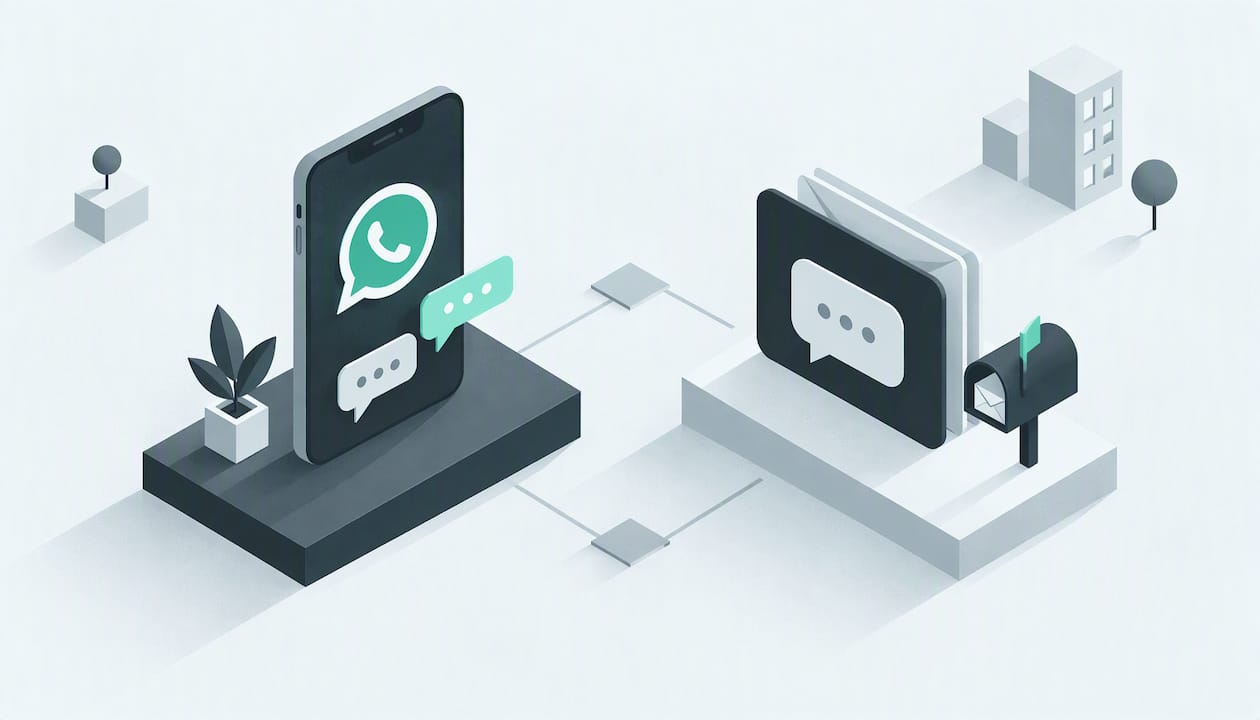
Every enquiry that sits unanswered in the wrong channel is a job a quicker competitor can take. For a trades or service firm, the WhatsApp vs SMS question is really about where customers reply fastest and where your team can keep up.
For most UK service businesses the answer is both, with a clear job for each. SMS reaches any mobile with no app, so it suits short reminders and alerts. WhatsApp suits conversations, because customers can send photos, video and documents in one thread, which makes it quicker to quote and book.
This guide compares reach, cost, features, delivery, consent rules and security, then shows where each fits for a removals firm, a roofer, a drainage company or a cleaning business.
TL;DR
- SMS works on any mobile without an app. WhatsApp needs the customer to have it installed and a data connection, but it is very widely used in the UK.
- WhatsApp suits two-way enquiries: photos of a leak or a roof, documents, voice notes and quick questions. SMS suits short, plain reminders and confirmations.
- Both are regulated. Marketing messages need the right consent under PECR, and WhatsApp adds its own opt-in and template rules on top.
- Cost depends on how you send and how many messages you send, so check current pricing with whichever provider or route you use before committing.
- Most trades do best using WhatsApp for conversations and SMS as a fallback for reminders, with every enquiry answered quickly on whichever channel it arrived.
Table of Contents
- The short answer: what actually differs
- Reach in the UK
- Cost: what actually drives it
- Features side by side
- Delivery and read receipts
- Consent and opt-out rules in the UK
- Security: is WhatsApp safer than a text?
- When to use WhatsApp, SMS or both
- Our view on WhatsApp vs SMS
- Where DeskAgent fits
- A practical way to decide
- FAQ
- Sources
The short answer: what actually differs
SMS is a text message carried by the mobile network. It goes to a phone number, appears in the phone’s messaging app, and needs nothing installed. It is limited to short text, though modern phones can handle some picture messages.
WhatsApp is an app that sends messages over the internet. Customers see your business name or number in an app they already open many times a day. You can send text, images, video, voice notes and documents, and the conversation stays in one thread that your team can scroll back through.
That difference shapes everything else. SMS is the lowest common denominator: it almost always lands. WhatsApp is the better conversation: the customer can send a photo of a blocked drain, you can send back a quote PDF, and nobody has to repeat themselves.
If you want the basics of how automatic replies work on WhatsApp, our guide to setting up a WhatsApp auto reply covers it step by step.
Reach in the UK
Reach has two parts: how many people can receive your message, and how many will actually see it.
On WhatsApp usage, the numbers are strong. Ofcom’s research on how the UK goes online found that WhatsApp was one of the three most commonly used apps among UK adults in 2025, with 90% of adults using it. For a business, that means the large majority of your customers, from a landlord in Leeds to a homeowner in Kent, already have the app.
SMS has a different kind of reach. Ofcom’s 2024 research on application-to-person messages found that 95% of smartphone users were aware of SMS, and that recipients most often received messages from the NHS or healthcare providers. In other words, people are used to receiving appointment-style texts from organisations they trust. That familiarity helps a boiler service reminder or a pest control visit confirmation feel normal rather than spammy.
The practical points:
- No app, no data needed for SMS. An older customer, or someone in a basement flat with poor signal, can still get a text. This matters for tenants and elderly homeowners.
- WhatsApp needs the customer to have the app and a connection. Most do, but not all, and a customer who has never saved your number may not expect you there.
- Customers must be reachable on the channel they choose. The best channel is often the one the customer used to contact you first.
Cost: what actually drives it
Cost is where many comparisons mislead, so it is worth being precise. Neither channel has a single price. What you pay depends on how you send.
SMS is usually charged per message through whichever service or route sends it, and long messages can be split into several parts. WhatsApp costs depend on whether you use the free business app by hand or connect through the business platform for automation, and on the type of message you send. Meta’s pricing has changed over time, so always check the current rates on the official WhatsApp Business pages rather than relying on any article, including this one.
What matters more for a trade business than the per-message price:
- Volume. A cleaning firm sending hundreds of reminders a week will feel per-message cost. A roofer sending a few quotes a day will barely notice it.
- Message type. A reply to a customer who messaged you is treated differently from a message you start. On WhatsApp, business-started conversations need pre-approved templates, according to Meta’s Business Messaging Policy.
- Time. The biggest cost is often the staff time spent typing the same answers, and the jobs lost when nobody replies for hours. Our post on lead response time goes into why replying quickly matters for winning the work.
So do not choose a channel on per-message price alone. A cheaper message that gets no reply costs more than a slightly dearer one that books the job.
Features side by side
| Feature | SMS | |
|---|---|---|
| Needs an app | Yes | No |
| Needs internet | Yes | No, uses the mobile network |
| Photos, video, voice notes | Yes | Limited |
| Documents such as quotes | Yes | No |
| Conversation thread | Yes, easy to scroll back | Basic |
| Business-started messages | Approved templates required | Plain text, subject to marketing rules |
| Works with older phones | Not always | Yes |
| Encryption in transit | End-to-end | Not designed for sensitive content |
For trades, the media row is the one that changes jobs. A drainage firm can ask for a photo of the manhole cover and the wet patch, and a removals firm can ask for a quick video walk-through of the rooms and the narrow stairs. Both help the office quote more accurately before anyone drives out. Doing that over SMS is clumsy at best.
Delivery and read receipts
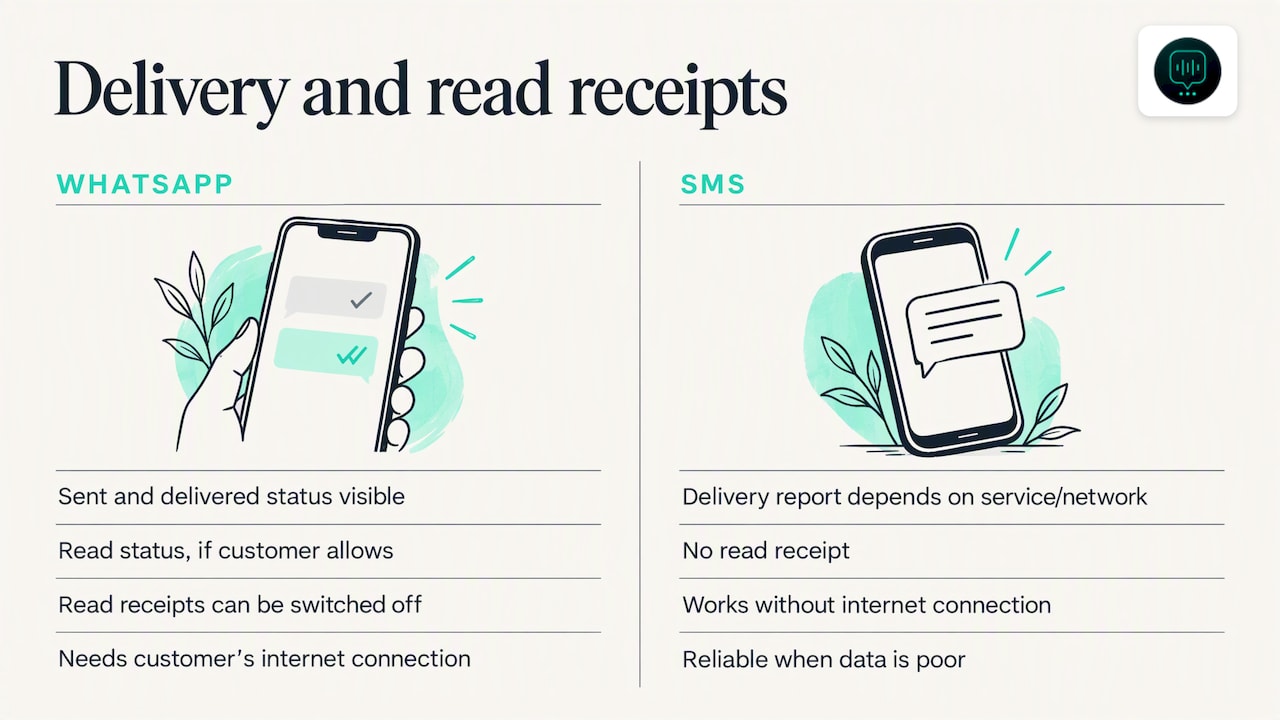
On WhatsApp you can see whether a message has been sent, delivered and, where the customer allows it, read. That is useful for chasing a quote: you know whether it was opened. Customers can switch read receipts off, so a missing read tick does not prove the message was ignored.
SMS gives you less certainty. Whether you get a delivery report depends on the sending service and the network, and there is no read receipt to speak of. What SMS does give you is reliability when data is poor: it does not depend on the customer’s internet connection.
This is why many firms use SMS as a back-up for anything time-critical, such as a same-day arrival window for a plumber or a gas engineer, and WhatsApp for everything that needs a conversation.
Consent and opt-out rules in the UK
This is the part owners most often get wrong, so read it carefully.
Service messages versus marketing. A message that simply confirms or manages a job you have been booked for, such as an arrival time or an appointment reminder, is different from a message promoting your services. The rules bite hardest on marketing.
PECR. Under the Privacy and Electronic Communications Regulations, businesses must not send marketing texts to individuals without specific consent, unless the soft opt-in applies to their own previous customers. The ICO also says the Data (Use and Access) Act 2025 amended PECR so that texts and emails sent but not necessarily received fall within the Regulations, and added a definition of direct marketing as advertising or marketing material directed to particular individuals. If you are unsure whether a message counts as marketing, treat it with care and check the ICO guidance.
WhatsApp’s own rules. Separately from the law, Meta’s policy requires you to obtain the recipient’s opt-in before messaging on WhatsApp, and business-started conversations must use approved templates. Automated replies are allowed within the 24-hour window as long as there is a clear route to a human, such as a phone number, email address, online support or a physical location.
A sensible habit for any trade: record how and when a customer agreed to hear from you, make it easy to say stop, and never add old enquiry lists to a marketing broadcast without checking your consent. Your own data protection duties apply alongside PECR, so if you are in doubt, the ICO’s small business guidance is the place to start.
Security: is WhatsApp safer than a text?
For most day-to-day trade messages, such as a time slot or a photo of a boiler, the risk is low. But it is worth knowing the difference.
The UK National Cyber Security Centre says SMS was not designed to carry high-risk content and has inherent weaknesses, so organisations using it should understand the risks and add controls where appropriate. Its business-communications guidance also warns that SMS and phone systems cannot reliably show who sent a message, which lets criminals impersonate organisations. It recommends keeping links to a minimum and choosing sender names carefully.
WhatsApp says its end-to-end encryption means only you and the person you are messaging can read what is sent. GOV.UK guidance on non-corporate channels takes a balanced view: end-to-end encrypted messaging is likely to be more secure than social-media messaging and consumer email, but you still need to think about device management, data protection and whether the channel suits the information.
In practice: do not send payment details, door codes or full ID documents by text. Keep your own phones locked, and remove former staff from any shared WhatsApp access straight away.
When to use WhatsApp, SMS or both
Here is how it tends to work for lead-driven UK trades.
Use WhatsApp for enquiries and conversations
- Removals. A customer messages asking about a three-bed move. You ask for a short video of the rooms, the parking situation and the stairs, then send back a written quote as a document. All of it sits in one thread.
- Roofing. A homeowner sends photos of a damaged ridge tile after a storm. You can triage urgency from the pictures and book the survey.
- Drainage. A blocked drain is urgent. A quick photo and a location pin help you decide whether it is a same-day job.
- Property maintenance. A tenant reports a fault and sends a photo; the office forwards the details to the right contractor with context attached.
Use SMS for short, plain, time-sensitive notices
- Appointment reminders and arrival windows for a plumber, electrician or heating engineer, where the customer might not check an app.
- Pest control visit confirmations for customers who are less comfortable with apps.
- Cleaning firms reminding a customer that the team arrives tomorrow, with a simple way to reschedule.
Use both when it matters
Send the booking confirmation on the channel the customer used, and use the other as a back-up for the reminder the day before. If a customer does not reply on WhatsApp, a short text is a reasonable nudge, as long as it is a service message and not marketing without consent.
The real danger is not choosing the wrong channel. It is leaving a message unanswered. Our guide to automated lead follow-up explains how to keep replies going out in minutes rather than hours.
Our view on WhatsApp vs SMS
We built DeskAgent because trades lose work in the gaps: the call missed on a roof, the WhatsApp left unread overnight, the email buried under spam. When we talk to owners, the channel debate usually hides the real issue, which is that nobody has time to answer everything quickly.
Our view is simple. Let the customer choose the channel, then answer them there, fast, with the full context kept together. WhatsApp tends to be where customers want a conversation, particularly when a photo helps. SMS remains a dependable way to say something short. Neither helps if the enquiry sits waiting.
We also think owners should stay in control of consent. Do not use a clever tool to blast people who never agreed to hear from you. Use messaging to respond, qualify, book and remind, and keep marketing separate and properly consented.
Monty Gordon, founder of DeskAgent
Where DeskAgent fits
DeskAgent® is a 24/7 AI front desk for UK service businesses. If most of your customers reach you on WhatsApp, the WhatsApp Agent handles those messages, qualifies each lead by intent and urgency, books into your calendar and hands your team a summary with the full context. Other agents cover calls, website chat and email, so an enquiry is picked up whichever way it arrives.
The pricing is fixed. The WhatsApp Agent is £125 a month, the Phone Agent is £125 a month, and the Web Agent and Inbox Agent are £85 a month each. Full DeskAgent, with all four agents plus DeskAgent HQ, is £285 a month. Single agents have no setup fee, because the first month covers the build. There are no contracts, and you can cancel any time.
If you want to start with everything, the Full DeskAgent 3-month pilot is a one-off £500 that covers the build and three months live, then £285 a month.
The free demo is a 30-minute call where we show an agent built for your business. You can book a free 30-minute demo to see how it would handle your own enquiries. For a wider look at how the channels connect, read our guide to multichannel customer service.
A practical way to decide
If you are choosing today, work through these questions:
- Where do your enquiries already arrive? Start with that channel and answer there.
- Do jobs need photos or documents? If yes, WhatsApp is the stronger primary channel.
- Are your customers mostly older or in poor-signal areas? Keep SMS as a reliable fallback.
- Do you send any marketing? Check consent first, record it, and give an easy opt-out.
- Who answers at 7pm on a Sunday? If the answer is nobody, decide how replies will go out. You can book a free 30-minute demo and we will show you what that looks like for your trade.
FAQ
Is WhatsApp better than SMS for a small trade business?
For conversations, usually yes, because customers can send photos, video and documents in one thread, and 90% of UK adults used WhatsApp in Ofcom’s 2025 research. For short reminders, SMS is still dependable because it needs no app. Most small firms get the best results using both for different jobs.
Can I send marketing texts or WhatsApp messages to old customers?
Only if you have the right consent. Under PECR you generally need specific consent for marketing messages, with a limited soft opt-in for your own previous customers. WhatsApp also requires opt-in and approved templates for business-started messages. Check the ICO guidance before sending anything promotional.
Is WhatsApp more secure than a normal text?
WhatsApp uses end-to-end encryption, while the NCSC says SMS was not designed to carry high-risk content. That makes WhatsApp the safer choice for most customer conversations. Even so, avoid sending payment details or door codes by either channel.
Which is cheaper for a business, SMS or WhatsApp?
It depends on how you send and how many messages you send. SMS is generally charged per message by the sending service, and WhatsApp costs vary by message type and how you connect. Check the current pricing with your provider rather than relying on a general comparison, and weigh it against the cost of slow replies.
Do I need to use both channels?
Not necessarily, but it helps. Reply on the channel the customer used, and keep the other as a back-up for time-critical reminders. What matters most is that every enquiry gets a quick, clear answer.
Sources
- Ofcom: From apps to AI search, how the UK goes online in 2025
- Ofcom: Application to Person (A2P) Message Recipient Research
- ICO: Electronic mail marketing
- ICO: Privacy and electronic communications, Data (Use and Access) Act 2025
- WhatsApp Business Messaging Policy
- NCSC: Protecting SMS messages used in critical business processes
- NCSC: Business communications, SMS and telephone best practice
- WhatsApp: Security
- GOV.UK: Using non-corporate communication channels
Recommended
- WhatsApp Shared Inbox: How Teams Share One Business Number
- WhatsApp Auto Reply: How to Set It Up for Your Business
- AI Front Desk: What It Is and How It Works for Service Firms
- Multichannel Customer Service for UK Service Firms: Fix Handoffs