Last updated
Capture Leads from Missed Calls: 6 Fixes for UK Trades
A missed call from someone with a leaking roof, a blocked drain or a move date to book is a job heading for the next firm on Google. Callers rarely wait around: Which? tells homeowners to get at least three quotes, so if you don’t respond quickly, someone else will.
You capture leads from missed calls in layers: forward calls to someone who can answer, send a missed call text back within minutes, use a voicemail greeting that asks for the right details, and add 24/7 answering for the times nobody can pick up. Then give every caller a named person and a next step.
This guide covers all six fixes, with examples from removals, roofing, drainage and cleaning, plus the UK texting rules to check before you automate anything.
DeskAgent® is an AI front desk for UK service businesses, so we see this problem daily. The advice below works whether or not you ever use our product.
TL;DR
- A missed call is not automatically a lost job, but a caller with a leaking drain or a damaged roof will usually ring the next firm if nobody responds quickly.
- Layer your fixes: forwarding first, then a missed call text back, then a voicemail greeting that asks for the right details, then 24/7 answering.
- Every missed call needs one owner, one next action and a time, otherwise the text or voicemail just stores a problem.
- Texts that reply to an enquiry are service messages, not marketing, but keep them free of promotions and read the ICO guidance.
- Track what happens to each enquiry, not just how many calls you missed.
Table of Contents
- Why missed calls cost you jobs
- Way 1: Make call forwarding work for you
- Way 2: Send a missed call text back
- Way 3: Fix your voicemail so it earns its keep
- Way 4: Use 24/7 AI answering
- Way 5: Build a follow-up routine
- Way 6: Track what happens to each enquiry
- UK texting rules: what to check before you automate
- Which layer should you start with?
- Our view: capture first, qualify second
- Where DeskAgent fits
- FAQ
- Sources
Why missed calls cost you jobs
Most people who ring a trades firm have a problem they want fixed. A removals customer is comparing two or three firms for a date. A homeowner with a roof leak is looking at the ceiling. A landlord with a blocked drain has a tenant chasing. Those callers are not browsing, and they rarely leave a message and wait politely.
The pattern is simple. If you are on a ladder, under a sink or driving between jobs (where holding a phone at the wheel is illegal), the phone rings out. The caller tries the next name on the search results. The first firm to respond usually has the advantage, because the caller is still in buying mode. We cover that in more detail in our post on why replying in minutes wins the job.
Not every missed call is a lost job, though. Some are sales calls, wrong numbers or suppliers. Some are existing customers who will ring back. That matters because the aim is not to chase every ring, it is to separate real enquiries from noise quickly and spend your time on the ones that can become work.
Three situations produce most missed calls in service firms:
- On-site and busy. You or your engineer cannot safely or politely answer. Common for roofers, electricians and drainage crews.
- Peaks. Several calls land at once, such as Monday morning or after a storm, and the office can only take one.
- Out of hours. Evenings, weekends and early mornings, when many people do their research and ring around.
Each calls for a slightly different fix, which is why a layered approach beats a single tool.
Way 1: Make call forwarding work for you
The cheapest fix is making sure the phone rings somewhere useful. Most UK business lines and mobile networks let you divert calls when you are busy or unanswered, either to another mobile or to a second person.
Set it up with some thought:
- Decide who is second in line. For a small plumbing firm that might be a partner or office admin. For a removals firm it might be the person who does the quoting.
- Use “no answer” and “busy” forwarding, not just permanent diverts, so the first person still gets the first chance.
- Check the ring time. If your phone rings for too long before diverting, callers may hang up first. Test it from a different phone.
- Agree what the second person does. They need to know your services, coverage area and how you book jobs, or they will just take a message.
The weakness of forwarding is that it moves the problem rather than solving it. If both of you are on jobs, the call still goes unanswered. It is a good first layer, not a full answer. If you would rather pay for a person to answer, compare a virtual receptionist vs an AI receptionist.
Way 2: Send a missed call text back
A missed call text back is an automatic text that goes to the caller soon after a call goes unanswered. It tells them you have seen the call, and invites them to reply or book. It does not answer the question, but it keeps the caller engaged for a few minutes longer.
A good text is short and honest. It should:
- name your business, so the caller knows who is replying;
- acknowledge the call;
- invite a simple reply, such as describing the job or its postcode;
- set a realistic expectation of when a person will respond.
For example, a drainage firm might send: “Hi, this is Northside Drainage. Sorry we missed your call. Reply with your postcode and what’s happening, and we’ll get back to you this morning.” That is a sample, not a template you must follow, and you should only promise a time you can keep.
Two limits are worth knowing. First, texts only reach mobiles, so a caller on a landline will not see it. Second, a text acknowledges, it does not book. Replies need an owner. If nobody reads them, you have built a faster way to ignore customers.
Way 3: Fix your voicemail so it earns its keep
Voicemail has a bad reputation, and for good reason: many callers will not leave a message. But a clear greeting that tells people exactly what to say can still recover a fair number of enquiries, especially from callers who really need the work done.
A useful greeting does three things:
- says who they have reached and what you do, so they know they have the right firm;
- asks for the details you need to quote or prioritise, such as name, number, postcode and a one-line description of the job;
- says when they can expect a call back, if you can keep that promise.
A roofing firm might ask callers to say whether water is coming in now, because that changes the priority. A cleaning business might ask whether the property is domestic or commercial and how large it is.
Then make a habit of checking it. A voicemail left at 8am and returned at 4pm is not much better than no voicemail. Set a fixed time, or a fixed trigger such as every time you leave a job, to listen and return calls.
Way 4: Use 24/7 AI answering
Forwarding, text back and voicemail all share one limit: they leave the caller waiting for a person. AI answering closes that gap by picking up the call or message straight away, at any hour.
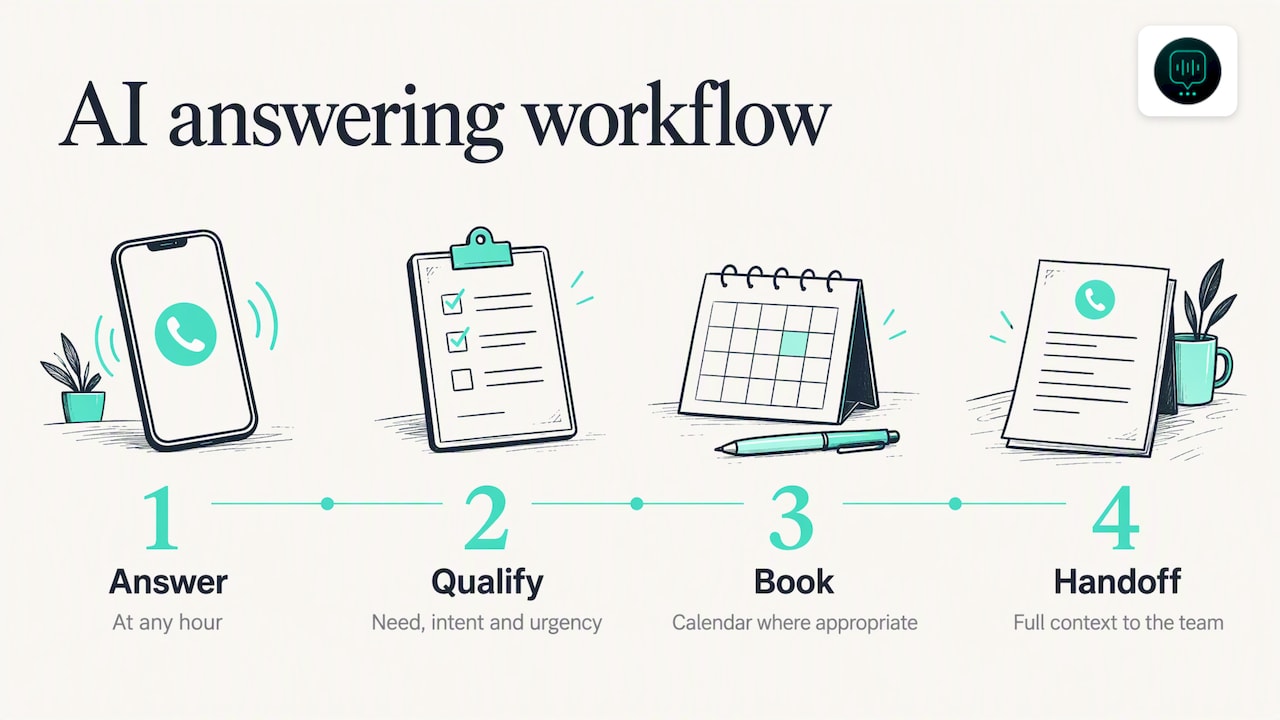
With a system like ours, the caller speaks to an agent trained on your services, coverage area and FAQs. It asks what they need, qualifies the enquiry by intent and urgency, books into your calendar where appropriate, and hands your team a summary with the full context, so nobody has to ask the same questions again. An enquiry that arrives at 11pm with a flooded kitchen can be marked urgent, while a quote request for next month can wait for the morning.
It also helps beyond the phone. Customers increasingly message on WhatsApp, use website chat or email, and an enquiry that comes in on any of those channels is just as easy to miss as a ringing phone. We go into more detail on this in our guide to what an AI front desk is and how it works.
To be fair about the trade-offs: AI answering is a front desk, not a replacement for your team. It captures, qualifies and passes on. You still do the job, give the final quote and build the relationship. And you should set it up with your own prices, coverage and rules so it says what you would say. If you are weighing cost, our AI receptionist pricing guide lays out what service firms typically look at.
What it looks like in practice
Take a removals firm. Calls often come while the crew is mid-lift. An answering agent can ask the collection and delivery postcodes, the date, the size of the home and whether packing is needed, then pass the owner a clear summary to price from. The owner calls back with a quote rather than starting from scratch.
Take a plumber at a boiler install. A caller reports no hot water. The agent captures the address, the fault and how urgent it is, and the plumber sees it at the next break. For the full phone side of this, see how the Phone Agent works.
If you would like to see this applied to your own business, you can book a free 30-minute demo. It is a call where we show an agent built for your business.
Way 5: Build a follow-up routine
Whatever captures the enquiry, the routine behind it decides whether it becomes a booking. A simple, repeatable sequence works well for small firms:
- Instant acknowledgement. An automatic text or message as soon as the call is missed or the enquiry arrives.
- A live callback. A person rings back as soon as they can. Many firms aim for within minutes during working hours, but only set a target you can actually meet.
- A final nudge. If the caller does not answer, send one short text and log the attempt. Do not keep chasing.
- A clear outcome. Booked, quoted, not suitable or no response. Record it.
Give each enquiry one owner and one next action with a time. If it is “someone will ring them”, nobody will. If it is “Dave rings at 10.30”, it happens.
Capture the same basics every time: name, number, what they need, postcode, how urgent it is and whether they want to book now. Agree in advance what makes a lead worth pursuing, such as being inside your area, within your minimum job size and wanting work in a sensible timeframe. That keeps you from spending an hour on a job you could never take. We cover this in depth in our guide to AI lead qualification for service businesses, and the follow-up side in our post on automated lead follow up.
Automation keeps the conversation alive, but a human should still watch the replies and finish the job of following up.
Way 6: Track what happens to each enquiry
You cannot improve what you do not count, but be careful what you count. A missed call is not the same as lost revenue, because some callers were never going to buy. A better measure is what happened to each enquiry.
Once a week, look at the same date range and note:
- how many real enquiries came in, by phone, WhatsApp, web chat and email;
- how many were suitable for the work you do;
- how many got a quote;
- how many booked;
- how many ended in paid work.
Keep “unknown” as its own category so you are not fooling yourself. Over a few weeks you will see where leads fall out. Maybe quotes go out slowly, or Monday mornings are the real problem, or callers from one postcode area never book. A weekly look is more useful than checking only when work feels quiet.
UK texting rules: what to check before you automate
If you send texts to people who ring you, the rules matter. In the UK, the Privacy and Electronic Communications Regulations (PECR) cover electronic marketing, and the ICO publishes guidance on them. The ICO texting rules set out what counts as direct marketing and what you need to do when you send it.
The key distinction for a trades firm is between a service message and a marketing message. The ICO says routine customer service messages do not count as direct marketing, as long as they do not include significant promotional material. A text that says you missed their call and asks what they need is a reply to their enquiry. A text that slips in a discount or a seasonal offer starts to look like marketing.
In practice:
- keep your missed call texts about the enquiry only;
- do not add promotions to them;
- if you want to send genuine marketing later, such as a reminder to book a boiler service, the ICO says consent must be freely given, specific and informed, with a clear opt-in action, so check the guidance first;
- keep a record of what you sent and when.
This is general information, not legal advice. If you are unsure about a specific message or campaign, check the ICO guidance directly or take advice from a data protection professional.
Which layer should you start with?
You do not need all six at once. A sensible order for most small firms:
| Situation | Start with |
|---|---|
| Owner-operator, one phone, mostly on site | Voicemail greeting and a missed call text back |
| Two to five staff, calls stack up at peak times | Forwarding, a call-back routine and an owner for each enquiry |
| Calls, WhatsApp, web chat and email all missed at times | 24/7 AI answering across channels |
| You are not sure where leads are lost | Weekly tracking before you buy anything |
A drainage firm with one van might be fine with a good voicemail and a text back. A roofing company that gets a surge of calls after bad weather will probably outgrow that quickly. A cleaning business handling lots of quote requests across email, web chat and WhatsApp has a different problem again: volume, not just missed rings.
If your issue is mostly out of hours, our post on after hours calls for service owners goes through how to capture leads while setting sensible limits.
Our view: capture first, qualify second
We built DeskAgent because we kept seeing the same thing in service firms: the work was good, the phone was the weak point. Owners were not ignoring customers. They were doing the job they were paid to do.
Our view is that the first goal is never to lose the enquiry. Capture the name, the need and the urgency, and then decide what is worth chasing. Trying to qualify by leaving callers on hold or in a voicemail maze loses people before they have said anything useful.
We also think AI should hand over, not hold on. The best result is a team member who picks up a summary, knows what the caller wants and can ring back with the right answer. It should not claim to replace you, and no tool can promise a set number of extra jobs. What it can do is make sure the enquiry is captured and the context reaches you.
Missed calls are rarely a motivation problem. They are a capacity problem, and the fix is making sure someone or something is always there to take the first step.
Monty Gordon, founder of DeskAgent
Where DeskAgent fits
DeskAgent has four agents. The Phone Agent answers inbound calls, the WhatsApp Agent handles WhatsApp messages, the Web Agent runs website chat and the Inbox Agent reads email enquiries, filters spam and replies. DeskAgent HQ lets you run it from WhatsApp: update prices and FAQs, pause it and get a daily lead summary.
Prices are fixed. The Web Agent and Inbox Agent are £85 a month each. The Phone Agent and WhatsApp Agent are £125 a month each. Full DeskAgent, with all four agents plus DeskAgent HQ, is £285 a month. Single agents have no setup fee, because the first month covers the build. There is also a Full DeskAgent 3-month pilot: a one-off £500 that covers the build and three months live, then £285 a month. There are no contracts and you can cancel any time. See the full breakdown on the pricing section.
If you want to see how it would handle your calls, you can book a free 30-minute demo and we will show you an agent built for your business.
FAQ
Can a missed call really still become a job?
Yes, if you respond quickly and the caller is still looking. A text, a callback or an AI agent picking up can keep them from ringing round. Some missed calls are not real enquiries, so the aim is to sort the genuine ones fast.
Is a missed call text back legal in the UK?
A text that simply replies to someone who has just rung you about work is a service message, which the ICO treats differently from direct marketing as long as it has no significant promotional content. Keep it short and about their enquiry. For anything promotional, check the ICO guidance on consent first.
I’m a one-man roofer. Do I need AI answering?
Not necessarily. A good voicemail greeting, a text back and a set time each day to return calls may be enough at first. AI answering starts to make sense when you are regularly missing calls on site, getting enquiries across several channels, or losing out of hours.
What should I ask a caller so I can quote properly?
Take their name and number, what they need, the postcode, how urgent it is and whether they want to book now. Trade-specific details help too: for removals, the collection and delivery addresses and date; for drainage, whether anything is overflowing; for cleaning, the property type and size.
Do I have to sign a contract for DeskAgent?
No. There are no contracts and you can cancel any time. Single agents have no setup fee because the first month covers the build.
Sources
- ICO: how do we comply with the PECR electronic mail marketing rules
- ICO: electronic and telephone marketing
- GOV.UK: using mobile phones when driving, the law
- Which?: how to find a reputable trader