Last updated
Virtual Receptionist vs AI Receptionist: Costs, Cover and Fit
Every call that rings out while you are on a job is a quote you may never get to give. That is why so many small firms look at outsourcing their phones, and the choice usually comes down to a virtual receptionist vs an AI receptionist.
The short answer: a virtual receptionist is a real person at an outside service who answers in your company name, and suits calls that need judgement or a human voice. An AI receptionist is software that answers instantly at any hour, asks your questions, qualifies the enquiry and books the job, usually for a flat monthly fee. Many trades get the best result from AI first contact with a person for the awkward calls. This guide compares cost, availability, difficult calls, caller preferences, setup and data protection, and the third option many small firms start with: hiring someone yourself.
TL;DR
- A virtual receptionist is a human answering service. An AI receptionist is software that holds the conversation and books into your calendar. They are different tools, not two names for one thing.
- Human services tend to charge by the minute, call or bundle. AI services tend to charge a flat monthly amount. Hiring in-house carries wages plus employer costs on top.
- AI handles many calls at once and answers at 2am. A human is better when a caller is upset, confused or has an unusual problem.
- Many trades get the best result by letting AI take the first contact and passing the awkward calls to a person.
- Whichever you pick, tell callers if calls are recorded and know who in your business is responsible for the data.
Table of Contents
- What a virtual receptionist actually does
- What an AI receptionist does
- Cost: virtual receptionist, AI receptionist and hiring in-house
- Availability and call volume
- How they handle complex calls
- What callers say they prefer
- Setup, contracts and data protection
- Which is better for your type of business?
- Using both: the hybrid approach
- Our view
- Where DeskAgent fits
- FAQ
- Sources
What a virtual receptionist actually does
A virtual receptionist is a trained person, usually in a shared team, who answers calls for several businesses. They greet the caller with your company name, take a message or ask a short set of questions you have agreed, and pass the details on by email or text. Some can transfer an urgent call to your mobile or put a booking in a diary you control.
The strength is obvious: a human voice, a bit of judgement and the ability to calm someone down. The limits are practical. The person answering is covering several firms, so they know your business from a script and a notes page, not from working in it. A caller asking whether you cover a particular postcode for a tree-damaged roof, or whether your van can take a piano up a narrow staircase, may get a polite promise of a call back.
Cover also depends on the plan. Many human services run office hours or extended hours, and round-the-clock cover usually costs more because it needs people on shifts.
What an AI receptionist does
An AI receptionist answers in a synthetic voice, or on chat, WhatsApp or email, and works through a conversation: what the job is, where it is, how urgent it is, and when the customer is free. It then books into your calendar or passes a summary to your team.
It does not tire, take lunch or put one caller on hold while it talks to another. If five people ring at once during a storm, all five are answered. That is the main structural difference, and it matters most for firms whose calls arrive in bursts.
The limits are also real. AI is only as good as what it has been told about your services, areas and prices. It can handle repeatable enquiries well, but a caller who wants to talk through a bereavement-related house clearance, or who is furious about a previous job, usually wants a person. We come back to that below.
Cost: virtual receptionist, AI receptionist and hiring in-house
Cost is where the three options differ most, so it is worth separating how each is charged from what it comes to.
How each option is typically charged
| In-house receptionist | Virtual receptionist | AI receptionist | |
|---|---|---|---|
| Charged by | Salary plus employer costs | Per minute, per call or monthly bundle | Usually a flat monthly subscription |
| Cost rises when | You add hours or cover | Call volume goes up | You add channels |
| Hours covered | The hours you pay for | Plan hours, with 24/7 costing more | Around the clock |
| Holiday and sickness | You arrange cover | Provider arranges cover | Not applicable |
| Training | You do it | Script and notes page | Built around your services and FAQs |
We have deliberately not put pounds in the human service columns. Pricing varies widely by provider and by plan, and it changes. Ask for a quote based on your own call volume, and check what happens when you go over your allowance, because overage charges are where the bill tends to drift.
What hiring someone yourself involves
The cheapest-looking option is rarely the cheapest. The statutory floor alone is £12.71 an hour for workers aged 21 and over from April 2026, according to GOV.UK, and a real receptionist on a trades-firm wage will earn above that. On top of wages you carry employer National Insurance, workplace pension contributions, paid holiday, sick pay and the time it takes to recruit and train. GOV.UK’s guide to employing staff for the first time walks through the registration, payroll and insurance steps before you take anyone on.
Then there is coverage. One full-time employee covers a working week, not the evenings, weekends and bank holidays when many drainage, heating and emergency roofing enquiries arrive. Hiring a second person for cover doubles the problem rather than solving it.
What an AI front desk costs
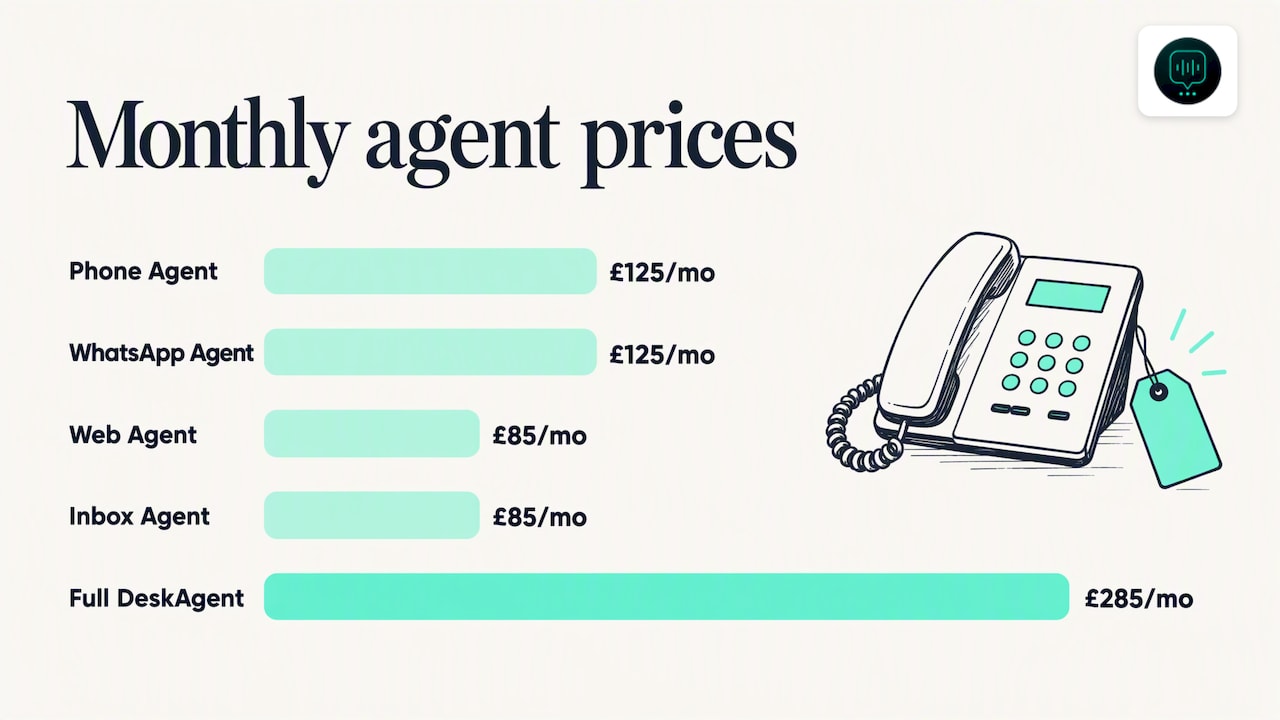
Our own prices are fixed and published, so there is nothing to guess. At DeskAgent®, the Phone Agent is £125 a month and the WhatsApp Agent is £125 a month. The Web Agent and the Inbox Agent are £85 a month each. Full DeskAgent, which is all four agents plus DeskAgent HQ, is £285 a month. Single agents have no setup fee, because the first month covers the build. There are no contracts and you can cancel any time. The pricing page has the full breakdown, and our guide to what AI receptionists cost UK service firms explains what drives the difference between providers. For named services such as Moneypenny and Smith.ai, see our DeskAgent comparisons.
Availability and call volume
This is the area where the two options feel most different in daily use.
Out-of-hours. A human service answers when its staff are working. If your plan is office hours, a call at 9pm about a burst pipe goes to voicemail or an out-of-hours message. A 24/7 human plan fixes that, at a price. AI answers at 9pm the same way it answers at 9am.
Simultaneous calls. A human receptionist handles one call at a time. When two people ring together, one waits or leaves a message. For a roofer after a gale, or a drainage firm on the morning after heavy rain, calls bunch together. Software can answer them in parallel. Callers who get voicemail often ring the next firm on the list, so the call you miss is not simply postponed.
Speed. AI picks up straight away. A human service usually answers within a few rings, but that is not something we can promise for any provider, and we do not promise a response time for ours either. What you can do is test: ring each option at awkward times and see what happens.
Channels. Customers no longer only ring. They message on WhatsApp, use the chat box on your website and email a quote request. A virtual receptionist is usually a phone-first service. An AI front desk can cover the phone, WhatsApp, web chat and email in one place, so the customer who messages at midnight gets an answer too. Our guide on fixing handoffs between channels shows why this matters when the same customer contacts you twice.
How they handle complex calls
A useful way to judge any receptionist is to imagine your three most awkward calls this month.
A removals enquiry. A customer wants a quote for a three-bedroom move in six weeks, with a piano, a loft full of boxes and a buyer who might pull out. A human can reassure and sense hesitation. An AI receptionist can still ask the right questions: dates, addresses, floors, access, large items and flexibility. It then hands your team a summary so nobody has to ring back to ask the basics.
A roofing emergency. Water is coming through a ceiling. The caller needs to know whether someone can come today. Urgency is the whole point of the call. Either option can flag it, but what matters is what happens next: does a person get an alert straight away, and does the caller know what to expect? Agree this before you go live, whichever route you choose.
A drainage complaint. A landlord is angry because a previous repair failed. This is a conversation about trust, not a booking. A person is the better first voice here.
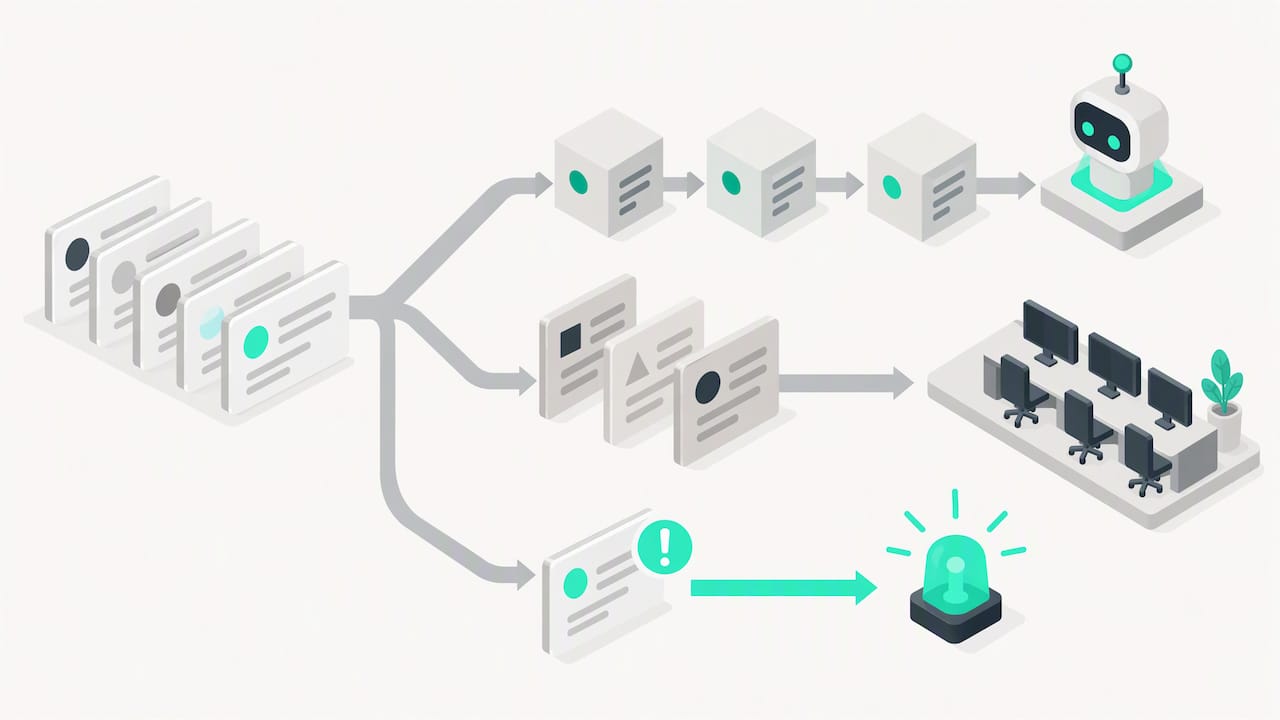
The pattern is consistent. AI is strong on structured, repeatable enquiries where the questions are known. People are stronger where emotion, ambiguity or negotiation is the heart of the call. Our piece on qualifying leads with AI covers how intent and urgency are sorted so the right enquiries reach you first.
What callers say they prefer
It would be convenient to claim customers do not mind talking to software. The evidence says otherwise. A survey of 6,000 adults in the US, Canada and UK, carried out by OnePoll and published by Keep Service in October 2025, found that 85% preferred a real person when contacting a local service, and 33% said they would hang up if connected to AI. It is a survey of stated preference, and the sample covers three countries, not only the UK, so treat it as a direction rather than a UK measure.
What should you do with that? Two things. First, make sure a person can step in when a caller wants one. Second, remember the alternative to an AI answer is often not a human answer, but voicemail at a moment when you are up a ladder or on a job. A prompt, accurate response, followed by a quick human call back, is a better experience than a ring that nobody picks up.
Setup, contracts and data protection
Before you sign anything, check five practical points.
- Contract length. Many human services use monthly or longer terms, and some set minimum call allowances. Ask what you pay in a quiet month.
- Setup. Find out who builds the call flow, who loads your services, coverage areas and FAQs, and how long it takes.
- Diary and tools. Check whether bookings go straight into your calendar or arrive as messages you have to copy across.
- Out-of-scope calls. Decide what is passed straight to you, and how: a text, a call, a summary.
- Call recording and data. This applies to both options.
On the last point, the ICO is clear that anyone recording business calls needs a justified purpose, such as evidence of a transaction, training or quality control. Callers must be told that calls are recorded and why, and further privacy information such as retention periods can be provided by other means. If an outside service answers for you, find out whether it records, where the recordings go and how long they are kept.
If you use AI, responsibility stays with you. The ICO’s guidance on governance and accountability in AI says organisations must assign responsibility and manage data-protection risks, including the risk that staff do not understand their duties. In a small firm that means naming one person who owns it and making sure anyone who sees customer details knows the basics. Short GDPR training for staff is a straightforward way to cover that, and the ICO’s advice for small organisations sets out what the law expects.
Which is better for your type of business?
There is no universal winner, but there are clear patterns.
| Your situation | Likely best fit |
|---|---|
| Calls arrive in bursts (storms, end-of-month moves, seasonal peaks) | AI, because it answers many calls at once |
| Most work is repeat enquiries with known questions (cleaning, pest control, boiler servicing) | AI |
| You need after-hours cover without paying for night shifts | AI |
| Customers are often upset, vulnerable or negotiating | Human, or AI with fast handover |
| You want a person to act on your behalf in complicated conversations | Human service or in-house |
| You take enquiries by WhatsApp, web chat and email as well as phone | AI across channels |
| You have a large office team already and calls are steady | In-house, possibly with AI for overflow |
A small cleaning firm with a steady stream of quote requests and no office staff is the clearest case for AI first. A drainage company with emergency work and long-term landlord clients might want a person involved in the harder calls. A property maintenance firm managing tenants for a letting agent probably needs both.
Using both: the hybrid approach
You do not have to choose. The set-up that works for many small firms is simple.
- AI answers first, every time, on every channel.
- It asks the standard questions, flags urgency and books routine jobs.
- Anything sensitive, complicated or unusual is passed to a person, with the full context so the customer does not have to repeat themselves.
- The person might be you, an office manager or an outside human service that takes overflow or specific call types.
The benefit is that people spend their time on conversations that need them, not on asking every caller for a postcode. An AI front desk can also send automated follow-ups, which keeps enquiries moving when you are busy. Our guide to automated lead follow-up sets out how this works in practice. If you are weighing an overnight human service as the second layer, our look at 24/7 answering services for UK small businesses explains what to ask.
Our view
We build an AI front desk, so you should read this section knowing that. We think the best question is not “human or machine?” but “what happens to the call I cannot answer?” For a trades firm, that call is usually from someone who needs a quick answer, rings the next firm if they do not get one, and is not interested in how your office is organised.
What we see is that most enquiries to service businesses are repetitive: what is the job, where is it, how soon, and when are you free? That is the kind of work software does well. What is not repetitive is the relationship, and that stays with your team. So we build DeskAgent to do the first part and hand over the second with a full summary, not to replace your people. DeskAgent HQ lets the owner run it from WhatsApp: update prices and FAQs, pause it and check today’s leads. Each agent is trained on your services, coverage and FAQs, so it answers as your business would, not as a generic script.
We would also rather you tested it than took our word. In the free demo, a 30-minute call, we show an agent built for your business, so you can judge the call quality yourself.
Monty Gordon, founder of DeskAgent
Where DeskAgent fits
If calls are your biggest gap, the Phone Agent answers inbound calls around the clock, qualifies by intent and urgency, books into your calendar and hands your team a summary. At £125 a month, with no setup fee and no contract, it is a sensible place to start. If you also want WhatsApp, web chat and email covered, Full DeskAgent is £285 a month. If you want to see it running before you decide, you can book a free 30-minute demo. Prefer to test with a full set-up first? The Full DeskAgent 3-month pilot is a one-off £500 covering the build and three months live, then £285 a month. You can cancel any time.
For a wider look at how the pieces fit, read our practical UK guide to AI receptionists for small business. You can also book a free 30-minute demo to see an agent set up for a removals, roofing, drainage or cleaning business like yours.
FAQ
Is a virtual receptionist the same as an AI receptionist?
No. A virtual receptionist is a real person, employed by an outside service, who answers calls for several businesses. An AI receptionist is software that holds the conversation itself. The names sound similar, which is why many owners assume they are the same thing.
Will my customers know they are talking to AI?
They should, and DeskAgent’s agents always say they are an AI if a caller asks. Some callers will still mind: survey evidence suggests many people prefer a person when contacting a local service, so it is sensible to make it easy for a caller to reach someone on your team. Being open about it, and making sure urgent or sensitive calls go to a person quickly, protects the customer experience.
Can an AI receptionist take a job booking, or only a message?
It can do more than take a message. DeskAgent qualifies each enquiry by intent and urgency, books into your calendar and gives your team a summary with the full context. Complicated or sensitive calls are better picked up by a person, so you decide what gets passed over.
Do I need to tell callers if calls are recorded?
Yes, if you or your provider records calls. The ICO says callers must be told that calls are recorded and why, and you need a justified purpose. Check with any provider, human or AI, whether they record and how long they keep recordings.
Is it cheaper to hire someone than to use a service?
Only if you need cover for set hours and call volumes are steady. Wages are only part of the cost: employer costs, holiday, sickness and recruitment all add up, and one employee cannot cover evenings and weekends. Compare the full cost of each option against the hours you actually need.
Sources
- GOV.UK: National Minimum Wage and National Living Wage rates
- GOV.UK: Employing staff for the first time
- Keep Service: AI survey report, October 2025
- ICO: Specific data protection considerations for different ways or methods of monitoring workers
- ICO: Governance and accountability in AI
Recommended
- AI Receptionist Pricing UK: What Service Firms Actually Pay
- AI Front Desk: What It Is and How It Works for Service Firms
- AI Lead Qualification for Service Businesses: A UK Guide
- Automated Lead Follow Up for Service Businesses: Reply in Minutes