WhatsApp Consent Wording UK: Opt-In Examples
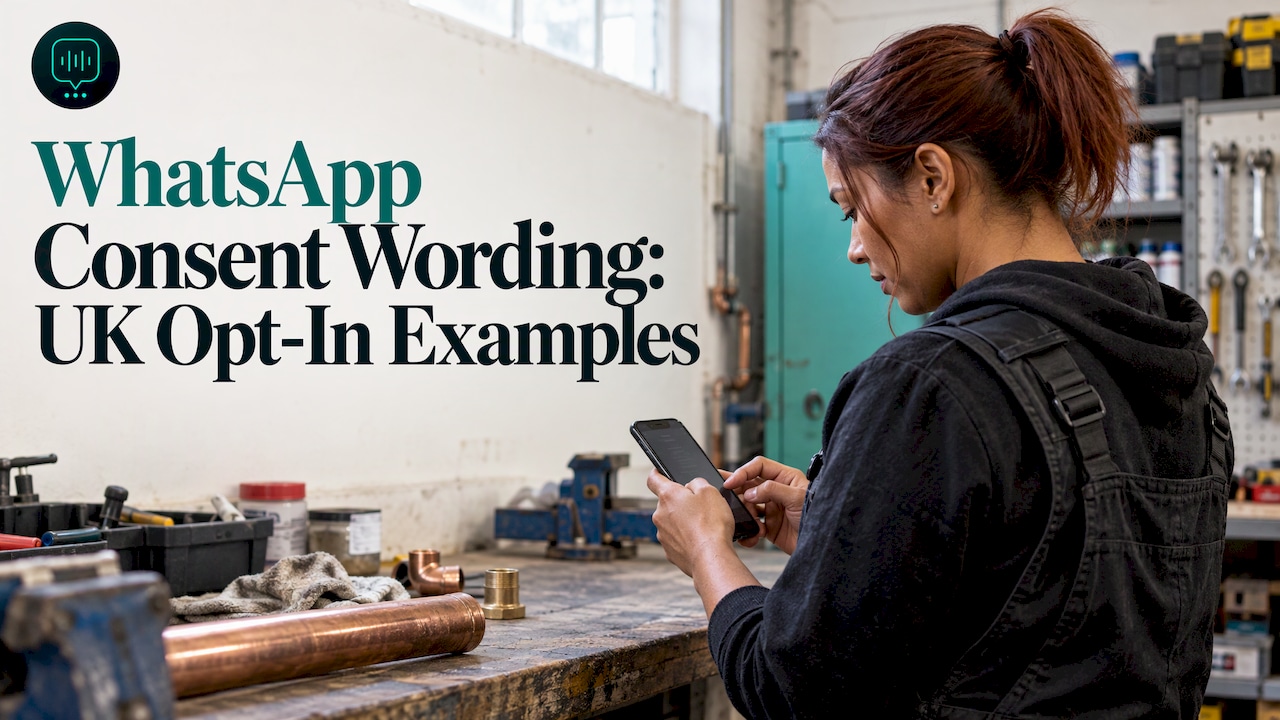
Replying to a customer who messaged you first is a service conversation and needs no marketing consent. Sending offers later is marketing and needs clear opt-in wording, or a properly handled soft opt-in. Below are five copy-and-paste wordings for UK trades, removals and cleaning firms, plus how to record and remove consent.
TL;DR
- Answering an enquiry, confirming a booking or sending an arrival time is a service message. Adding an offer to it turns it into marketing.
- Marketing on WhatsApp needs either clear, specific opt-in consent or a correctly used soft opt-in, with an easy way to say no every time.
- A customer messaging you first, or handing over their number for a quote, is not consent to receive offers later.
- Keep a record of who opted in, when, where and to what wording, and make stopping as easy as starting.
- This guide is plain-English information for business owners, not legal advice. For a specific situation, check the ICO guidance or take advice from a solicitor.
Table of Contents
- What is the difference between replying to a customer and marketing to them?
- Service or marketing: which WhatsApp messages are which?
- How does PECR consent work in plain English?
- What is the soft opt-in and can trades firms use it?
- Does a customer messaging first count as consent to marketing?
- What wording should I use to ask for WhatsApp opt-in?
- How do I record WhatsApp consent?
- How do customers withdraw consent?
- What should I avoid when following up with customers?
- Our view: keep the enquiry conversation and the marketing list apart
- Can DeskAgent handle the WhatsApp side for my firm?
- A quick checklist before you send your first WhatsApp offer
- FAQ
- Sources
What is the difference between replying to a customer and marketing to them?
The ICO draws the line like this: a service message is for information only and cannot contain anything promotional. Its own example is a message saying an engineer will be round to service the central heating at 10am on Tuesday. Add a line inviting the customer to sign up to a home care plan and it becomes direct marketing. That is the whole rule in one example, and it is explained in the ICO’s marketing and data protection guidance for small organisations.
For a trades or cleaning firm, that gives a simple working test:
- Did the customer ask for it, or does it carry out something they already agreed? Quote replies, booking confirmations, arrival windows, access questions and invoices are service.
- Does it try to sell something extra? Seasonal offers, referral discounts, ‘we miss you’ nudges and review-for-discount requests are marketing.
A roofer in Ealing who replies to a leak enquiry with a quote and a survey slot is having a service conversation. The same roofer messaging every past customer in October about a discounted gutter clean is marketing, and the customer needs to have agreed to that.
Mixed messages are where firms slip up. One promotional sentence in an otherwise useful message can change its status, so keep confirmations clean.
Service or marketing: which WhatsApp messages are which?
Use this table as a quick check before you send. It reflects the ICO’s service-message principle and common sense about what a customer expects. If a message sits in a grey area, treat it as marketing or strip out the promotional part.
| Message | Type | Consent needed for marketing? |
|---|---|---|
| Reply to a customer’s quote request with a price and availability | Service | No |
| Confirmation: ‘Your drain survey is booked for Thursday, 9am-11am’ | Service | No |
| ‘Our engineer is 20 minutes away’ | Service | No |
| Removals reminder: ‘Your packing crew arrives at 8am tomorrow, please clear the driveway’ | Service | No |
| Invoice and payment details for completed work | Service | No |
| Follow-up asking if the customer still wants the quote they requested | Service, if it stays on that quote | No |
| Confirmation with ‘Book a boiler service now and get 10% off’ added | Marketing | Yes |
| ‘Winter gutter clean offer for past customers’ | Marketing | Yes, or a valid soft opt-in |
| ‘We miss you, here is a discount on your next clean’ | Marketing | Yes, or a valid soft opt-in |
| Review request that offers a prize or discount | Marketing | Yes |
| Referral scheme invitation | Marketing | Yes |
A published guide to SMS and WhatsApp marketing terms takes the same view: reminders and delivery updates are part of the transaction, but a reminder with an offer attached, or a birthday discount, is marketing. That page is a solicitor’s commentary rather than regulator guidance, so use the ICO page above as your anchor.
How does PECR consent work in plain English?
Two sets of rules sit behind this. UK GDPR covers how you handle personal data, including phone numbers and message history. The Privacy and Electronic Communications Regulations (PECR) cover electronic marketing. The ICO’s position is that if you need consent under the electronic marketing rules to send a message, consent is in practice also your lawful basis under UK GDPR. You do not get to pick a looser basis for the same message. See the ICO’s guidance on when consent is appropriate.
In practice, valid consent means:
- Specific. The customer knows they are agreeing to marketing from your business, by WhatsApp, about the kind of thing you will send.
- Freely given. You cannot make it a condition of getting a quote or a job.
- A clear positive action. A ticked box the customer ticks themselves, a reply of YES, or tapping a button. Pre-ticked boxes are not allowed.
- Not buried. A line hidden in long terms and conditions does not count.
The ICO’s guidance on electronic and telephone marketing also says consent should cover both your organisation and the type of communication. Be careful with lists bought or shared from elsewhere: generic consent that covers any third party is not enough.
What is the soft opt-in and can trades firms use it?
The soft opt-in is a limited exception for existing customers. It lets you send marketing without fresh consent, but only when all of these are true:
- You collected the person’s details while selling something to them, or negotiating to sell them something.
- You are marketing similar goods or services of your own.
- You gave them a clear chance to opt out when you first collected their details.
- You give them an easy way to opt out in every marketing message afterwards.
That is how the ICO describes it in its guidance for small organisations.
A cleaning firm that took a customer’s number to arrange a regular clean, and offered an opt-out at the time, could in principle send offers on related cleaning services. A drainage firm should not use a number given for an emergency call-out to promote an unrelated service, and it should not message someone who only asked for a quote and never bought.
Because the soft opt-in depends on how and why you collected the details, many small firms find it simpler to ask for explicit opt-in at the same moment. That is what the wordings below are for.
Does a customer messaging first count as consent to marketing?
No. When a customer messages you first, they have invited a reply to that enquiry. They have not agreed to receive offers next spring. The same applies when someone gives you their number so you can ring back about a quote: the reason they gave it sets the limit on what you can do with it.
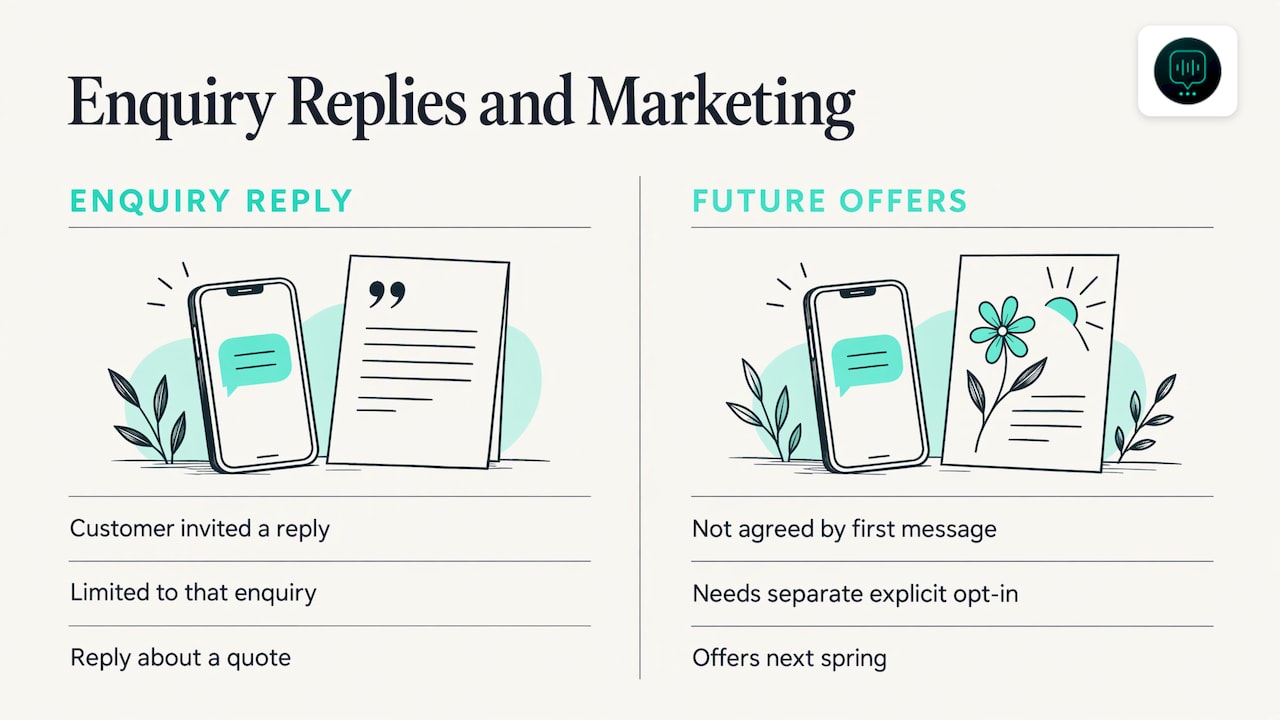
There is one more practical point. WhatsApp has its own rules on top of the law. WhatsApp’s Business Messaging Policy expects businesses to have the right permission before they message people, so even a message that passes under PECR still has to sit within the platform’s terms.
The safe habit: reply helpfully to the enquiry, keep that thread to the job in hand, and ask for marketing opt-in separately, with its own clear wording.
What wording should I use to ask for WhatsApp opt-in?
The ICO’s own example opt-in invites people to tick boxes for the channels they want, such as email, text, phone call or post. Follow that pattern: a plain description, a separate choice, no pressure. Adapt the bracketed parts to your firm.
1. Website quote or contact form
Place an unticked box beneath the submit button, separate from your terms and privacy notice:
[ ] Yes, I would like [Business name] to send me occasional offers and seasonal reminders by WhatsApp. You can opt out at any time by replying STOP. This is optional and does not affect your quote.
Why it works: the box is optional, unticked, names your business, names the channel and says what you will send. For a removals firm, change the middle to ‘moving tips and offers on packing and storage’. Our page on removals covers how removals firms handle enquiries more broadly.
2. Phone call
Say it in your own voice, then log the answer straight away:
Before I let you go: would you like us to send you occasional offers and reminders on WhatsApp? It is completely optional, it will not affect your job, and you can reply STOP at any time. Is that a yes?
Wait for a clear yes. Silence or ‘I suppose’ is not consent. Note the date, the time and who took the call. A plumber who has just finished a call-out on the van can ask this in ten seconds, but only ask once the job is dealt with, not as a condition of booking it.
3. Quote PDF
Put this in a separate box on the quote, not in the small print. Give a way to act, such as a link or a QR code that opens a WhatsApp message pre-filled with the keyword:
Want occasional offers and reminders from [Business name] on WhatsApp? Send the word YES to [our WhatsApp number] using the link below. Optional, and separate from this quote. Reply STOP at any time to end them.
The customer’s own reply is the affirmative action. Ticking nothing and signing the quote is not consent to marketing.
4. WhatsApp chat
After you have finished the customer’s enquiry, and not before, send one message:
Thanks, you are all booked in. Would you also like occasional offers from [Business name] on WhatsApp, such as seasonal gutter and roof checks? Reply YES to opt in. Reply STOP at any time to end them. No reply means we will only message you about your job.
This keeps the job conversation and the marketing request distinct. If they say nothing, you carry on with service messages only. For how automatic replies fit around this, see our guide to a WhatsApp auto reply for your business.
5. Invoice
Add a short line at the bottom with a link or QR code:
Would you like occasional offers and reminders from [Business name] on WhatsApp? Scan the code or send YES to [our WhatsApp number]. Optional. Reply STOP at any time.
An invoice is a good place for an existing customer who has just paid, but the same rule holds: the line only invites them. Nothing is agreed until they act.
Wording mistakes to avoid
- Pre-ticked boxes, or ‘by continuing you agree to marketing’.
- Bundling WhatsApp, email, text and phone into one tick. Let people choose each channel.
- Vague promises like ‘updates’ when you mean discounts.
- Making a free quote, survey or priority slot depend on saying yes.
- Borrowing a number from a list a partner, letting agent or lead site collected, unless the consent named your firm specifically.
How do I record WhatsApp consent?
If a customer ever asks how you got their number, or you need to show you had permission, a record answers the question. A sensible record for each opt-in holds:
- The customer’s name and WhatsApp number.
- The date and time.
- The source: web form, phone call, quote, chat or invoice.
- The exact wording they saw or heard, with a version date.
- What they agreed to, such as ‘offers and seasonal reminders by WhatsApp’.
A spreadsheet with a column per item is enough for a small firm. Keep the wording versions in a separate tab so you can show what was live on any date. For a chat opt-in, the WhatsApp thread itself is the evidence, so note where it is stored and keep it for as long as you are using the permission.
It also helps if everyone who answers customers understands the basics. Short GDPR training for staff is one way to make sure the person on the phones knows when to ask and when to stay silent.
A tidy record also stops you sending to someone who changed their mind. Each time you plan a campaign, filter on the current list, not an old export.
How do customers withdraw consent?
Stopping must be as easy as starting. If a customer opted in with one WhatsApp message, they should be able to opt out with one WhatsApp message.
- Say how to stop in every marketing message, such as ‘Reply STOP to opt out’.
- Treat any clear request to stop as a withdrawal, not only the exact keyword. ‘Please stop messaging me’ counts.
- Act at once: update your list the same day, before the next campaign goes out.
- Confirm with a short message, then do not message them with marketing again.
- Keep a note of the opt-out, with the date, so the person does not slip back onto a list.
A withdrawal of marketing consent does not stop service messages. If a roofing customer opts out of offers and later has a scaffold booking, you can still send the arrival time for that job.
What should I avoid when following up with customers?
Most mistakes come from enthusiasm rather than bad intent. Watch for these:
- Adding a promotion to a booking confirmation. Keep the confirmation clean and send any offer separately, to opted-in people only.
- Chasing a quote with discounts. Asking whether someone still wants the quote they requested is a normal follow-up. Offering a limited-time discount in that message turns it into marketing.
- Messaging old enquiries. Someone who asked for a quote two years ago and never bought is not covered by the soft opt-in.
- Adding customers to broadcast lists because they are in your phone. Having a number saved is not permission.
- Ignoring STOP replies because the message arrived on a busy day. Whoever monitors the inbox needs to know what to do.
If you want more on how WhatsApp compares with texting for these jobs, our guide to WhatsApp vs SMS for business goes through it.
Our view: keep the enquiry conversation and the marketing list apart
We build DeskAgent around one idea: the first job of a front desk is to answer the person who got in touch, fast and usefully. That conversation is about their leak, their move or their clean. It is not the moment to push offers.
Our WhatsApp Agent answers messages, qualifies the enquiry by job type, postcode and urgency, and hands your team a summary. It is natural-sounding and always says it is AI if asked. It follows up with the customer on WhatsApp about the enquiry they made. We think that is the right order: serve first, then, if the customer agrees, offer more.
For firms using DeskAgent, the sensible set-up is to keep the agent’s replies and follow-ups on service topics, and to run any marketing opt-in wording as a separate, clearly worded step of your own. With DeskAgent HQ you can update your FAQs and prices from one WhatsApp chat, and check today’s leads and summaries by asking, so your team always sees what each customer actually asked for.
A busy removals office in Croydon or a drainage firm in Barnet loses more work to slow replies than to anything else. Getting the reply right is where we would start. The consent wording above is the tidy second step.
Monty Gordon, founder of DeskAgent
Can DeskAgent handle the WhatsApp side for my firm?
DeskAgent® is a done-for-you AI front desk for UK service businesses. The WhatsApp Agent answers customer messages on your business number, is trained on your services, coverage area and FAQs, qualifies each enquiry, books into your calendar and passes your team a summary with the full context.
The WhatsApp Agent is £125 a month, and the Full DeskAgent, with all four agents (Phone, WhatsApp, Web and Inbox) plus DeskAgent HQ, is £285 a month. Single agents have no setup fee, because the first month covers the build, and there are no contracts, so you can cancel any time. The Full DeskAgent 3-month pilot is a one-off £500 covering the build and three months live, then £285 a month. Full details are on the pricing page. If you would like to see it working for your trade, you can book a free 30-minute demo: a 30-minute call where we show an agent built for your business.
For how replies, follow-ups and handoffs fit together, see our guide to automated lead follow up.
A quick checklist before you send your first WhatsApp offer
- Is the person on a list because they actively opted in, or because they qualify under the soft opt-in?
- Does the message say who you are and what it is about?
- Does it tell them how to stop?
- Is the opt-in recorded with date, source and wording?
- Have you removed everyone who has said stop?
- Are service messages kept free of promotions?
If any answer is no, fix that before sending. If you want to talk it through with someone, book a free 30-minute demo and we will show you how an agent fits your own enquiry flow, though for the legal detail you should rely on the ICO guidance or a solicitor.
FAQ
Do I need consent to reply to a customer who WhatsApps me first?
No marketing consent is needed to reply to their enquiry. Keep the reply to what they asked about: price, availability, access, booking. Only add offers if they have separately opted in.
Can I use the soft opt-in for a customer who only asked for a quote?
It is risky. The soft opt-in relies on you having sold, or been negotiating to sell, to that person, and on giving them an opt-out when you collected their details. If they only asked for a price and then went quiet, ask for explicit opt-in instead.
Is a customer giving me their number the same as agreeing to messages?
No. A number given to arrange a job covers messages about that job. It does not cover offers. Ask for marketing permission separately and record the answer.
Can I add a tick-box saying ‘I agree to receive offers’ to my quote form?
Yes, as long as it is unticked, optional and separate from your terms, and says what you will send and by which channel. A pre-ticked box is not valid consent.
What should I do when someone replies STOP?
Remove them from marketing straight away and note the date. You can still send service messages about a live job, such as an arrival time, but no offers.
Sources
- ICO: Marketing and data protection in detail
- ICO: When is consent appropriate?
- SMS and WhatsApp marketing terms
- WhatsApp’s Business Messaging Policy
- GDPR training for staff