How to Get More Removal Jobs: 9 Ways That Work

To get more removal jobs, reply to every enquiry fast, quote from a video survey, follow up, collect reviews, finish your Google Business Profile, build borough pages, partner with estate agents, work comparison-site leads quickly and offer storage. Each way below ends with one action for this week.
TL;DR
- Most removals work goes to the firm that answers first and sounds sure of itself, so speed comes before any marketing spend.
- A finished Google Business Profile, recent reviews and a page for each borough you cover bring in enquiries at little cost.
- Estate agent referrals and comparison-site leads add volume, but only pay if you reply quickly and quote accurately.
- Track every enquiry back to its source, so you know which way is filling the diary.
- Each of the nine ways ends with a “do this week” action you can finish in a day or less.
Table of Contents
- Why do removals firms lose jobs they should have won?
- What are the nine ways to get more removal jobs?
- How do you know which way is working?
- What do we think removals firms should fix first?
- How does DeskAgent cover the calls you miss?
- FAQ
- Sources
Why do removals firms lose jobs they should have won?
Most lost jobs are not lost on price. They are lost while your crew is lifting a wardrobe in Croydon and the phone rings out. The Moving School’s UK guide says domestic customers typically contact three to five firms, and that whoever answers first and sounds competent sets the benchmark for the rest.
That is the problem behind the first three ways. The other six bring more people to your door, which only helps if the first three are working.
What are the nine ways to get more removal jobs?
1. Answer every call and chat fast
A removals owner is on a van or in a flat for most of the working day. The enquiry comes in at 11am, the customer rings the next firm on the list at 11:05, and the job is gone before you have your gloves off.
The fix is cover, not willpower. That means a second person on the phones, a rota with the office, or an AI front desk. Whichever you choose, the customer needs a real answer on the first attempt: what you do, whether you cover their postcode, and what happens next.
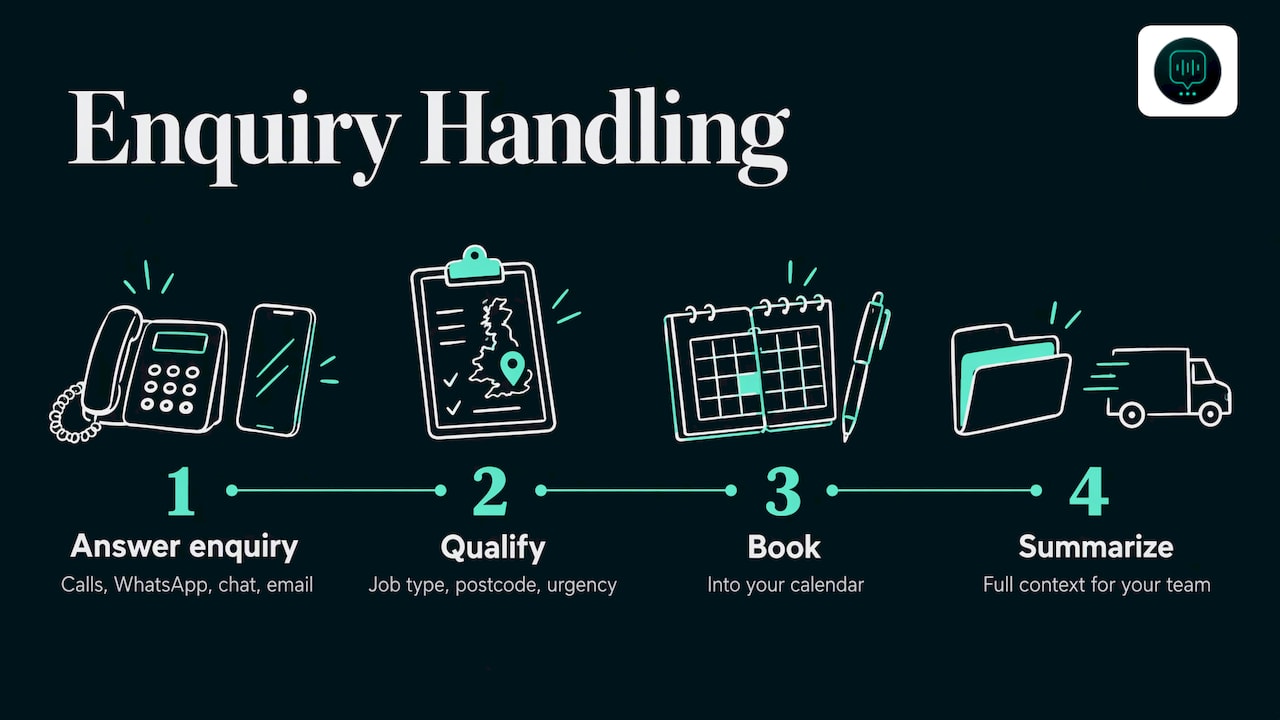
This is where we come in. Our AI receptionist for removal companies answers calls on your business number via call forwarding, plus WhatsApp messages, website chat and email. It qualifies each enquiry by job type, postcode and urgency, books into your calendar and gives your team a summary with the full context. It is natural-sounding and always says it is AI if asked. If you want to see one built for your firm, you can book a free 30-minute demo. It is a 30-minute call where we show an agent built for your business.
Do this week: ring your own business number from your mobile at 10am on a weekday and note what a customer would hear. If it rings out or goes to a full voicemail box, fix that first.
2. Offer video surveys over WhatsApp
Most removals customers already have WhatsApp, and a phone camera is all a survey needs. Ask the customer to walk through each room, show the loft and garage, and film the stairs, the parking and the access to the door. You see the real job, not a guess over the phone.
That protects you from underquoting, which is the quickest way to lose margin on a move. It also saves a morning of driving to a survey that may not convert. A customer in Streatham can send you a video from the sofa while you are still eating lunch.
Tell the customer exactly what to film in your first reply. A short checklist, such as every room, every cupboard with contents, the stairs and where the van can park, stops you chasing for missing footage.
Do this week: write a five-line message telling customers how to film a survey, and save it as a reply you can paste in.
3. Follow up every quote
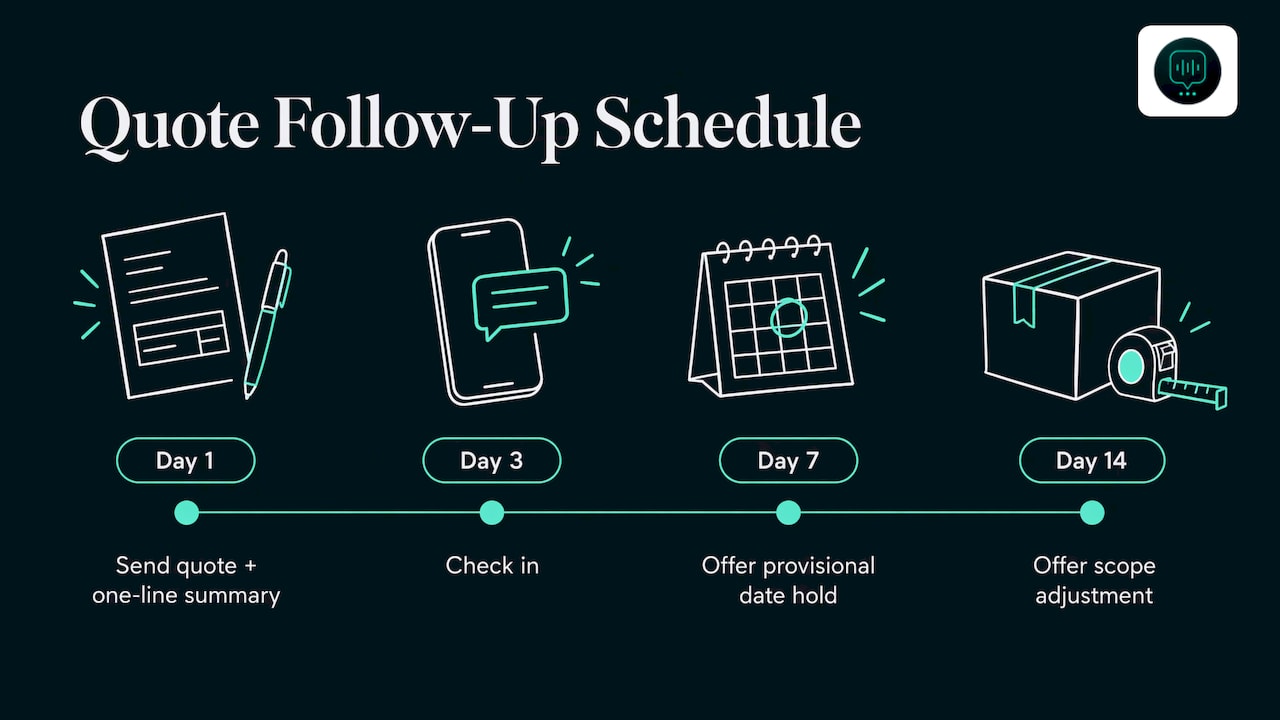
Most quotes that do not convert were not refused, they were forgotten. The customer got three quotes, got busy, and booked whoever kept in touch. The Moving School’s guide recommends sending the quote with a one-line summary on day one, then checking in on day three, offering to hold the date provisionally on day seven, and offering to adjust the scope on day fourteen.
That schedule is easy to write and hard to keep when you are on jobs all week. It is the kind of job that belongs to a system. Our guide to automated lead follow-up shows how to set it up. DeskAgent follows up with the customer on WhatsApp after the first enquiry.
Do this week: open your last 20 unbooked quotes and message every one that is under a month old with an offer to hold a date.
4. Ask every customer for a review
Choosing a removals firm means trusting strangers with everything you own, so reviews carry unusual weight. One UK SEO guide says a firm with forty recent reviews beats one with twelve old ones almost regardless of the star score. Recent matters as much as high.
Ask on the day of the move, while the boxes are still being unpacked and the customer is relieved. Send the review link by WhatsApp there and then, not in an email a week later. Reply to every review, including the poor ones, politely and briefly.
Do this week: save your Google review link as a WhatsApp reply and send it to your last ten customers.
5. Finish your Google Business Profile
For most local searches, the map results are where the enquiry is won. Google’s tips to improve your local ranking come down to relevance, distance and prominence: a complete and accurate profile, verified location details and opening hours, and the reviews and photos that make the business better known.
For a removals firm, that means choosing the closest primary category, listing each service separately (home moves, office moves, packing, storage), and uploading real photos of your vans and crew. One UK removals SEO guide adds that a profile can list up to 20 service areas, and that the booking button should point to your survey form.
Do this week: log in, check every field is filled, add ten new photos of your own vans and crew, and add your service areas.
6. Build a page for every borough you cover
Customers search by place: “removals Croydon”, “man and van Ealing”. A single “areas we cover” list will not rank for those. A separate page for each borough or town you work in will, provided each page says something real about moving there.
Removals Plus suggests a page per service and a page per town served, plus a reviews page and a phone-friendly quote form. Customers look for a star rating, a trade body logo and photos of real vans within seconds.
For a Croydon firm, a good page covers parking permits on the roads you know, typical flat access, and a few lines on recent moves nearby. Write it as you would explain it to a customer, not as filler.
Do this week: write one page for your best borough, 300 words of real local detail, and add a link to your quote form.
7. Partner with estate agents and letting agents
Estate agents and letting agents know about a move before anyone else does. A simple referral arrangement, where you send them business back or agree clear rules, puts you in front of customers at the moment they need you. Noticed’s 2025 marketing guide recommends partnering with estate agents, letting agents and cleaning companies in this way.
Start small. Pick three agents near your base, drop in a one-page offer and promise a same-day reply on every referral. Speed matters here more than anywhere: an agent who sends you one slow-answered lead will not send a second. Meeting local agents in person also helps, and business owner networking events are one place to build those relationships.
Do this week: list the five nearest estate and letting agents and call or visit two of them.
8. Work comparison-site leads, but only if you reply fast
Lead marketplaces send volume immediately, and you pay per lead. The Moving School’s lead-source table says they work when you respond fast. The same lead goes to several firms, so the maths turns on your conversion rate, not the lead price.
The guide’s worked example: a £60 lead converting at 30% costs £200 per booking, which on an £850 move at 35% margin is barely viable. The same lead at 60% conversion costs £100 per booking. Improving your reply speed and quote quality is therefore worth more than haggling over the price per lead.
Do this week: work out your conversion rate from marketplace leads over the last three months, and stop buying any source that costs more per booking than you make on the move.
9. Upsell storage and packing
A move is not always a single-day job. Customers with a gap between completion dates, or an office clearing space, often need storage, and packing is a natural add-on. Offering both when you quote raises the value of each booking without any extra marketing cost.
Noticed also suggests tiered quote options, so the customer can pick a basic move, a move with packing, or a full service. Offering three tiers makes the middle one look sensible and gives you a reason to talk through the job rather than just quote a number.
Do this week: add a storage line and a packing line to your standard quote template, with a price for each.
How do you know which way is working?
Count every enquiry and note where it came from: map listing, website form, call, WhatsApp, agent referral, marketplace. Paradigm Media Networks advises tracking three numbers for each source: enquiries, surveys booked and moves booked. Most firms already hold this in a diary or spreadsheet and just need to link it to the source.
There is a useful example of what tracking can show. A Bristol firm, R&J Removals, spent £1,000 a month on Google Ads and, after adding call tracking, a dedicated landing page and restructuring its campaign, raised monthly enquiries by 83% to an average of 35 and cut cost per enquiry to around £30, according to a 2026 case study. Your results will differ, but the habit of counting is the point.
What do we think removals firms should fix first?
We build DeskAgent for trades owners who are on a job when the phone goes. Removals is one of the clearest cases we know: the customer is comparing firms, the owner is carrying a sofa, and the enquiry goes to whoever picks up.
Our view is that you fix the front door before you pay to bring more people to it. Reviews, a good profile and borough pages all send people to your phone, WhatsApp and website. If those are covered, every other way in this article works harder.
That is why DeskAgent is four agents, Phone, WhatsApp, Web and Inbox, plus DeskAgent HQ. They share one brain, trained on your services, coverage area and FAQs, and the owner runs it from one WhatsApp chat: update prices, pause the agents, check today’s leads. A roofer in Ealing has the same problem on a different job, and the same front desk answers it.
Monty Gordon, founder of DeskAgent
How does DeskAgent cover the calls you miss?
Our Phone Agent is £125 a month, and the WhatsApp Agent is also £125 a month. The Web Agent and Inbox Agent are £85 a month each. Single agents have no setup fee, because the first month covers the build, and there are no contracts: you can cancel any time. Our Phone Agent answers inbound calls on your business number via call forwarding.
Full DeskAgent, with all four agents plus DeskAgent HQ, is £285 a month. The Full DeskAgent 3-month pilot is a one-off £500 that covers the build and three months live, then £285 a month. All prices are on our pricing page. If you would rather see it first, book a free 30-minute demo and we will show you an agent built for your removals business.
FAQ
How do I get more removal jobs without paying for ads?
Start with the free routes: a finished Google Business Profile, a review request after every move, a page for each borough you cover and referrals from local estate and letting agents. These build over weeks and months rather than days. Fast replies to the enquiries you already get cost nothing and often add the most.
What should I do when I miss a call while I’m on a move?
Reply by WhatsApp or text as soon as you can, saying who you are and what you need to know: postcode, date and size of the move. Better still, have cover so the call is answered the first time. Our Phone Agent answers on your business number via call forwarding and passes your team a summary with the full context.
How quickly should I send a removals quote?
The Moving School’s guide says quotes should arrive within 24 hours, ideally the same day. A first reply that confirms receipt and says what survey or information you need can go out much sooner, and it keeps the customer from moving on to the next firm.
Do video surveys really help me win more moves?
They help you quote from what is really in the property, including stairs, access and contents, so there are fewer nasty surprises on the day. They also save travel time. A customer can film their rooms in a few minutes and send the video by WhatsApp.
Sources
- Google’s tips to improve your local ranking
- The Moving School: Removal Leads, How to Generate Them
- Paradigm Media Networks: SEO for Removal Companies, a 10-Step UK Plan
- Removals Plus: What a removals website actually needs to do
- Noticed: Marketing Guide for Removals Services in the UK
- The Movers & Storers Magazine: Google Ads case study