Trades Lead Management: Enquiry to Booked Job

Trades lead management means giving every enquiry, whether it arrives by phone, WhatsApp, web chat or email, one line on one list with a stage and a next step. Use five stages: new, qualified, quoted, booked and lost. Then spend 15 minutes a week reviewing the list, so no job quietly disappears.
TL;DR
- Put every enquiry on one list, whatever channel it came from, with a named owner and a next-action date.
- Use five stages only: new, qualified, quoted, booked, lost. Every line sits in exactly one.
- Reply fast and follow up on a set rhythm, then record a reason when a job is lost.
- If you agree a job at the customer’s home, check the 14-day cancellation rules before work starts.
- Spend 15 minutes each week on the list: stuck quotes, lost reasons and enquiries by channel.
Table of Contents
- What is trades lead management, and how is it different from lead generation?
- How do I keep calls, WhatsApp, email and web chat on one list?
- What does a five-stage enquiry tracker look like?
- What should I ask to qualify an enquiry?
- How quickly should I reply, and how do I follow up?
- What do I need to know about cancellation rights for jobs agreed at the customer’s home?
- How do I run a 15-minute weekly review?
- Why we think one front desk beats a notebook
- Can DeskAgent fill the tracker for me?
- FAQ
- Sources
What is trades lead management, and how is it different from lead generation?
Lead generation is how enquiries reach you: Google, directories, recommendations, a van with your number on it. Lead management is what happens after the enquiry lands. Who picks it up, what you ask, when you quote, who chases, and what you write down when the customer goes quiet.
Most small trades firms are fine at the first and weak at the second. The enquiry comes in while the owner is on a roof, under a sink or halfway through a flat move. It gets a quick reply from the van, a note on the back of a hand or a WhatsApp that scrolls out of sight. Nobody decided to lose that job. It just had no home.
A lead management routine is nothing grander than three habits:
- Every enquiry is recorded in the same place, the same way.
- Every enquiry has a stage and a next step with a date.
- Once a week, you look at the whole list and make decisions.
You do not need a big system for a team of 1 to 30 people. A spreadsheet is enough to start with, and it is the format we use below.
How do I keep calls, WhatsApp, email and web chat on one list?
Enquiries rarely arrive in one place. A drainage customer rings because water is backing up. A landlord in Ealing messages on WhatsApp about a roof leak. A removals customer in Croydon fills in a web form at 11pm. A letting agent emails a list of three flats needing a deep clean. If each of those lives in its own app, the only system joining them is your memory.
The fix is a single rule: an enquiry does not exist until it is on the list. It does not matter where it started. Whoever receives it, you, your office manager or a colleague, adds a line before doing anything else.
A few practical habits make that stick:
- Add the line first, then reply. It takes under a minute, and it stops the “I’ll do it later” gap.
- Record the channel. Phone, WhatsApp, web chat, email or word of mouth. After a couple of months this tells you which channel brings the work and which one leaks it.
- Give every line one owner. “The office” is not an owner. A name is.
- Write the next action and its date in the same row. A row with no date is a job waiting to be forgotten.
The habit most worth building is the evening check. Before you close the day, look for new rows with no owner, callbacks that were promised and not made, and anything marked “waiting on customer” with no date. We cover the wider multichannel picture in our guide to multichannel customer service.
What does a five-stage enquiry tracker look like?
The tracker is a spreadsheet with one row per enquiry. Keep the stages short and unambiguous, so two people would put the same enquiry in the same stage.
| Stage | What it means | Moves on when |
|---|---|---|
| New | An enquiry has arrived and nobody has spoken to the customer properly yet | You have confirmed the job, the address and how urgent it is |
| Qualified | You know what the job is, where it is, how soon it is needed and that you can do it | A price, estimate or visit slot has been given |
| Quoted | The customer has a price or a visit date | They say yes, say no, or go quiet past your cut-off |
| Booked | The customer has agreed, and the date and details are confirmed | The job is done, or it is cancelled and moves to lost |
| Lost | The customer chose someone else, went silent, or you declined the job | Nothing: record the reason and leave it |
That gives you the columns for the spreadsheet itself. Here is a layout you can copy into any spreadsheet tool:
| Date in | Customer | Channel | Postcode | Job type | Urgency | Stage | Owner | Next action | Next action date | Quote value | Lost reason |
|---|---|---|---|---|---|---|---|---|---|---|---|
| 3 Nov | Mr Patel | Phone | CR0 | 2-bed flat move | Flexible, next month | Quoted | Sam | Chase quote | 7 Nov | Quoted amount | |
| 4 Nov | Letting agent | W5 | Flat roof leak | Urgent | Qualified | Dee | Site visit | 5 Nov | |||
| 4 Nov | Ms Okoye | SE15 | Blocked drain | Today | Booked | Sam | Job done, send invoice | 4 Nov | Quoted amount | ||
| 5 Nov | Web form | Web chat | N17 | Boiler service | This week | New | Unassigned | Call back | 5 Nov | ||
| 1 Nov | Mr Evans | Phone | HA1 | Pest survey | This week | Lost | Dee | None | Went with cheaper quote |
A few rules keep the sheet honest:
- Urgency uses three words only: today, this week, flexible. You can sort and filter on them.
- Lost is a stage, not a deletion. Deleted rows teach you nothing. Lost rows with a reason tell you where the money went.
- The lost reason is a short phrase, such as price, timing, no reply, outside our area, or not our kind of job.
- Never leave Owner blank on a new row for more than a few minutes.
What should I ask to qualify an enquiry?
Qualifying means getting just enough to decide the next step, not delivering the whole quote down the phone. One trades playbook suggests using the first conversation to confirm the job, offer the next available slot and check the decision-maker will be there, then securing a visit rather than quoting on the spot.
For most trades, five questions do the work:
- What is the job? One sentence, in the customer’s words.
- Where is it? Get the full postcode. It tells you straight away whether the job is in your area and how long the travel is.
- How urgent is it? Water coming through a ceiling is not the same as a kitchen refit next spring.
- Who decides? A tenant reporting a leak is not the landlord who approves the spend. A removals customer may be waiting for a mortgage completion date.
- What is the best way and time to reach them? Phone, WhatsApp or email, and when.
Two trade examples show how the answers change the stage:
- A roofer in Ealing gets a message about a leaking flat roof. The postcode is in the patch, the leak is active, and the contact is the letting agent, not the owner. The row goes to Qualified with urgency set to “today”, and the next action is a visit slot and a request for the owner’s approval route.
- A removals firm in Croydon gets a web enquiry for a two-bed move. The customer has no date yet because the purchase has not exchanged. The row is Qualified, urgency is “flexible”, and the next action is a chase on a date a week before the likely move.
The same questions are what our AI lead qualification guide walks through if you want to see how they can be automated.
How quickly should I reply, and how do I follow up?
Speed matters because customers with a leak, a blocked drain or a move date tend to contact several firms. A survey reported by Fix Radio in 2022 found that 34% of tradespeople believe they have lost work because they could not answer the phone, and 60% said they struggled to answer the phone while at work. That is a survey of opinion, not a measure of your own firm, which is why the tracker tells you more.
A sensible target is an acknowledgement within a minute or so, and a human call or message soon after. One UK trades guide suggests an automatic acknowledgement within one minute and a call within five minutes in opening hours. You will not always hit that from a roof, but the principle is sound: the customer should know quickly that someone has their enquiry. Our post on lead response time goes deeper, and the one on capturing leads from missed calls covers the missed-call side.
A follow-up rhythm that fits a small firm
Quotes go quiet because the customer is busy, not because they have said no. Decide a rhythm once and stick to it. The same playbook recommends staged follow-ups and a close-the-loop step around day 10 if nothing has been booked: offer a call, or record the enquiry as lost with a reason.
A rhythm you can put straight into the sheet:
- Same day: acknowledge and confirm what happens next.
- Day 2 or 3: check the quote arrived and ask if they have questions.
- Around day 7: a short nudge by the customer’s preferred channel.
- Around day 10: close the loop. Ask if they still want the job, or mark it lost with a reason.
The dates matter more than the wording. Put each follow-up in the Next action date column, and the weekly review will show you any that were missed.
What do I need to know about cancellation rights for jobs agreed at the customer’s home?
This is the part of the process people forget, because it sits between Quoted and Booked. When a customer agrees to a job at their home rather than at your premises, consumer cancellation rules can apply. Business Companion’s guide to off-premises contracts explains that the Consumer Contracts Regulations require detailed information to be given to consumers and, in certain circumstances, give them a 14-day cancellation period.
What that means for your tracker:
- Add a column, or a tick, for “agreed at customer’s home”. It prompts you to check whether the cancellation rules apply to that job before you move it to Booked.
- Give the required information and a cancellation form where a right to cancel exists. The guide sets out what must be provided and the model wording.
- If the customer wants work to start inside the 14 days, get that request clearly and in the right form. The guide says you must tell them they will have to pay the reasonable costs of the service delivered up to the point of cancellation.
- Check the exceptions. The guide explains that some contracts fall under the lighter on-premises rules instead, and that repair and maintenance work has its own information requirements. Read it against your own type of work.
This applies to consumers, not business customers such as a managing agent or a landlord company. If you are unsure which rules fit a particular job, ask your local Trading Standards service or a solicitor. A written note in the Booked row of what you gave the customer and when is useful if a dispute arises.
Once the job is booked and done, payment follows. If late payers are a problem, this practical piece on credit control in business is a sensible next read, and the tracker can carry an invoice date in the Next action column.
How do I run a 15-minute weekly review?
Pick a fixed slot: Friday at 4pm, Monday at 7:30am, whatever you will actually keep. Open the sheet and work through these steps with a timer.
Minutes 0 to 3: new and unowned. Filter for Stage = New. Anything older than a day needs an owner and a call today. Anything with no owner is the first thing you fix.
Minutes 3 to 7: stuck quotes. Filter for Quoted with a next action date in the past. Decide for each one: chase, close the loop, or mark lost. Do not leave it as “maybe”.
Minutes 7 to 10: booked jobs. Check each booked row has the address, a contact, a date and confirmation. If it was agreed at the customer’s home, check the cancellation paperwork is noted.
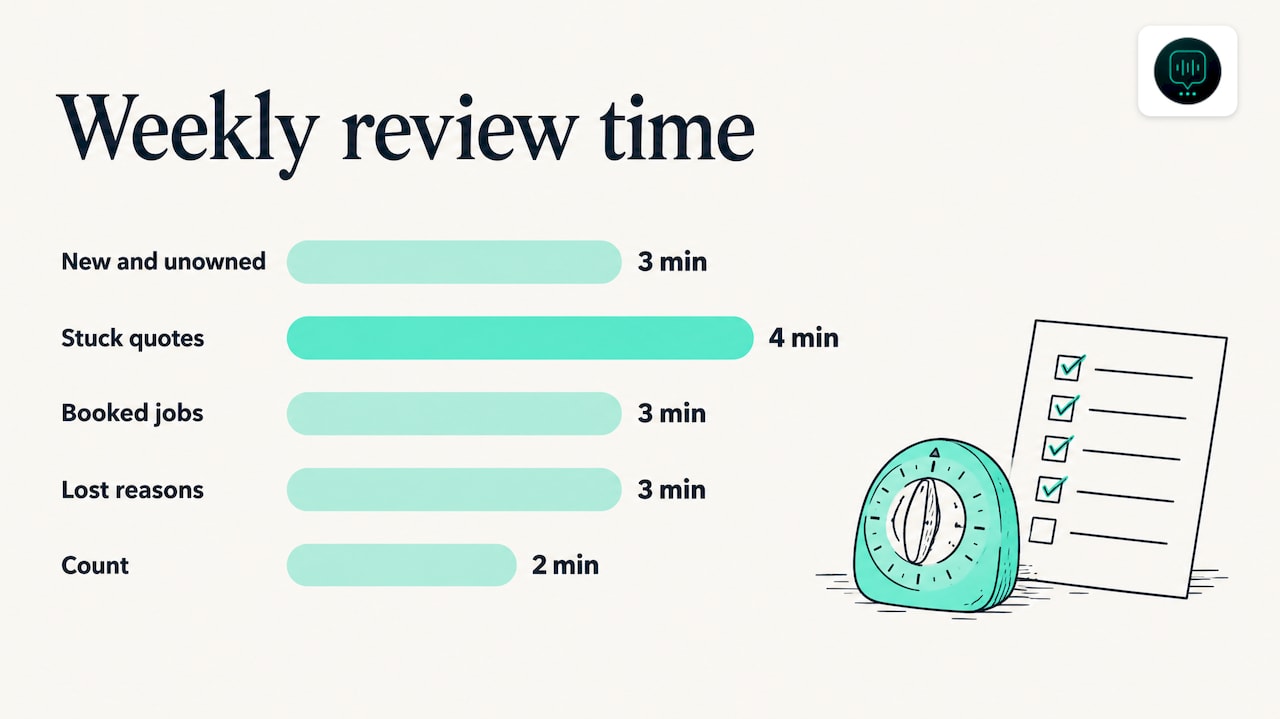
Minutes 10 to 13: lost reasons. Read the reasons from the week. If price keeps appearing, look at how you quote. If “no reply” is common, look at how quickly you responded.
Minutes 13 to 15: count. Write four numbers in a small table at the top of the sheet:
| Week | New enquiries | Spoken to | Quoted | Booked |
|---|---|---|---|---|
| Week ending 7 Nov | Your count | Your count | Your count | Your count |
These are your own figures, so no benchmark is needed. A routine suggested for UK trades is to compare weekly counts week to week to spot holiday gaps or cold-snap spikes. After a month you will see where enquiries thin out: between new and spoken-to (a response problem), spoken-to and quoted (a qualification problem), or quoted and booked (a pricing or follow-up problem).
Then add one count by channel: how many enquiries came by phone, WhatsApp, web chat and email. If a quarter of your enquiries come by WhatsApp and you are answering it last, you have found your next improvement.
Why we think one front desk beats a notebook
We built DeskAgent around a simple observation: trades firms do not lose work because they are bad at the job. They lose it because the enquiry arrives at the wrong moment, and nothing catches it.
A spreadsheet is a good start, and the five-stage tracker above works whether you use our service or not. But a spreadsheet only records what you remember to type in. The real gap is at the front: the call you cannot take on a roof, the WhatsApp you read at 9pm, the email that sits under invoices.
That is why we set DeskAgent up as four agents sharing one brain: Phone, WhatsApp, Web and Inbox, plus DeskAgent HQ. Each is set up for your business and trained on your services, coverage area and FAQs. It asks the qualification questions, notes the job type, postcode and urgency, routes urgent jobs to the owner, books into the calendar and hands your team a summary with the full context. The agents sound natural, and they always say they are AI if asked.
The tracker then becomes a place you review, not a place you have to feed by hand.
Monty Gordon, founder of DeskAgent
Can DeskAgent fill the tracker for me?
DeskAgent® is a done-for-you AI front desk for UK service businesses with 1 to 30 staff, London first. The Phone Agent answers calls forwarded from your business number. The WhatsApp Agent handles messages, the Web Agent runs website chat, and the Inbox Agent reads email enquiries, filters spam and replies. Each one qualifies the enquiry, books into your calendar, hands your team a summary and follows up with the customer on WhatsApp.
With DeskAgent HQ, you run it from one WhatsApp chat: update prices and FAQs, pause the agents, check today’s leads and ask for summaries when you want them. For a removals firm, the setup is tailored to quote enquiries and move details, which you can see on our removals page.
Prices are published on the pricing page:
| Plan | Price |
|---|---|
| Web Agent | £85 a month |
| Inbox Agent | £85 a month |
| Phone Agent | £125 a month |
| WhatsApp Agent | £125 a month |
| Full DeskAgent (all four agents plus DeskAgent HQ) | £285 a month |
Single agents have no setup fee, because the first month covers the build. The Full DeskAgent 3-month pilot is a one-off £500 that covers the build and three months live, then £285 a month. There are no contracts and you can cancel any time. If you would like to see how it would work for your firm, you can book a free 30-minute demo: a call where we show you an agent built for your business.
FAQ
I only get a handful of enquiries a week. Do I really need a tracker?
Yes, because small volumes are where memory fails quietly. With five or six enquiries a week, one lost job is a meaningful share of your work. A sheet takes a minute per enquiry, and the weekly review takes 15 minutes.
Should I use a spreadsheet or a proper system?
Start with the spreadsheet. It forces you to decide your stages, your urgency words and your follow-up rhythm. If you outgrow it, or the typing becomes the bottleneck, you can automate the front end of the process and keep the same five stages.
When does a quote count as lost?
When the customer says no, or when your close-the-loop step gets no answer. Around day 10 is a common cut-off, but choose one that fits your type of job: a removals quote for a move months away needs longer than a drain unblock. Record the reason either way.
Do cancellation rights apply to every job I agree at someone’s house?
Not necessarily. They concern consumers, and the rules include exceptions and different information requirements for repair and maintenance work. Read the guidance on off-premises contracts for your type of job, and ask Trading Standards or a solicitor if you are unsure.
Can the weekly review be shorter than 15 minutes?
Once the sheet is tidy, many owners finish in 10. If it takes much longer, it is usually because rows have no next-action date. Fix that and the review speeds up. You can also book a free 30-minute demo to see how an agent keeps those fields filled.
Sources
- Business Companion: consumer contracts, off-premises sales
- Lead Generation and Appointment Setting: A Trades Playbook
- Stop missing calls: a callback system for UK trades
- Credit control in business: a practical guide for UK owners