AI Receptionist for Removal Companies: Setup

To set up an AI receptionist for a removals firm, give it your areas, services, survey options, packing and storage rules and minimum notice. Then let it ask eight standard quote questions, so every enquiry reaches you as a clear summary. Here is how, step by step, for UK firms.
TL;DR
- An AI receptionist answers calls and messages when your crews are on a job, asks the same quote questions every time and passes you a summary.
- Setup is mostly information: areas covered, services, survey options, packing, storage and minimum notice. We build it for you with our AI receptionist for removal companies.
- The eight quote questions cover collection and delivery postcodes, date, property size, access, packing, extras and how the customer wants to be contacted.
- Urgent or unusual jobs can be routed to you, and the customer is followed up on WhatsApp.
- There are no contracts and you can cancel any time.
Table of Contents
- What does an AI receptionist actually do for a removals firm?
- What do you need to give the agent before it goes live?
- What are the eight quote questions it should ask?
- What does a call sound like? An illustrative example
- How do leads reach you once the agent has the details?
- How do you compare your options for answering the phone?
- What should you check about call data and privacy?
- What we think about AI front desks for removals
- What does it cost, and how does the pilot work?
- FAQ
- Sources
What does an AI receptionist actually do for a removals firm?
A removals phone rings at the worst moments: your crew is carrying a wardrobe down three flights, you are driving the lorry, or it is Saturday evening and the office is shut. Someone planning a move usually contacts several firms in one sitting. The firm that picks up, or replies first, tends to get the conversation.
An AI receptionist takes that first conversation. It answers the call, finds out what the customer needs, and records the details in a form you can quote from. At DeskAgent® we build this as four agents sharing one brain: the Phone Agent, the WhatsApp Agent, the Web Agent and the Inbox Agent, plus DeskAgent HQ, which lets you run everything from one WhatsApp chat.
For a removals firm that means:
- Calls: the Phone Agent answers inbound calls on your business number through call forwarding, so customers keep ringing the number already on your van.
- WhatsApp: the WhatsApp Agent answers messages from customers who would rather type a photo of their sofa than talk.
- Website chat: the Web Agent handles visitors on your quote page.
- Email: the Inbox Agent reads enquiries, filters spam and replies.
Each one qualifies by job type, postcode and urgency, books into your calendar and hands your team a summary with the full context. If you want the background on why speed matters, our post on lead response time goes through it, and capturing leads from missed calls covers the phone side.
It is natural-sounding, and it always says it is an AI if a caller asks. It does not pretend to be a person on your staff.
What do you need to give the agent before it goes live?
Setup is the part owners expect to be technical. It is not. It is a short brain dump of how your firm already works, which we then turn into an agent trained on your services, coverage area and FAQs. This is done for you: you supply the facts, we build and test.
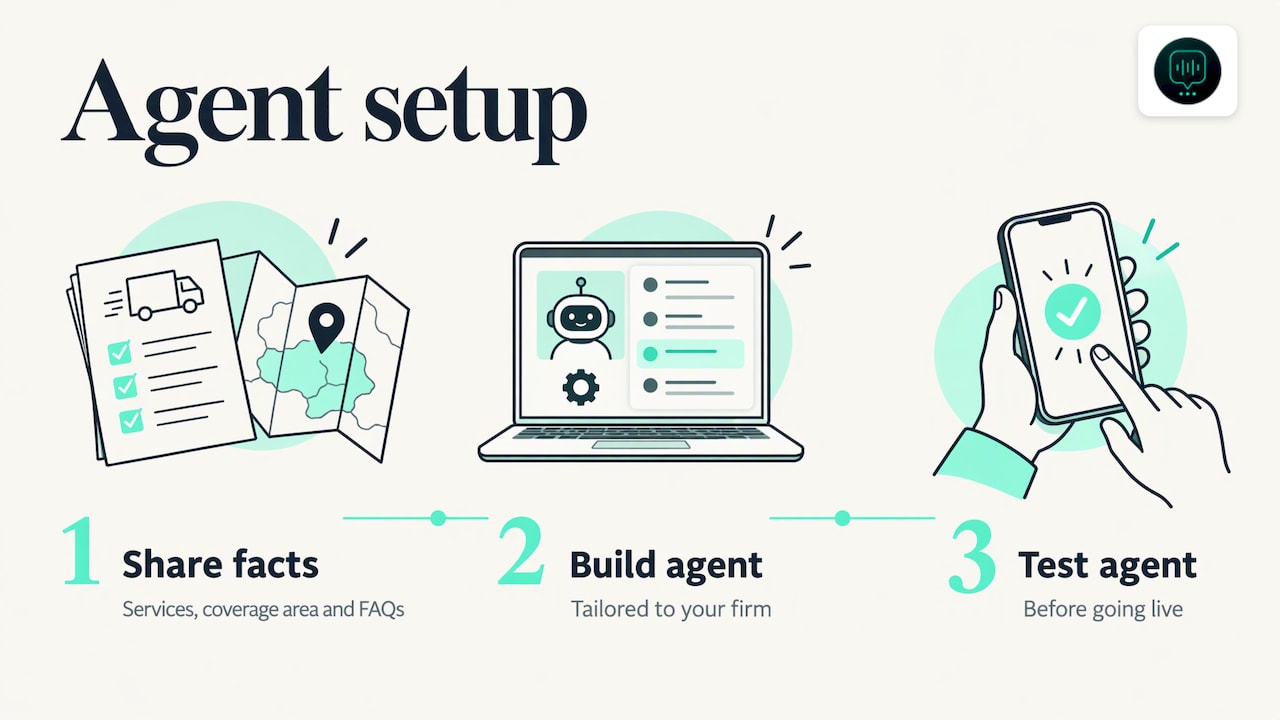
Gather the following before the build.
Which areas do you cover?
List the postcodes or boroughs you work in, and the distances you will travel. A man-and-van in Croydon might cover CR, SM, BR and SW postcodes plus anywhere within an hour. A 20-staff mover with several lorries might cover the whole of the South East and long-distance moves across the UK.
Be specific about the edges. If you do not do Scotland, say so. If you do Brighton from Croydon every week and Newcastle only occasionally, say that too. The agent uses the postcode it hears to decide whether the job fits, so a clear boundary stops you wasting a callback on work you would turn down.
Which services do you offer?
Write down what you actually do, in plain words:
- house moves by bedroom count, flats and offices
- single-item or small van loads
- student moves
- house clearance, if you do it
- long-distance and international moves
- storage, with or without collection
Also write down what you do not do. If you will not move pianos, or you do not take hot tubs, the agent should know before a customer builds their hopes up.
What survey options do you offer?
Most removals firms quote in one of three ways, and the agent needs to know which of them you offer:
- In-person survey: someone visits the property.
- Video survey: the customer walks through the home on a video call or sends a recorded walk-through.
- Quote from details: a phone or WhatsApp description is enough for smaller jobs.
Tell us which job sizes get which. For example, a studio flat might be quoted from details, while a four-bed house gets a video or in-person survey. The agent can then book the survey slot into your calendar, rather than leaving a note that says “call back”.
What are your packing and storage rules?
Spell out whether packing is included, optional or not offered, and whether you supply boxes. Say what you cannot pack, such as items you will not take responsibility for. For storage, state whether you offer it, for how long, and whether it is on your premises or with a partner. These are among the most common questions in a removals enquiry, so the agent should answer them the way you would.
What is your minimum notice?
This one saves the most time. If you need 48 hours for a van job and two weeks for a full house move in peak season, tell the agent. If you take same-day jobs for a premium, say how those get handled. Customers asking for a date you cannot meet can then be told promptly, and anything you want to hear about personally can be flagged.
What should reach you immediately?
Decide what counts as urgent. For a removals firm that might be a move within the next few days, a customer stuck with a collapsed completion date, or a large commercial job. Urgent jobs can be routed to you straight away, while everything else arrives as a summary.
If you want to see how this looks for your own firm, you can book a free 30-minute demo. It is a 30-minute call where we show an agent built for your business.
What are the eight quote questions it should ask?
A good removals enquiry is the same eight pieces of information every time. When the agent collects them in a consistent order, you can quote without ringing the customer back to ask what you should have known already. We train the agent on these, adjusted to your firm.
- Where are you moving from? The collection postcode and property type: house, flat, office or storage unit.
- Where are you moving to? The delivery postcode, or “not sure yet” if it is a storage move.
- When do you want to move? The preferred date, plus how flexible they are. A flexible customer is often cheaper to fit around your diary.
- How big is the move? Number of bedrooms, or for offices the number of desks and rooms. A short list of any large or awkward items.
- What is access like? Floors, whether there is a lift, parking and any restrictions, such as a permit bay or a narrow street. Access is what turns a simple quote into a long day.
- Do you want packing? Full pack, fragile items only, boxes supplied, or self-packed.
- Do you need anything extra? Storage, dismantling and reassembly, cleaning, or disposal of unwanted items.
- How should we get back to you? The customer’s name, their preferred channel (call, WhatsApp or email) and the best time, plus whether they would like a survey and what type.
The order matters. Postcodes first lets the agent confirm quickly that you cover the route. Date second flags urgency. Access last avoids making the customer feel interrogated before they have had a chance to say what they want.
The agent does not need to price the job. Its role is to capture the details and the customer’s preference, and hand them to you with context. If you want it to say anything about price, such as that quotes are given after a survey, you tell us and we train it on that wording.
What does a call sound like? An illustrative example
Here is a short, made-up example of how a call might go. It is an illustration of the flow, not a record of a real call.
Example: Saturday evening, a 3-bed in Croydon moving to Brighton
Agent: Good evening, you’ve reached the removals team. I’m an AI assistant and I can take your details so the right person gets back to you. What are you looking to move?
Caller: Hi, we’re moving a three-bed house from Croydon to Brighton, probably in about three weeks.
Agent: Thanks. Can I take the postcode you’re moving from, and the one you’re moving to?
Caller: CR0 and BN1.
Agent: Great, we cover that route. Do you have a particular date in mind, and is there any flexibility?
Caller: A Friday would be ideal, but we could do a Thursday.
Agent: Noted. Is there a lift or parking restriction at either address, and roughly how many floors?
Caller: Two floors at ours, parking on the road. Brighton end is a flat on the first floor.
Agent: Would you like packing, or will you box everything yourselves? And is there anything bulky, like a piano or a large wardrobe?
Caller: We’ll do the boxes ourselves, but there’s a big wardrobe that needs taking apart.
Agent: Understood. For a three-bed we usually offer a video survey. Would you like me to book one for early next week, and should we message you on WhatsApp to confirm?
Caller: Yes, WhatsApp is best.
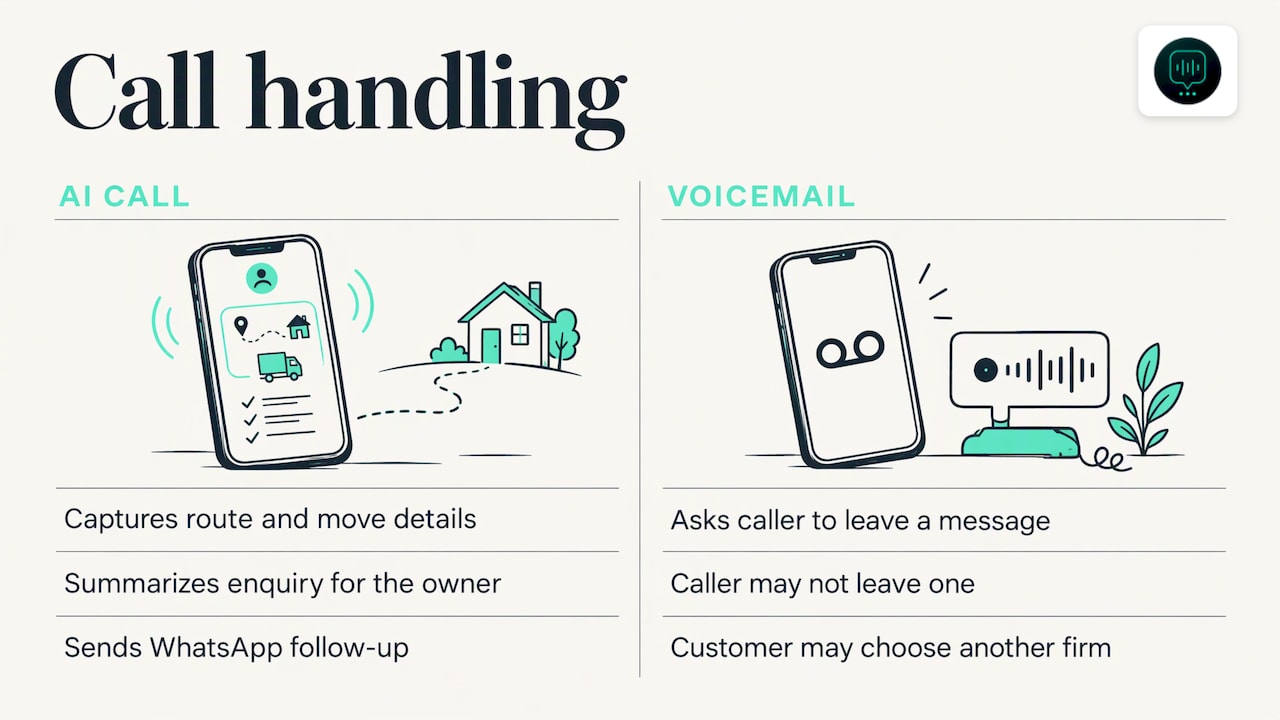
While the caller is still on the line, or just after, the owner’s team gets a summary: collection CR0, delivery BN1, three-bed house, preferred Friday or Thursday in about three weeks, two floors with on-road parking, first-floor flat at the other end, self-packing, wardrobe dismantling, video survey wanted, contact by WhatsApp. The customer then receives a follow-up on WhatsApp.
Compare that with the alternative on a Saturday evening: a voicemail that says “please leave a message”, which the customer may not leave, because they have already moved on to the next firm on the list.
How do leads reach you once the agent has the details?
The summary is what you will use every day, so it is worth designing it with us. A good removals summary has the route, the date, the property size, the access notes, the extras and the customer’s preferred contact, in that order, so you can scan it between jobs.
From there:
- Urgent jobs are routed to the owner according to the rules you set.
- Bookings go into your calendar, such as a survey slot or a callback.
- Hand-off keeps the full context, so your office does not have to ask the customer to repeat themselves.
- Follow-up goes to the customer on WhatsApp. For the wider idea, our post on automated lead follow up explains it.
Running it from your phone with DeskAgent HQ
DeskAgent HQ is the part owners tend to like most. You run the whole front desk from one WhatsApp chat. You can update prices and FAQs, pause the agents, check today’s leads and ask for summaries. When you ask for today’s leads, HQ replies with them. It does not send scheduled summaries on its own, so you stay in control of when you look.
That matters on a removals firm because things change quickly: a lorry goes off the road, you are booked solid for a fortnight, or you want to add a Brighton discount for a quiet month. A message to HQ updates the agent without logging into anything.
How do you compare your options for answering the phone?
Owners usually weigh up a handful of types of solution. We do not name other providers here, because the type matters more than the brand. This table sets out what to check across the common ways firms handle enquiries.
| Option | Who builds it | Covers calls, WhatsApp, web and email | Trained on your areas and quote questions | Owner control |
|---|---|---|---|---|
| Voicemail or missed-call text | You | Calls only | No | Listen back yourself |
| Part-time office staff | You hire and train | Depends on hours | Yes, by training | Limited to working hours |
| Do-it-yourself chatbot or generic AI tool | You | Often one channel | Only what you build | Whatever you configure |
| Done-for-you AI front desk | Built for you | Four agents: Phone, WhatsApp, Web and Inbox | Yes, trained on your services, postcodes and urgency rules | Run from WhatsApp via DeskAgent HQ |
If you want a done-for-you build, ours is designed to cover all four channels with one shared brain, so a customer who rings, then messages, is not treated as a stranger the second time. That is the reasoning behind our Phone Agent, which sits at the front of the build for most removals firms.
When you compare, ask each option the same five things:
- Does it work on my existing business number, or do I need a new one?
- Can it ask my eight quote questions, in my order?
- What happens out of hours and when a call needs a person?
- How do details reach me, and in what format?
- What do I pay each month, and can I leave without a contract?
What should you check about call data and privacy?
A removals enquiry contains names, addresses and, often, dates when a home will be empty. That is personal data, so it is worth knowing how your provider handles it. Ask where recordings and transcripts are stored, how long they are kept, who is the data controller and how deletion works when you cancel.
You are also responsible for being open with callers. If calls are recorded or analysed, say so. Our agents always say they are AI if asked, and you should agree wording with us for any greeting. For a plain-English walkthrough of retention and deletion policies for small firms, this guide to GDPR for small businesses is a good place to start.
What we think about AI front desks for removals
We built DeskAgent for tradespeople who do the work and cannot also sit by the phone. Removals is a clear example. The best part of your day is out on a job, and the leads come in during the hours you are carrying furniture.
Our view is that a front desk should be set up for your business, not handed to you as a blank tool. That is why every agent is trained on your services, coverage area and FAQs, and why the build is done for you.
We also think customers deserve honesty. Our agents sound natural, and they always say they are AI if asked. They collect the details, qualify the enquiry and hand your team a summary, so the human part of the job, the survey, the quote and the move, stays with you.
Monty Gordon, founder of DeskAgent
What does it cost, and how does the pilot work?
The prices below are what we publish. There are no contracts and you can cancel any time. You can see the full detail on our pricing page.
| Plan | Price |
|---|---|
| Web Agent | £85 a month |
| Inbox Agent | £85 a month |
| Phone Agent | £125 a month |
| WhatsApp Agent | £125 a month |
| Full DeskAgent (all four agents plus DeskAgent HQ) | £285 a month |
Single agents have no setup fee, because the first month covers the build. For a removals firm, the Phone Agent at £125 a month is the usual starting point, with the WhatsApp Agent added when customers start messaging photos.
If you would rather start with everything, the Full DeskAgent 3-month pilot is a one-off £500 that covers the build and three months live, then £285 a month.
To see how it would work for your lorries and crews, book a free 30-minute demo. We show you an agent built for your removals business, using your areas and your quote questions.
FAQ
Will customers know they are talking to an AI?
Our agents are natural-sounding, and they always say they are AI if a caller asks. Many customers care less about who answers and more about being answered at all. You can agree the greeting wording with us when we build it.
Do I have to change my business number?
No. The Phone Agent answers inbound calls on your business number via call forwarding, so the number on your vans and website stays the same. You can pause the agents from DeskAgent HQ if you ever want calls to come straight to you.
Can it give a price over the phone?
It is built to qualify the enquiry and capture the quote details, so you can price the job properly. If you want it to explain how you quote, such as after a video or in-person survey, you tell us and we train it on your wording.
What happens with an urgent or unusual move?
You set the rules for what counts as urgent. Those jobs are routed to you, and everything else comes to your team as a summary with the full context. You can also ask DeskAgent HQ on WhatsApp for today’s leads whenever you want a look.
Am I tied in if it does not suit my firm?
There are no contracts, and you can cancel any time. Single agents have no setup fee, as the first month covers the build, and the Full DeskAgent pilot is a one-off £500 covering the build and three months live.