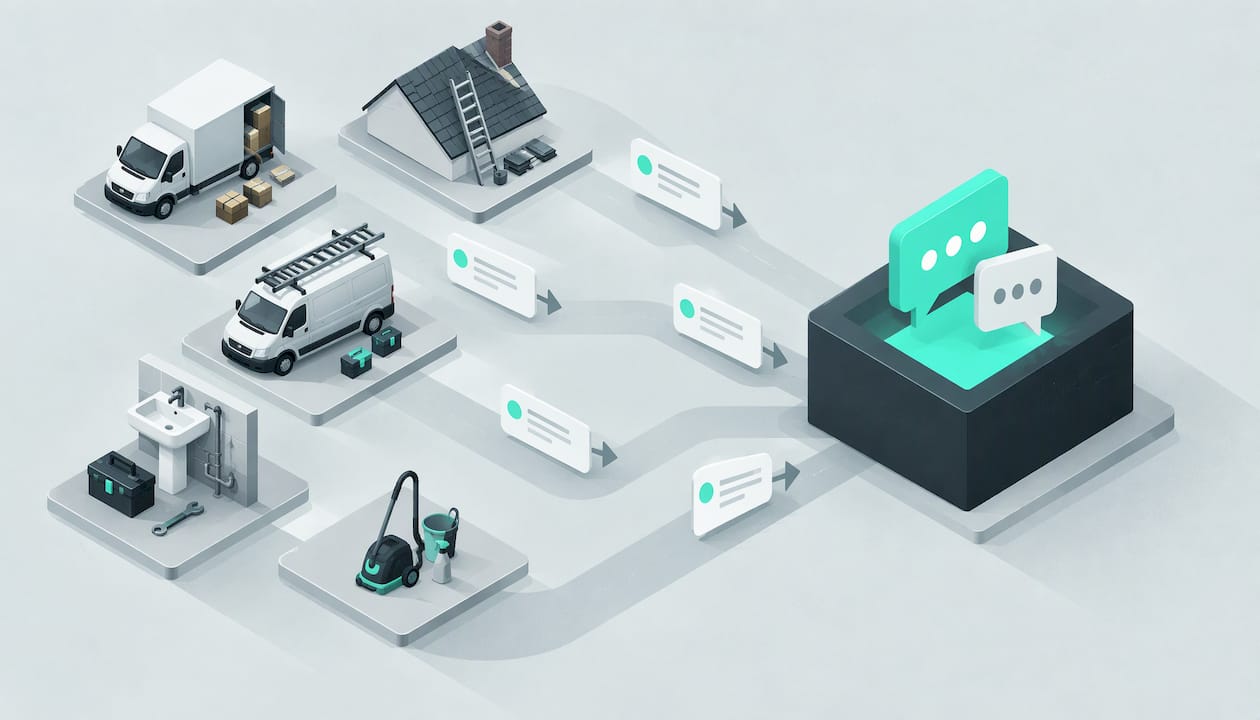
AI Call Answering for UK Trades: How It Works

AI call answering picks up your business line when you can’t, finds out what the caller needs, and passes the details to your team. For a trades firm, the way to judge it is to ring it yourself as a customer. Below are eight test calls to make before you buy, and what a good answer sounds like.
TL;DR
- AI call answering listens, works out what the caller wants from the information you gave it, replies in a synthetic voice and sends you a summary.
- Ring the demo line as your own customer: an emergency, a quote, an angry caller, a noisy call, “are you a robot?”, a wrong number, a price question and a call-back request.
- A good agent says it is AI when asked, asks for the job type, postcode and urgency, and never guesses a price it hasn’t been given.
- UK consumer law holds you responsible for what an AI agent says on your behalf, so test it before it takes real calls.
- DeskAgent® has no contracts, and single agents have no setup fee.
Table of Contents
- How does AI call answering work for a trade firm?
- Why test AI call answering before you buy?
- What are the eight test calls to make?
- What should you score after the eight calls?
- What does AI call answering cost for a trade firm?
- What does UK law expect when AI answers your calls?
- What do we think a good AI front desk looks like?
- Is DeskAgent right for your firm?
- FAQ
- Sources
How does AI call answering work for a trade firm?
The call comes in on your normal business number and is forwarded to the agent when you are busy, on a roof, under a sink or in the back of a van. Three steps happen in sequence: speech recognition turns the caller’s words into text, a language model decides what the caller wants, and a synthetic voice speaks the reply.
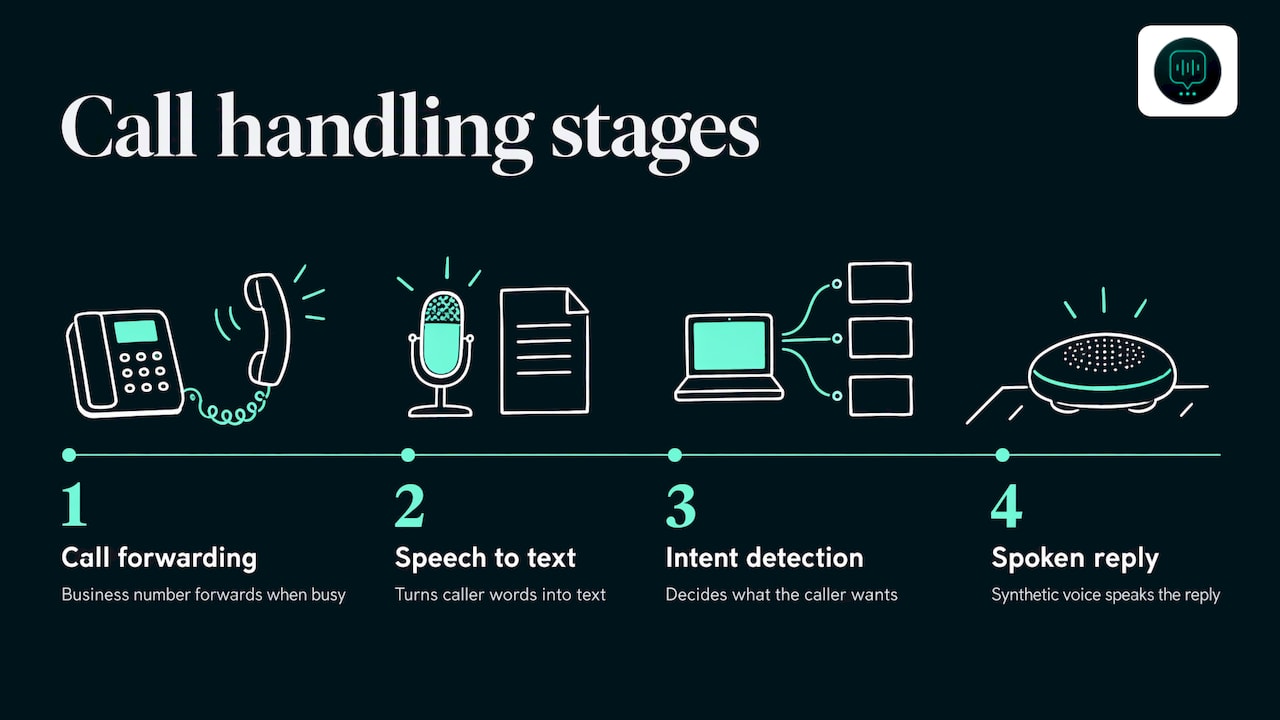
What separates a useful agent from a novelty is what it has been told about your business. A drainage firm in Bromley needs it to know which postcodes you cover and what counts as an emergency. A removals firm in Croydon needs it to ask about the move date, the number of bedrooms and the access at both ends.
Our Phone Agent works this way. It answers inbound calls on your business number via call forwarding, and it is set up for you and trained on your services, coverage area and FAQs. It qualifies each enquiry by job type, postcode and urgency, routes urgent jobs to you, books into your calendar and hands your team a summary with the full context. It then follows up with the customer on WhatsApp.
Why test AI call answering before you buy?
A brochure tells you what a system can do. A phone call tells you how it sounds to the person who is about to give you a £4,000 roofing job or walk away.
There is also a legal reason. The CMA’s guidance on complying with consumer law when using AI agents says consumer law applies whether a customer deals with a person or an AI. It says the business stays responsible even when a third party supplies the AI. It expects the AI to be tested before it is used and overseen by people afterwards. Testing it yourself, with your own awkward scenarios, is how you meet that in practice.
The guidance also says customers should be told they are dealing with AI where they might otherwise be misled. That is why the fifth test below matters.
Treat the demo as a short audition. Ring from your mobile, in the van if you can, and play the customer. We invite you to do this on our demo line, which you will find on our website. You can also book a free 30-minute demo, a call where we show an agent built for your business.
What are the eight test calls to make?
Make each call twice if you can: once politely, once badly. Customers rarely phone in a calm, tidy way.
1. The emergency: “My ceiling is coming down”
Ring as a homeowner with water coming through the ceiling, or a roof leak during a storm. You are testing whether the agent recognises urgency and acts on it.
What a good answer sounds like: it stays calm, asks the one or two questions that matter (what is happening, what is the address or postcode, is anyone at risk) and tells you what happens next. It does not read out a long menu. It treats the job as urgent and routes it to the owner, rather than taking a message for Monday.
A plumber or drainage firm should check one more thing: if the caller describes a danger to people, such as a gas smell, the agent should not try to solve it. It should point the caller to the emergency services and flag the job to you. Ask how your agent is set up to treat those calls.
What a bad answer sounds like: it asks for the caller’s email address first, or answers an emergency in the same tone as a routine enquiry.
2. The quote request: “How much to move a two-bed flat?”
This is the call that removals firms lose to faster competitors. Ring as someone moving from Croydon to Reading, or a landlord wanting a quote for a clear-out, and see how the enquiry is captured.
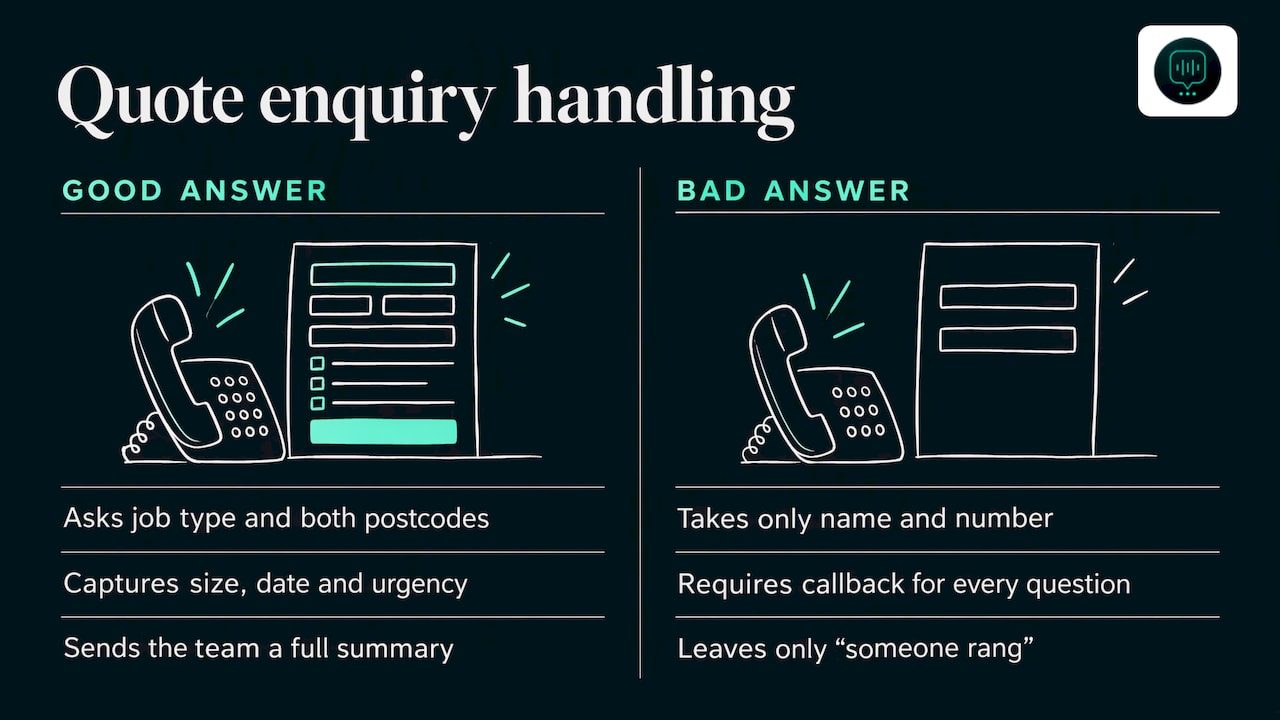
What a good answer sounds like: it asks for the things you would ask on the phone yourself: job type, postcode at both ends, rough size, preferred date and how urgent it is. It then says what happens next, and the details land with your team as a summary rather than a vague “someone rang”. Our removals page and our guide to AI receptionists for removal companies show how this is set up for movers.
Roofers and cleaners can run the same call with a different job. Ask for a flat roof repair in Ealing, or a one-off end-of-tenancy clean, and check the questions suit the trade.
What a bad answer sounds like: it only takes a name and number. Then you still have to ring back and ask every question yourself, which is the delay you were trying to remove.
3. The angry customer: “This is the third time I’ve rung”
Ring as someone whose boiler repair was missed, or a landlord whose pest treatment didn’t work. Be short with it. Interrupt.
What a good answer sounds like: it doesn’t argue, doesn’t read a script and doesn’t promise a refund, a visit time or an outcome it has no authority to give. It acknowledges the problem, collects the facts and gets the matter to a person. The CMA guidance and the wider advice on AI receptionists agree on this point: complaints and upset callers belong with a human.
What a bad answer sounds like: a cheerful, repeated “I’d be happy to help with that!” while the caller is shouting. Or an invented promise that you then have to honour.
4. Background noise: the call from a road, a roof or a van
Your customers ring from building sites, school runs and windy car parks. Ring from somewhere noisy: a main road, a kitchen with the extractor on, or with the radio playing.
What a good answer sounds like: if it mishears something, it checks. It reads back the postcode or phone number and asks you to confirm. Postcodes and names are where speech recognition goes wrong most often, so a repeat-back is a sign of care. Try an awkward surname and a postcode with letters that sound alike, such as B and D.
What a bad answer sounds like: it carries on with a wrong postcode, and the job goes to the wrong area or the callback goes to the wrong number.
5. “Are you a robot?”
Ask it plainly, halfway through the call, in the middle of giving your details. Then ask again.
What a good answer sounds like: a straight yes. Our agents are natural-sounding, and they always say they are AI if asked. The agent should then carry on helping, without turning stiff or defensive.
This is a trust issue as much as a legal one. The CMA’s guidance says disclosure matters where not knowing could affect a customer’s decisions, and the ICO’s guidance on explaining AI sets out how organisations should be open with people about AI’s role. A customer who finds out later that they were talking to software they were not told about is a customer you may lose.
What a bad answer sounds like: a dodge (“I’m here to help you today”), a joke that avoids the question, or a flat denial.
6. The wrong number
Ring and say you want to speak to a solicitor, or ask for a pizza. Or ring a drainage firm and ask for a wedding photographer.
What a good answer sounds like: it works out the call isn’t for your business, says so politely and doesn’t waste anyone’s time. It doesn’t log the caller as a hot lead or send your team a summary full of nonsense.
This matters because a front desk that records every call as a job fills your day with noise. A sensible agent keeps the summaries your team receives worth reading.
What a bad answer sounds like: it tries to book you a boiler service because you said “service”.
7. The price question: “How much do you charge?”
Ask a plumber for the cost of unblocking a sink, a roofer for the price of re-pointing a chimney, or a cleaner for the rate per hour. Then push: “Just give me a ballpark.”
What a good answer sounds like: it gives only what you have told it to give. If you publish a call-out fee or a minimum charge, it can say so. If the price depends on a survey, it says that and moves to booking the survey. Warnings about AI receptionists are consistent on this point: one that guesses to fill a silence can give the wrong price or date, and callers treat what it says as official.
Owners also need to be able to change the answer easily. With DeskAgent HQ you can update prices and FAQs from one WhatsApp chat, so the agent doesn’t quote last season’s rates.
What a bad answer sounds like: a made-up figure, or a refusal to say anything at all, including your published call-out fee.
8. The call-back request: “Can someone ring me later?”
Tell the agent you can’t talk now. You are at work, in a meeting, with the kids.
What a good answer sounds like: it asks when suits you and the best number, confirms the details and records the preference. The summary your team receives should include the whole conversation and the time you asked for, so nobody phones at the wrong moment and asks you to repeat yourself. A follow-up on WhatsApp is useful here, because many customers would rather reply by message than answer a call from an unknown number.
What a bad answer sounds like: “Someone will be in touch” with no time and no record of what you needed.
What should you score after the eight calls?
Keep it simple. After each call, note four things:
| Check | What you want to hear |
|---|---|
| Job details | Job type, postcode and urgency captured, not just a name |
| Honesty | Says it is AI when asked, and doesn’t invent prices or dates |
| Handover | Urgent jobs go to a person, and the summary tells your team everything |
| Tone | Natural and calm, including when you are rude or the line is bad |
If an agent fails the emergency call or the “are you a robot?” call, stop there. Those two tell you the most.
Ring at an odd time as well, such as 11pm on a Sunday. The point of AI call answering is that it picks up when your team can’t. A roofer who is on a site until 6pm and a removals firm that gets most of its quote enquiries in the evening both need the line covered after hours.
What does AI call answering cost for a trade firm?
Our prices are published and simple:
- Phone Agent: £125 a month
- WhatsApp Agent: £125 a month
- Web Agent: £85 a month
- Inbox Agent: £85 a month
- Full DeskAgent, with all four agents plus DeskAgent HQ: £285 a month
There are no contracts and you can cancel any time. Single agents have no setup fee, because the first month covers the build. The Full DeskAgent 3-month pilot is a one-off £500 that covers the build and three months live, then £285 a month. Our inbound calls are unlimited. You can see the plans on our pricing page, and our guide to what service firms actually pay for an AI receptionist explains how to compare quotes.
When you compare any service, ask what happens to the bill when your busiest week comes. Per-call and per-minute pricing can rise with your enquiries, and a heating firm in a cold snap gets exactly the volume that costs the most.
What does UK law expect when AI answers your calls?
Three points are worth knowing, and none needs a lawyer to understand.
You are responsible for what the agent says. The CMA’s guidance on consumer law and AI agents says a business is accountable for its AI as it is for its staff, even when someone else built it. So what the agent says about prices, dates and your terms is your word.
Be open about AI. The same guidance says AI use should be disclosed where customers might otherwise be misled. An agent that tells callers it is AI when asked meets the plain-sense test, and so does a business that is clear on its website and in its greeting.
Handle personal data properly. Callers give you names, addresses and phone numbers. The ICO publishes the UK rules for organisations using AI, including the ICO’s guidance on explaining AI, and it is the place to check your own obligations. If you are unsure how they apply to your firm, ask a data protection adviser.
What do we think a good AI front desk looks like?
We built DeskAgent for the owner who is up a ladder when the phone rings, not for a call centre. The firms we work with lose jobs in a very ordinary way: a missed call, a slow reply, a customer who rings the next firm on the list.
So we think about the front desk as a whole. Four agents (Phone, WhatsApp, Web and Inbox) share one brain, so the customer who rang on Monday and messaged on Tuesday is not asked everything again. Each agent is set up for you, trained on your services, your coverage area and your FAQs.
The eight test calls above are the ones we would make ourselves. We want you to ring the demo line and try to catch it out. An agent should say it is AI when asked, should hand urgent jobs to you and should leave your team with a summary they can act on.
Then there is the owner’s side. DeskAgent HQ lets you run it all from one WhatsApp chat: update prices and FAQs, pause the agents, check today’s leads and ask for summaries when you want them. That is the control a busy owner needs.
Monty Gordon, founder of DeskAgent
Is DeskAgent right for your firm?
If missed calls cost you jobs, a front desk that answers every call, asks the right questions and gets urgent work to you is worth trying properly. Start with the Phone Agent at £125 a month, or the Full DeskAgent at £285 a month if enquiries also come in on WhatsApp, your website and email.
The easiest way to judge it is on the phone, with your own jobs. In the free demo, a 30-minute call, we show an agent built for your business, whether you run removals, roofing, drainage, plumbing, cleaning, pest control or property maintenance. You can book a free 30-minute demo on our site. Our guide to the best AI receptionists in the UK covers the other options by type if you want to compare first.
FAQ
Can AI really answer my phone calls while I’m on a job?
Yes. Calls to your business number are forwarded to the agent when you can’t pick up. It asks what the job is, where it is and how urgent it is, then passes the details to you. Urgent jobs are routed to the owner.
Will customers know they are talking to AI?
Our agents are natural-sounding and always say they are AI if asked. They don’t pretend to be a person. Test it yourself with call five above.
Do I need a contract or a setup fee?
No contracts, and you can cancel any time. Single agents have no setup fee, because the first month covers the build. The Full DeskAgent 3-month pilot is a one-off £500 covering the build and three months live, then £285 a month.
What if a caller wants to speak to a person?
That is exactly what the angry-customer and emergency calls test. A good setup gets urgent jobs and upset callers to you, with a summary of what has already been said, so you don’t start from scratch.
Can it handle more than phone calls?
Yes. DeskAgent has four agents, Phone, WhatsApp, Web and Inbox, plus DeskAgent HQ. The Phone Agent covers calls, while the others cover WhatsApp messages, website chat and email enquiries, including filtering spam.