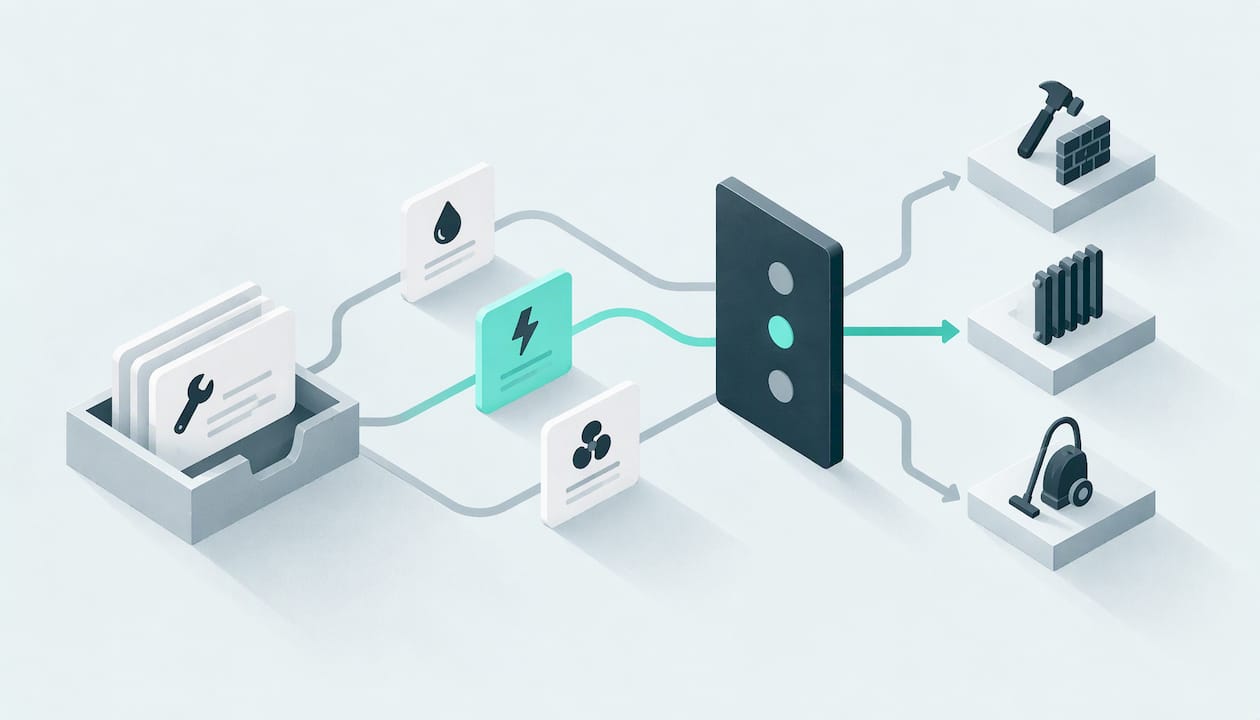
Priority Jobs Scheduling for Trades: A Guide
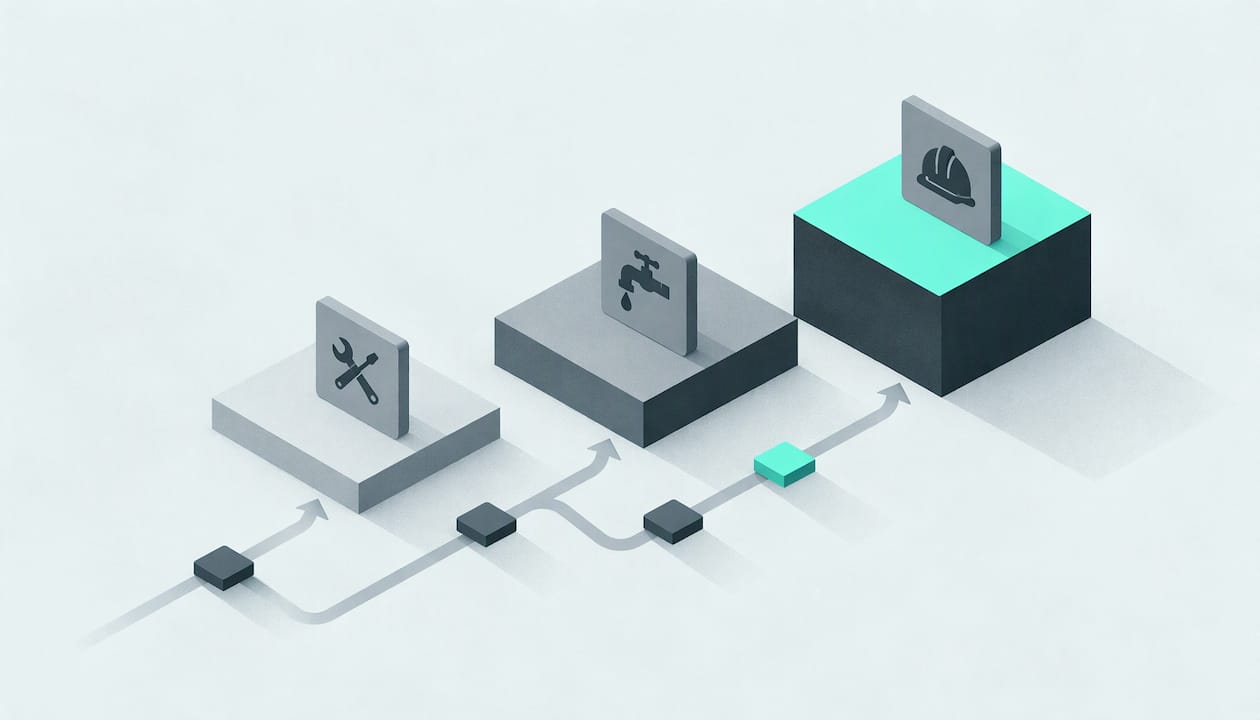
Priority jobs scheduling means sorting every enquiry into emergency, urgent or routine before you touch the diary. Ask the same few triage questions each time, give each band a fixed meaning, and hold two buffer slots a day so emergencies never bump booked customers without warning. DeskAgent® can ask those questions for you.
TL;DR
- Three bands are enough for a small firm: emergency, urgent and routine. Write down what each one means so the loudest caller does not set the order.
- Six triage questions decide the band: danger, location, the job, access, timing and whether it is your kind of work.
- Keep two buffer slots in every day, one mid-morning and one mid-afternoon, and release them only when the day is clearly quiet.
- Social housing work has legal clocks: Awaab’s Law sets 24 hours for emergency hazards and 10 working days to investigate significant ones.
- Tell every displaced customer yourself, early. Most broken promises are really unannounced changes.
Table of Contents
- Why does a first-come-first-served diary cost trades work?
- What does a job priority matrix look like for trades?
- What triage questions set the priority band?
- What are the Awaab’s Law timescales for social housing repairs?
- How do you fit emergencies around planned work?
- What does a sample day with two buffer slots look like?
- Can the same system reduce no-shows and failed visits?
- How can an AI front desk apply your priority rules?
- What does a good priority rule look like in writing?
- What is our view on priority jobs scheduling?
- FAQ
- Sources
Why does a first-come-first-served diary cost trades work?
Without a written rule, jobs go into the diary in the order they were asked for. That sounds fair, but it means a routine gutter clean booked on Monday can block a roof leak that rings in on Tuesday, or a scared caller with a dripping tap can pull a plumber away from a customer who is already waiting.
It also costs you in a quieter way. When you are up a ladder or under a sink, the call goes to voicemail, and the caller moves on to the next firm on the list. Your priority system only works on enquiries you actually capture. For more on that side, see our post on handling emergency maintenance calls.
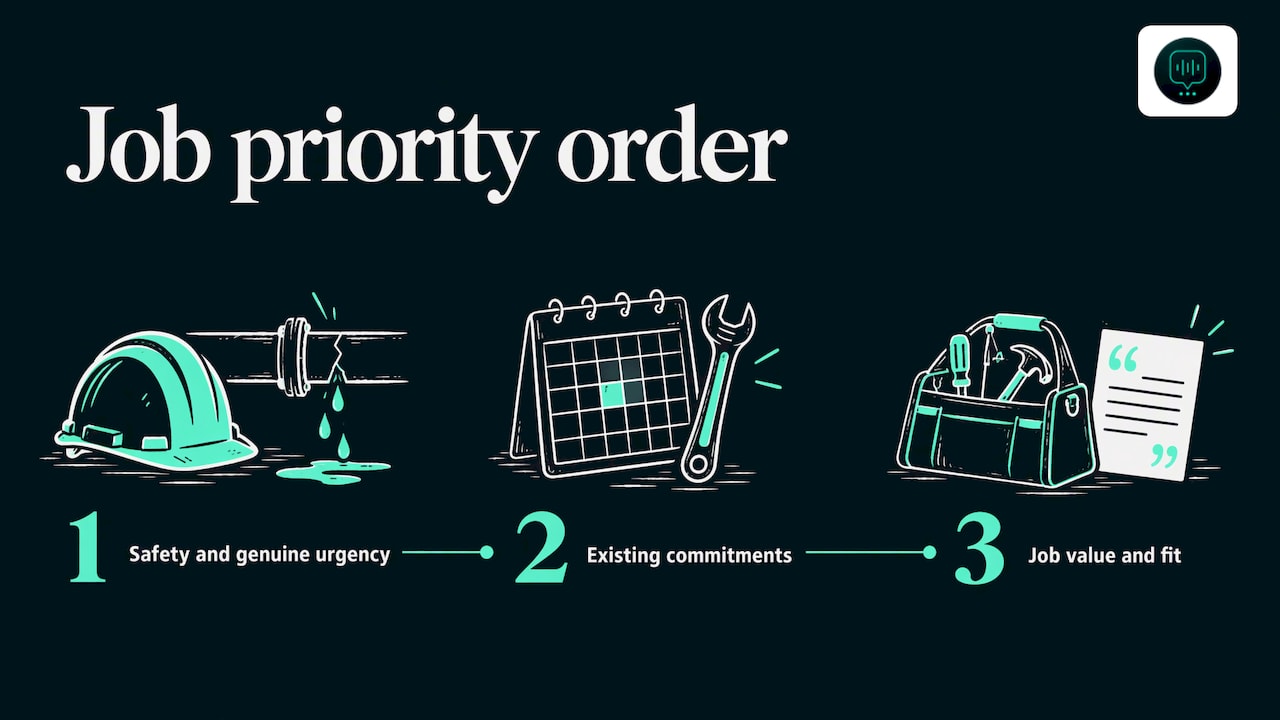
The fix is a rule that is simple enough to apply when the phone is ringing. Safety and genuine urgency come first, then commitments you have already made to other customers, then the value and fit of the job. Customers do not decide the band by how they sound. You do, from facts.
What does a job priority matrix look like for trades?
A job priority matrix is a short table that says what each urgency band means, which jobs fall in it and what you tell the customer. It balances two things: how much harm or damage follows if nobody acts, and how soon. The government’s own maintenance prioritisation guidance for schools takes the same risk-based approach, rating health and safety, impact on operations and likelihood of failure, and says its matrices are examples to adapt rather than a fixed method.
Here is a version a property maintenance firm or small trades business can adopt as it stands and then adjust.
| Band | What it means | Trade examples | What to tell the customer |
|---|---|---|---|
| Emergency | Immediate danger to people or fast-growing damage. Act now, ahead of routine work. | Burst pipe flooding a flat in Lewisham. Sparking or burning smell from a consumer unit. Roof torn open after a storm in Ealing. Sewage backing up into a home from a blocked drain. | Give safety advice first (isolate water, leave the property, ring 999 for fire or immediate danger). Then say you are sending the nearest qualified operative and that you will confirm timing as soon as you know it. Give no arrival time you cannot keep. |
| Urgent | Real disruption or a risk that worsens, but nobody is in immediate danger. Same day or next available slot. | No heating in cold weather. A slow roof leak into a loft. A drain that is slow but still flowing. A wasp nest by a school entrance. A removals customer whose completion date has moved forward. | Explain it is being treated as a priority and give your honest next availability, plus the call-out charge and labour rate up front. |
| Routine | Planned or non-critical work. Booked around the first two bands. | Annual boiler service. Gutter clearance. Quote for a loft conversion. A removals survey for a house move in six weeks. Regular office cleaning. | Offer a booked window, say what to prepare, and say you will confirm the day before. |
Two rules keep the table honest. First, a customer calling a job urgent does not make it urgent. A late decision on their side is not an emergency on yours, and an urgent job can justify a premium rate if you have the capacity and skills, as long as you do not abandon commitments you have already made or skip safety checks. Second, a band can change. A small leak that has reached an electrical fitting has moved up. Record the reason when you move a job, so the next decision is easier.
What triage questions set the priority band?
Triage is a handful of questions asked in the same order on every enquiry, whether it arrives by phone, WhatsApp, web chat or email. These six cover most trades:
- Is anyone in danger? Gas smell, carbon monoxide alarm, live electrics near water, fire, a collapsing ceiling or a flooded home with vulnerable occupants. If yes, give safety advice and treat it as an emergency. For a gas smell, the caller should leave the property and contact the National Gas Emergency Service, not wait for you.
- Where is the property? A postcode tells you whether the nearest operative is in Croydon or on the other side of London, and whether the job is in your coverage area at all.
- What exactly is the problem? “Leak” could be a weeping joint or a ceiling coming down. Ask where the water is coming from, whether it can be isolated, and how fast it is happening.
- Can we get in? Keys, a tenant who works nights, a managing agent’s permission, parking for a van or a removals lorry, scaffolding access for a roof.
- What is the timing? Is there a hard deadline such as a completion date, a tenant moving in, an inspection or a landlord’s obligation?
- Is it our kind of work? A roofer should not hold a slot for a boiler fault. Decline early and cleanly.
Write the answers into the job record, because the person who attends needs them. Each answer also feeds back into the band. Danger moves a job up. Missing access holds it in a “waiting for information” state until someone has chased it. For a deeper look at how we handle sorting enquiries, our post on AI lead qualification covers job type, postcode and urgency.
What are the Awaab’s Law timescales for social housing repairs?
If you do repairs for housing associations or councils, the urgency bands are partly set for you. Awaab’s Law applies to social landlords in England, and the GOV.UK Awaab’s Law guidance sets two clocks that matter to a contractor:
- Emergency hazards: the landlord must investigate and carry out relevant safety work within 24 hours of becoming aware of the hazard. An emergency hazard is one that poses an imminent and significant risk of harm to the occupier.
- Significant hazards: the landlord must investigate within 10 working days of becoming aware of them. The guidance’s own damp and mould example then schedules a mould wash within five working days of the investigation, with monitoring continuing while the underlying cause is dealt with.
In practice, that means a landlord’s emergency or significant-hazard job arrives with a clock already running. Build those into your matrix as a fixed note on the band: if a damp and mould report is flagged as a potential emergency hazard, it goes straight into your emergency band and a named person confirms with the landlord who will attend. For significant hazards, the investigation visit needs a booked slot early in the 10 working days, not at the end.
This is the one area where a deadline is not your choice. We do not set or promise attendance times for you, and the guidance is where to check the detail of how the landlord’s obligations apply to a particular job.
How do you fit emergencies around planned work?
Emergencies are unpredictable one at a time, but over a few months they become predictable in total. Look back at your last quarter and count how many same-day jobs came in and how many hours they used. That number sizes your buffer.
A workable approach has four parts:
- Fixed first. Booked appointments with an agreed window and any job with a hard deadline go into the diary before anything else.
- Flexible work fills the gaps. Routine jobs that can happen any day this week are clustered by area, so one van covers a neighbourhood rather than crossing London twice.
- Buffers are real. Field-service planners commonly suggest holding around 10 to 20 per cent of daily hours for reactive work, sized from your own history. Start there and adjust.
- Usable hours are not paid hours. Subtract travel, parking, stocking the van and paperwork before counting capacity.
When an emergency lands on a full day, run it through the same short check: is it truly an emergency, who is the nearest qualified operative, what is the knock-on for the job they would leave, and who will tell the affected customer? If nobody can take it without breaking a promise, your options are to move a flexible job, agree a longer window with the customer or hand it on, rather than quietly stacking it on an overloaded route.
What does a sample day with two buffer slots look like?
Here is a day for a two-person plumbing and drainage firm in south London. Each van has a mid-morning and mid-afternoon buffer. Times are working estimates, not promises to customers.
| Time | Van 1 | Van 2 |
|---|---|---|
| 8:00 to 10:00 | Fixed: booked boiler repair, Croydon | Fixed: booked drain survey, Streatham |
| 10:00 to 11:00 | Buffer 1 (emergency or urgent work) | Buffer 1 (kept free, or used for a flexible job nearby) |
| 11:00 to 13:00 | Flexible: two routine jobs, same postcode area | Time-critical: landlord’s repair with a compliance deadline |
| 13:00 to 14:00 | Lunch, restock, paperwork | Lunch, restock, paperwork |
| 14:00 to 15:30 | Fixed: booked radiator replacement | Flexible: quote visit |
| 15:30 to 16:30 | Buffer 2 (same-day urgent work) | Buffer 2 (released only if the day is quiet) |
| 16:30 to 17:00 | Close-out notes and next-day confirmations | Close-out notes and next-day confirmations |
Two things make this work. The buffers are protected, so the office does not fill them at 8am with a quote visit. And there is a release rule: if by early afternoon nothing has come in, Buffer 2 is offered to a flexible job, so the time is not wasted.
If a burst pipe arrives at 9:15, Van 1 takes it in Buffer 1 or, if it is truly dangerous, swaps with the least critical fixed job. The displaced customer gets a call from you straight away. Emergencies damage relationships not because appointments move but because nobody tells the person who was displaced. Decide in advance who makes that call.
Can the same system reduce no-shows and failed visits?
It helps, because a clear window and early confirmation make wasted trips less likely. Klipboard’s research on UK and Irish garages (2026, covering 1.8 million bookings from January to May) found that 12% of bookings ended in a no-show. That is a garage dataset, but the lesson carries over to any firm that books time slots: an empty slot is lost money.
Practical habits for trades:
- Give a window you can reliably keep, not the narrowest one the customer would like.
- Confirm at booking, the day before and when you are on the way, by message rather than email alone.
- State access needs in the confirmation: keys, parking, who will be home.
- If you will be late, say so before the window passes, with the new expected time.
A removals firm in Croydon, for example, loses a whole lorry crew’s day if the customer has not arranged parking. Asking about access at the enquiry stage, and confirming it again before the move, protects that day. Our removals page explains how that sort of enquiry is handled.
How can an AI front desk apply your priority rules?
A priority system fails at the moment of the call. You are on a roof, the office manager is on another line, and the enquiry is not triaged until someone has time. We built DeskAgent so that your rules are applied to every enquiry as it arrives.
The Phone Agent answers inbound calls on your business number via call forwarding. It is trained on your services, coverage area and FAQs, and qualifies each enquiry by job type, postcode and urgency. Urgent jobs are routed to you, jobs are booked into your calendar, and your team gets a summary with the full context. It then follows up with the customer on WhatsApp. The WhatsApp, Web and Inbox Agents do the same job on their channels, sharing one brain. The agents sound natural and always say they are AI if asked.
With DeskAgent HQ, you can run it all from one WhatsApp chat: update prices and FAQs, pause the agents, check today’s leads and ask for summaries.
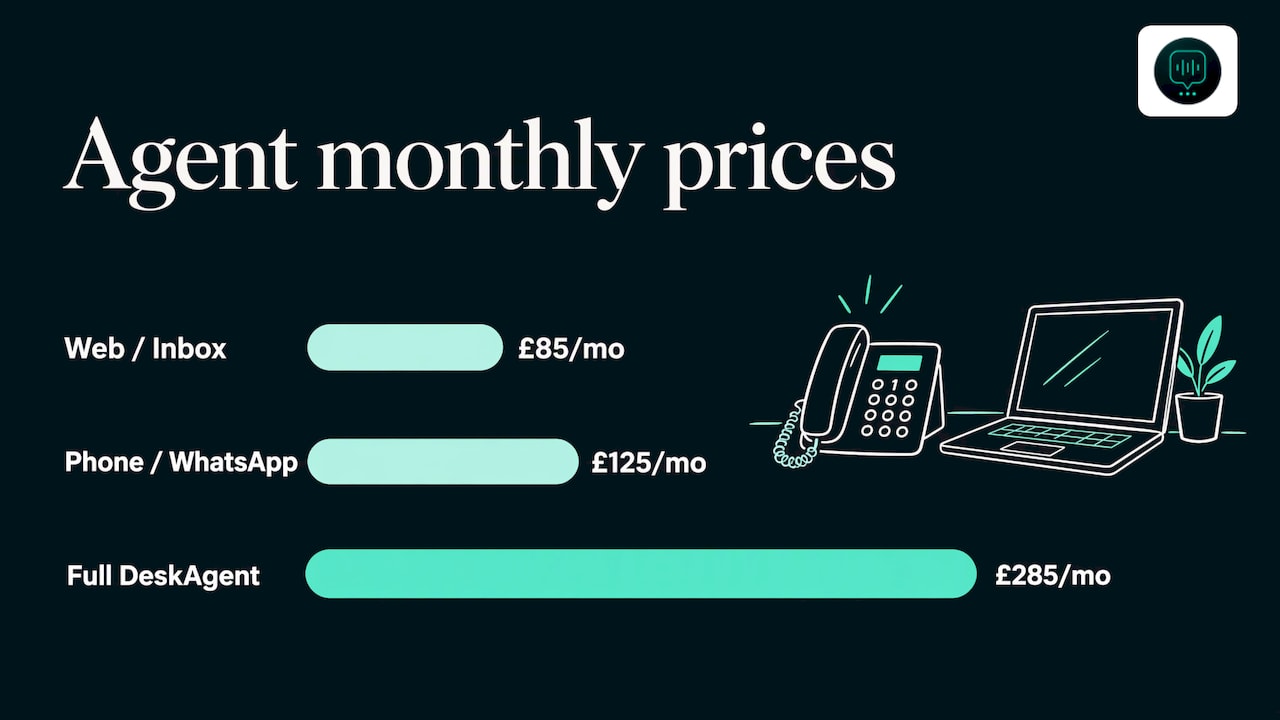
Pricing is published and simple. The Web Agent and Inbox Agent are £85 a month each. The Phone Agent and WhatsApp Agent are £125 a month each. Full DeskAgent, which is all four agents plus DeskAgent HQ, is £285 a month. Single agents have no setup fee, as the first month covers the build. The Full DeskAgent 3-month pilot is a one-off £500 that covers the build and three months live, then £285 a month. There are no contracts and you can cancel any time. See the full pricing, or book a free 30-minute demo: a call where we show an agent built for your business.
What does a good priority rule look like in writing?
Write it on one page and keep it next to the phone. A sample for a property maintenance firm:
- Safety and immediate damage come first, whoever calls.
- Statutory or contractual clocks come second, such as a social landlord’s Awaab’s Law deadline.
- Appointments already confirmed come third. They move only with a call from us.
- Everything else is ordered by fit, location and value.
Add the names: who takes emergencies, who calls displaced customers, who may move a booked job. Review it every quarter against what actually happened. If emergencies keep eating Buffer 2, make it bigger. If nobody ever uses Buffer 1, cut it.
The rule matters most when you are busiest. Without it, the person who rings most often or complains loudest sets your day, and that is rarely your best customer.
What is our view on priority jobs scheduling?
Most trades owners we talk to already know which jobs matter most. The trouble is that the knowledge sits in their head, and their head is on a roof, under a sink or in a van when the call comes in.
We think a priority matrix is only worth having if it is applied the same way to every enquiry, at every hour, on every channel. That is why DeskAgent is built as four agents, Phone, WhatsApp, Web and Inbox, sharing one brain, with DeskAgent HQ on top so you can change a price, pause the agents or ask for today’s leads from a WhatsApp chat.
Your rules decide the bands. The agents ask the questions, pass urgent jobs to you, book the rest into your calendar and give your team the full context. That leaves you to do the thing the diary cannot do for you: attend the job.
Monty Gordon, founder of DeskAgent
FAQ
How do I decide whether a plumbing or roofing call is an emergency?
Ask whether anyone is in danger and whether damage is getting worse quickly. Water that cannot be isolated, electrics near water, a gas smell or a roof open to the weather are emergencies. A slow drip or a cosmetic problem is not, however the caller describes it.
How many buffer slots should I keep each day?
Two is a sensible start for a small firm, one in the morning and one in the afternoon. Look at the last three months of same-day jobs and size them to match, then adjust each quarter. Release a buffer to routine work only when the day is clearly quiet.
What do I say to a customer I have to move for an emergency?
Call them yourself, early, and explain plainly that an emergency has come in. Offer the next realistic slot and confirm it in writing. Do not blame the customer or promise a time you cannot keep.
Can I charge more for urgent same-day work?
Many firms do, provided the call-out charge, labour rate and material terms are stated up front. Premium work should not mean dropping existing commitments or skipping safety checks, and the rate should be written into your priority rule so everyone applies it the same way.
Sources
- Awaab’s Law: Guidance for social landlords, GOV.UK
- How to prioritise maintenance, Department for Education guidance
- The average UK garage loses over £40,000 per year from customer no-shows, Klipboard research, 2026