Telephone Answering Service: UK Small Firm Guide

A telephone answering service picks up your business calls when you cannot, takes the details and passes them on. For a UK trades or small firm, choose on twelve things: hours, who answers, what gets captured, how messages reach you, emergencies, contract length, pricing, data, scripts, recordings, setup time and trial.
TL;DR
- A telephone answering service covers calls you miss while you are on a roof, under a sink or in a van. What matters is what happens to the enquiry afterwards, not just that someone picked up.
- Ask twelve questions before signing: the checklist below covers hours, emergencies, contract, pricing, data, recordings, setup and trial.
- Pricing comes in a handful of models: per message, per minute, bundled calls, flat monthly and subscription. Pick the one that fits your call volume, not the lowest headline number.
- An AI front desk such as DeskAgent® answers calls, WhatsApp, web chat and email, qualifies each enquiry and books into your calendar, with no contracts.
Table of Contents
- What is a telephone answering service and who is it for?
- What should I ask before I sign up? The 12-question checklist
- How is a telephone answering service priced?
- What are the types of telephone answering cover?
- How do trades firms use a telephone answering service?
- Where does an AI telephone answering service fit?
- Should I choose a human or AI service?
- Why we built DeskAgent the way we did
- What does it cost to get started with DeskAgent?
- FAQ
- Sources
What is a telephone answering service and who is it for?
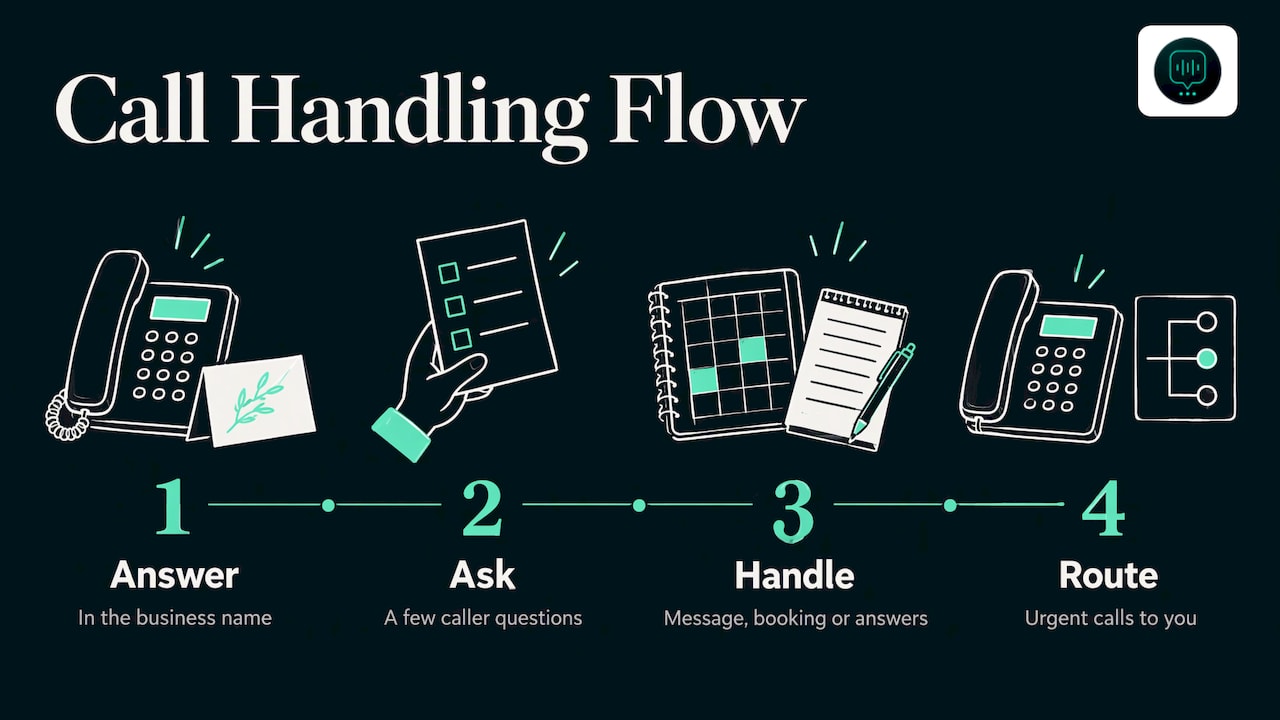
A telephone answering service takes your calls when you are busy, away or closed. Someone, or something, answers in your business name, asks the caller a few questions, and sends you the details. Some services only take a message. Others book appointments, route urgent calls to you or answer simple questions about your services.
It is built for people who cannot be at the phone all day. That is most of the UK business population: the FSB’s UK small business statistics show that small firms make up the overwhelming majority of UK private sector businesses, and many of them are owner-run with nobody back at the office.
Take a roofer in Ealing who is forty feet up when a homeowner rings about a leak. Or a drainage firm in Croydon with both vans out on call-outs. Or a removals company in Lewisham whose office manager is on a lunch break while someone rings for a quote. The caller does not leave a voicemail and wait. They ring the next firm on the list. An answering service exists to stop that.
What should I ask before I sign up? The 12-question checklist
Work through these in order. Write the answers down and compare them across any provider you are considering, human or AI.
1. What hours does it cover?
Most enquiries for trades arrive outside 9 to 5: early mornings, evenings, weekends. Ask whether the service answers 24 hours a day, or only office hours plus an overflow option. Check bank holidays and Christmas too. A burst pipe on Boxing Day is still a burst pipe.
2. Who or what actually answers?
There are three broad types: a shared pool of human receptionists, a dedicated receptionist or small team, and an AI agent. Ask how calls are picked up when several arrive at once, and whether callers ever wait in a queue. If it is AI, ask how it behaves when someone asks whether they are speaking to a person. Our agents always say they are AI if asked, and that is a good standard to hold any provider to.
3. What does it capture from each call?
This is the question most people skip. A name and a number is not an enquiry. For a removals firm you need the collection and delivery postcodes, the property size, the date and whether there is a lift. For a plumber you need the fault, the postcode and how urgent it is. Ask for a sample of what lands in your inbox after a typical call, and check it matches how you quote.
4. How do messages reach you?
Email, text, an app, WhatsApp, a portal? If you are on a ladder, a long email is no use. You want a short summary you can read in ten seconds with the full detail behind it. Ask how fast messages are passed on, and whether the timing is promised in writing or just described in marketing.
5. What happens with an emergency?
Decide in advance what counts as urgent: no heating in winter, a flooded kitchen, a collapsed section of guttering, a wasp nest over a school run. Ask whether the service can route those calls to you or an on-call colleague straight away, what it does when you do not pick up, and who it tries next. Get the escalation order agreed before you go live.
6. How long is the contract and how do you leave?
Some services tie you into twelve months or more. Others run monthly. Ask about notice periods, what happens to unused minutes or calls, and whether you can pause during a quiet season. Our own plans have no contracts and you can cancel any time, which is worth comparing against any term you are offered.
7. Is pricing per call, per minute or flat?
The model changes your bill far more than the headline figure does. See the table below. Work out your typical month: how many calls, how long each lasts, how many are sales calls or wrong numbers you would rather not pay for.
8. Where is call data stored, and who can see it?
Calls contain names, addresses and sometimes details about when a property is empty. Ask where the data is stored, who can access it, how long it is kept and how you can have it deleted. Ask whether the provider has a privacy notice you can read before signing. The Information Commissioner’s Office (ICO) is the UK regulator for data protection, and any provider should be comfortable explaining how it handles personal data.
9. Who writes the script, and can you change it?
A good service is trained on your services, your coverage area and your prices or price guidance. Ask who writes the script, how long changes take and whether you pay for each update. If you add a service or stop covering a postcode district, the service needs to reflect that quickly.
10. Are calls recorded, and for how long?
Recordings help when a customer disputes what was agreed. They also bring responsibilities: callers should be told a call is recorded, and recordings should not be kept longer than you need them. Ask whether recording is on by default, whether you can switch it off, and how you access a recording.
11. How long does setup take, and who does it?
Some providers hand you a form and a login and leave you to it. Others build the service for you. Ask for a realistic timeline, what you need to provide (call forwarding settings, price lists, FAQs, service areas) and whether the first month is a trial of the build or a full billing month.
12. Can you try it first?
A trial or demo tells you more than a brochure. Ask whether there is a free trial, a money-back period or a short rolling month, and test with real scenarios: a late-night emergency, a quote request, a wrong number, a caller with a strong accent or a bad line.
How is a telephone answering service priced?
Prices vary with how the provider counts the work. Here are the models you will meet and what each means for a small firm.
| Pricing model | How it works | Suits | Watch for |
|---|---|---|---|
| Per message | You pay for each message taken, often in monthly bundles | Very low call volumes | Costs climb in busy weeks; spam and wrong numbers may count |
| Per minute | Billed on talk time, often with a minimum block | Short, simple calls | Long quote calls use the bundle fast |
| Bundled calls | A monthly fee covers a set number of calls | Steady, predictable volume | Overage charges, unused calls lost at month end |
| Flat monthly fee | One price however many calls arrive | Busy firms and seasonal spikes | Check what is included, such as channels and booking |
| Subscription per channel | A monthly price for each channel, such as phone or WhatsApp | Firms who want to add channels over time | Compare the all-in price for the channels you need |
Work out your numbers before you ask for a quote. Count missed calls across a normal fortnight, note how long your average quote call takes, and add VAT where the provider quotes ex-VAT prices. If your price is per call, a busy season such as the first cold snap for heating engineers can quietly double your bill.
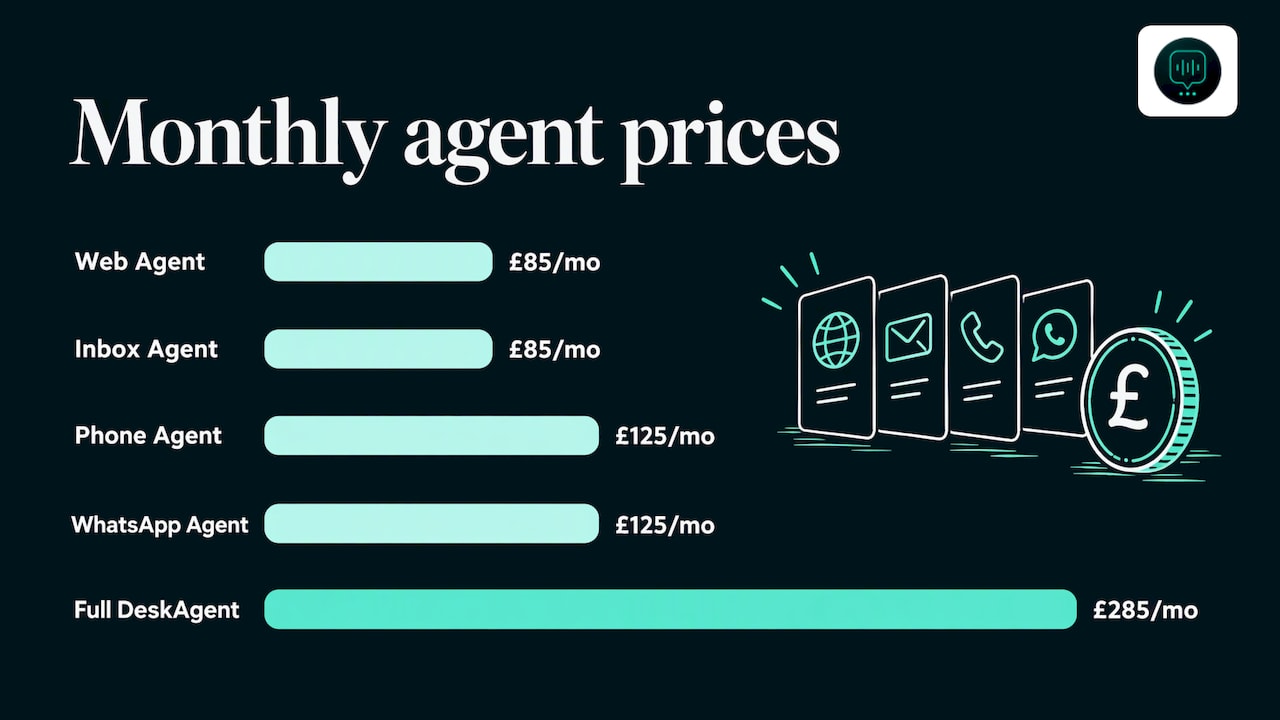
For reference, our monthly prices are published: Web Agent £85, Inbox Agent £85, Phone Agent £125, WhatsApp Agent £125, and Full DeskAgent, with all four agents plus DeskAgent HQ, £285. The full breakdown is on the pricing page.
What are the types of telephone answering cover?
It helps to know the options by type, because they solve different problems.
- Voicemail and a callback routine. Free and simple, but the caller has often rung somebody else by the time you ring back.
- Diverting to a colleague. Works until they are also busy, on holiday or asleep.
- Missed-call text-back. Reaches mobiles and acknowledges the call, but it does not take details, qualify the job or book anything.
- A human answering service. Receptionists follow a script, take a message and pass it on, usually for a monthly fee plus per-call or per-minute charges.
- An in-house receptionist. Familiar with your business, but only there during working hours and needing cover for breaks and absence.
- An AI front desk. Answers every call, qualifies by job type, postcode and urgency, and can book into your calendar.
The point that separates these is what happens to the enquiry after the call. A message-taker passes on a name and number. A front desk that knows your services and areas can sort the job before you ever see it. For more on the human options and what they cost, see our guide to a 24/7 answering service in the UK.
How do trades firms use a telephone answering service?
The best setups follow the shape of the job.
Removals. A quote enquiry is time-sensitive. The caller is often ringing three or four firms and books the first that engages properly. The agent needs to capture both postcodes, the date, the property size and access details, then hand you a summary. There is more on this in our removals page.
Roofing. Weather drives the calls. After a storm you may get dozens in a day while your crew is on site. You need to separate emergency leaks from quote requests and get the urgent ones to you straight away.
Drainage and plumbing. Blocked drains and burst pipes are urgent and local. A call from outside your coverage area wastes your time, so postcode screening matters as much as speed.
Cleaning and pest control. High enquiry volume, many of them repeat or price-led questions. Here consistent answers to FAQs matter, and so does booking straight into the diary.
If you want more on the trade-specific side, our answering service for tradesmen guide goes into detail.
Where does an AI telephone answering service fit?
An AI front desk answers your business number through call forwarding, asks the questions you would ask, and passes on a summary. Our Phone Agent is built exactly for this: it answers inbound calls on your business number, qualifies each enquiry by job type, postcode and urgency, routes urgent jobs to you and books into your calendar. The voice is natural-sounding, and it always says it is AI if asked.
The important bit for a small firm is that enquiries do not only come by phone. Customers send WhatsApp messages, fill in website chat and email at 10pm. Four agents (Phone, WhatsApp, Web and Inbox) share one brain, so the same services, coverage area and FAQs apply everywhere, and the follow-up with the customer goes out on WhatsApp.
When you apply the 12 questions to an AI service, the answers look like this:
- Hours: 24/7.
- Who answers: an AI agent that says it is AI if asked.
- Captured: job type, postcode and urgency.
- Delivery: a summary handed to your team with the full context.
- Emergencies: urgent jobs routed to the owner.
- Contract: none, and you can cancel any time.
- Pricing: a flat monthly price per agent.
- to 10. Data, scripts and recordings: ask us to walk you through each in the demo.
- Setup: done for you, trained on your services, coverage area and FAQs. Single agents have no setup fee; the first month covers the build.
- Trial: the Full DeskAgent 3-month pilot is a one-off £500 covering the build and three months live, then £285 a month.
You can see an agent working before you commit. You can book a free 30-minute demo, a call where we show an agent built for your business.
Should I choose a human or AI service?
The honest way to decide is by how your calls actually look. Count a fortnight of missed calls and sort them.
If most are simple messages (“please ring me back”) and you value a single familiar voice, a human message-taking service covers that need. If you lose work because callers want an answer, a quote route or a booking on the spot, and they arrive by phone, WhatsApp and web chat at all hours, an AI front desk that qualifies and books is the more complete fit, and it does not charge more for being busy.
Whichever you pick, use the same test: after the call, do you hold a job you can act on, or just a name and a number?
Why we built DeskAgent the way we did
Most small firms do not lose work because they are bad at the job. They lose it because the phone rang while they were doing the job.
We built DeskAgent as a done-for-you front desk, not a chatbot you assemble yourself. Four agents, Phone, WhatsApp, Web and Inbox, share one brain, trained on your services, postcodes and urgency rules. Each enquiry is qualified, urgent jobs go to you, the diary is booked and your team gets a summary with the full context. DeskAgent HQ lets you run it all from one WhatsApp chat: update prices and FAQs, pause the agents, check today’s leads and ask for summaries when you need them.
A telephone answering service should leave you with jobs, not just messages. That is the standard we hold ourselves to.
Monty Gordon, founder of DeskAgent
What does it cost to get started with DeskAgent?
If you want one channel, pick a single agent: Web Agent or Inbox Agent at £85 a month, Phone Agent or WhatsApp Agent at £125 a month. There is no setup fee on single agents, because the first month covers the build. If you want all four agents plus DeskAgent HQ, Full DeskAgent is £285 a month, and the 3-month pilot is a one-off £500 covering the build and three months live, then £285 a month. There are no contracts and you can cancel any time.
Full details are on the DeskAgent site, and the cost side is covered in our AI receptionist pricing guide. To see which agent suits your firm, book a free 30-minute demo.
FAQ
Will callers know they are talking to an AI?
Our agents are natural-sounding and always say they are AI if a caller asks. We never present them as people. Most callers want their problem logged and a booking made, and the agent does that at any hour.
What if a caller has an emergency, like a flooded kitchen?
The agent qualifies every enquiry by job type, postcode and urgency, and routes urgent jobs to the owner. You decide in advance what counts as urgent, so a burst pipe and a quote request are treated differently.
Do I have to change my phone number?
No. The Phone Agent answers inbound calls on your existing business number via call forwarding. Customers ring the number they already know.
Am I locked into a contract?
No. There are no contracts and you can cancel any time. Single agents have no setup fee because the first month covers the build.
Can I change prices or FAQs myself later?
Yes. DeskAgent HQ lets you update prices and FAQs, pause the agents and check today’s leads from one WhatsApp chat, and you can ask for summaries whenever you want them.